


Prevalence of oral diseases/conditions in Uganda
- PMID: 16245993
- PMCID: PMC1831927
- DOI: 10.5555/afhs.2005.5.3.227
Prevalence of oral diseases/conditions in Uganda
Abstract
Objectives: The aim was to report the prevalence of oral diseases/conditions among a Ugandan population.
Methods: Subjects aged 12 (n=696) and 35-44 years (n=396) were chosen from randomly selected urban and peri-urban areas of Arua, Mbale, Kampala and Mbarara districts. They were clinically examined by 4 trained and calibrated dentists for oral diseases/conditions using criteria described by World Health Organisation.
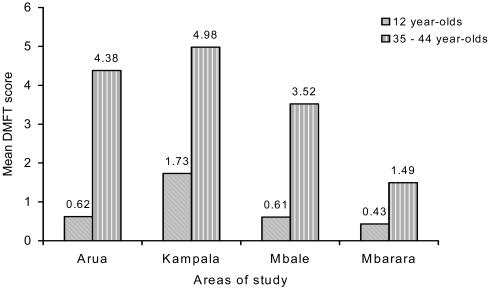
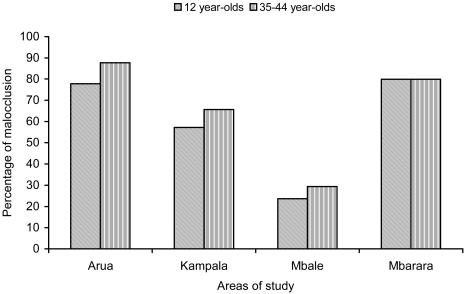
Results: Dental caries (DMFT >or=1) was recorded in 40% and 62.5% of the children and adults, respectively. The overall mean DMFT score was 0.9 for children and 3.4 for adults. Caries was significantly more severe in females as compared to males in children (p<0.05), whereas in adults, there was no significant gender difference. Kampala had a significantly higher mean DMFT score compared to other districts in all age groups (p>0.05). Culculus deposits were generally, more prevalent in adults as compare to children except in Mbarara district. Gum bleeding was also significantly more prevalent among children as compared to adults (p<0.05). Significantly higher prevalence of gum bleeding in both children and adults was recorded in Arua district as compared to other areas (p<0.05). Each of the age groups had a prevalence of malocclusion of 61%. However, the severity of malocclusion varied between age groups and districts. The prevalence of dental fluorosis was 3% and 4% for children and adults, respectively. All subjects in Arua district were fluorosis-free. Tetracycline enamel staining was less than 1% in both age groups. Enamel attrition was more prevalent in adults as compared to children: 19% versus 1%.
Conclusion: The prevalence of oral diseases/conditions was generally low among the study population. Caries experience was significantly higher in the Kampala (urban) district as compared to rural districts in all age groups; the D - component being the major contributor.
Figures
References
-
- Welbourn HF. The teeth of children attending Kampala child welfare clinics and schools. East African Medical Journal. 1956;33:181–187. - PubMed
-
- Møller IJ, Pindborg JJ, Roed-Petersen B. The prevalence of dental caries, enamel opacities and enamel hypoplasia in Ugandans. Archives of Oral Biology. 1972;17:9–22. - PubMed
-
- Jensen K, Kizito EK, Langbæk J, Nyika TA. Dental caries, gingivitis and oral hygiene among schoolchildren in Kampala, Uganda. Community Dentistry and Oral Epidemiology. 1973;1:74–83. - PubMed
-
- Tirwomwe F, Ekoku Y, Bælum V, Fejerskov O. Oral health in Uganda: Results of a national survey 1987. Nairobi: Ministry of health, Uganda/Kenya Medical Research Institute; 1988.
-
- Rwenyonyi CM, Birkeland JM, Haugejorden O, Bjorvatn K. Dental caries among 10- to 14-year-old children in Ugandan rural areas with 0.5 and 2.5 mg fluoride per liter in drinking water. Clinical Oral Investigations. 2001;5:45–50. - PubMed
Publication types
MeSH terms
LinkOut - more resources
Full Text Sources
Medical