


Intraindividual variability may not always indicate vulnerability in elders' cognitive performance
- PMID: 16248699
- PMCID: PMC2908894
- DOI: 10.1037/0882-7974.20.3.390
Intraindividual variability may not always indicate vulnerability in elders' cognitive performance
Abstract
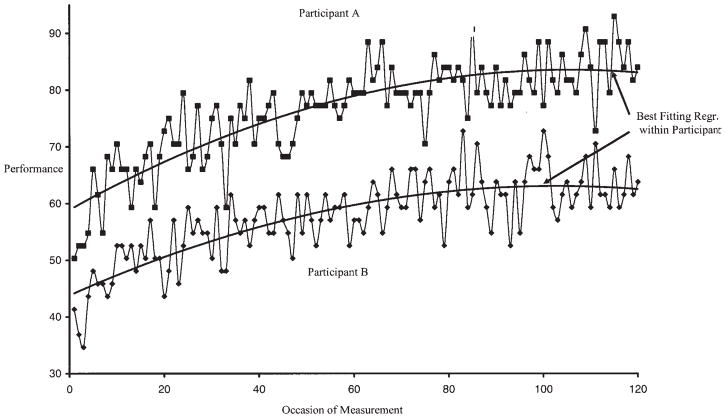
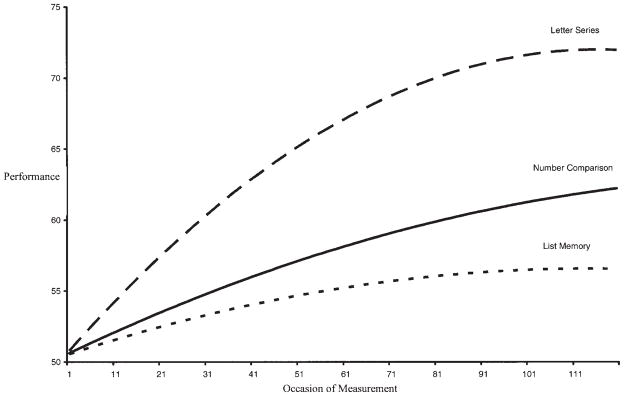
This study examined consistency of performance, or intraindividual variability, in older adults' performance on 3 measures of cognitive functioning: inductive reasoning, memory, and perceptual speed. Theoretical speculation has suggested that such intraindividual variability may signal underlying vulnerability or neurologic compromise. Thirty-six participants aged 60 and older completed self-administered cognitive assessments twice a day for 60 consecutive days. Intraindividual variability was not strongly correlated among the 3 cognitive measures, but, over the course of the study, intraindividual variability was strongly intercorrelated within a task. Higher average performance on a measure was associated with greater performance variability, and follow-up analyses revealed that a higher level of intraindividual variability is positively associated with the magnitude of a person's practice-related gain on a particular measure. The authors argue that both adaptive (practice-related) and maladaptive (inconsistency-related) intraindividual variability may exist within the same individuals over time.
Copyright (c) 2005 APA, all rights reserved.
Figures
References
-
- Almeida DM, McGonagle KA, Cate RC, Kessler RC, Wethington E. Psychosocial moderators of emotional reactivity to marital arguments: Results from a daily diary study. Marriage and Family Review. 2003;34:89–113.
-
- Anstey KJ. Sensorimotor variables and forced expiratory volume as correlates of speed, accuracy and variability in reaction time performance in late adulthood. Aging, Neuropsychology, and Cognition. 1999;6:84–95.
-
- Baltes PB, Reese HW, Nesselroade JR. Life-span developmental psychology: Introduction to research methods. Mahwah, NJ: Erlbaum; 1977.
-
- Bruhn P, Parsons OA. Reaction time variability in epileptic and brain-damaged patients. Cortex. 1977;13:373–384. - PubMed
