. 2005 Nov 1;102(44):16096-101.
doi: 10.1073/pnas.0505312102. Epub 2005 Oct 25.

Pervasive social deficits, but normal parturition, in oxytocin receptor-deficient mice

Affiliations

Pervasive social deficits, but normal parturition, in oxytocin receptor-deficient mice

Yuki Takayanagi et al. Proc Natl Acad Sci U S A. .

Abstract

The oxytocin receptor (OXTR) and its ligand, oxytocin (OXT), regulate reproductive physiology (i.e., parturition and lactation) and sociosexual behaviors. To define the essential functions of OXTR, we generated mice with a null mutation in the Oxtr gene (Oxtr(-/-)) and compared them with OXT-deficient (Oxt(-/-)) mice. Oxtr(-/-) mice were viable and had no obvious deficits in fertility or reproductive behavior. Oxtr(-/-) dams exhibited normal parturition but demonstrated defects in lactation and maternal nurturing. Infant Oxtr(-/-) males emitted fewer ultrasonic vocalizations than wild-type littermates in response to social isolation. Adult Oxtr(-/-) males also showed deficits in social discrimination and elevated aggressive behavior. Ligand Oxt(-/-) males from Oxt(-/-) dams, but not from Oxt(+/-) dams, showed similar high levels of aggression. These data suggest a developmental role for the OXT/OXTR system in shaping adult aggressive behavior. Our studies demonstrate that OXTR plays a critical role in regulating several aspects of social behavior and may have important implications for developmental psychiatric disorders characterized by deficits in social behavior.


Figures
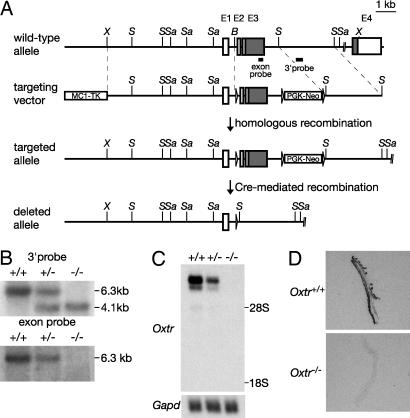
Fig. 1.
Fig. 1.
Generation of Oxtr-/- mice. (A) The wild-type and mutant Oxtr loci and gene targeting constructs. Exons (E) are indicated by boxes (white boxes, 5′ and 3′ UTRs; gray boxes, coding regions). Positions of restriction enzyme sites and the probes used for Southern blot analysis are shown (X, XhoI; S, SphI; Sa, SacI; B, BamHI). The loxP sites are represented by arrows (not to scale). (B) Southern blot analysis of genomic DNA from littermate progeny from Oxtr+/- crosses. SacI-digested tail DNA was hybridized with the radiolabeled probes indicated in A.(C) Northern blot analysis of poly(A)+ RNA (2 μg per lane) from the pregnant uteri (day 19 of gestation) of Oxtr+/+, Oxtr+/-, and Oxtr-/- mice. The blot was sequentially hybridized with Oxtr and Gapd cDNA probes. (D) OXTR-binding autoradiograms of uteri from pregnant Oxtr+/+ and Oxtr-/- mice (day 19 of gestation).
Fig. 2.
Fig. 2.
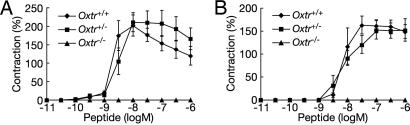
Reproductive functions in Oxtr -/- mice. (A and B) The amplitude of OXT-(A) or AVP-(B) stimulated contractions of myometrial strips isolated from pregnant mice (day 19 of gestation) of each genotype. These investigations were performed as described (21).
Fig. 3.
Fig. 3.
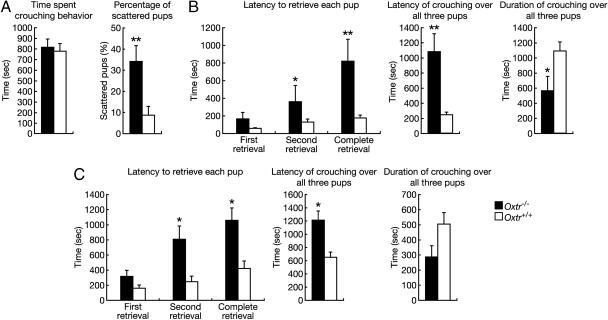
Maternal nurturing in female Oxtr-/- mice. (A) Observation of newly postpartum Oxtr-/- (n = 9) and Oxtr+/+ (n = 10) females before tests for maternal behavior. (B and C) Tests for maternal behavior. Pup retrieval and crouching behaviors in Oxtr-/- (n = 9) and Oxtr+/+ (n = 10) postpartum females (B), and Oxtr-/- (n = 15) and Oxtr+/+ (n = 7) virgin females (C) from heterozygous intercrosses. Failure to retrieve or crouch was assigned as 30 min, the length of the observation period. *, P < 0.05 and **, P < 0.01 (Mann–Whitney U test). Error bars, standard error.
Fig. 4.
Fig. 4.
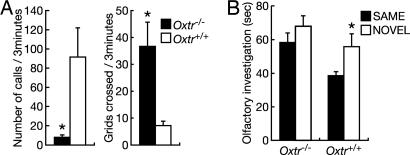
Infant ultrasonic vocalization and adult social discrimination. (A) Measurements of social isolation-induced ultrasonic vocalizations (Left) and locomotor activity (Right) in Oxtr-/- (n = 8) and Oxtr+/+ (n = 10) male pups from heterozygous intercrosses. (B) Test for social discrimination test. After the first exposure to a female and an interexposure interval, this female (SAME) was placed back along with another female (NOVEL). Oxtr-/- (n = 14) and Oxtr+/+ (n = 10) males were examined for investigation times directed to the SAME or NOVEL females. *, P < 0.05 (Mann–Whitney U test). Error bars, standard error.
Fig. 5.
Fig. 5.
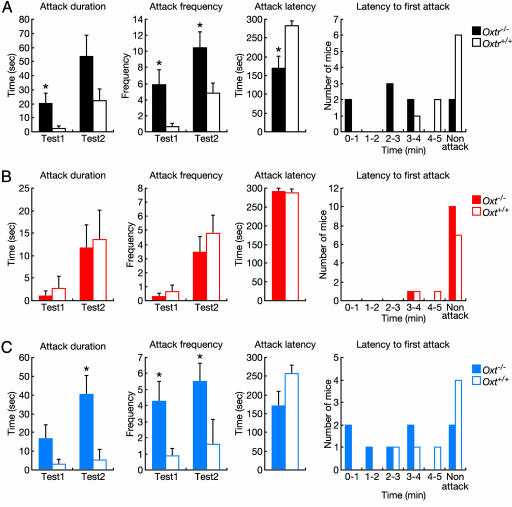
Aggressive behavior as measured by the resident-intruder test. (A and B) Aggressive behavior in the resident-intruder test of Oxtr-/- (n = 9) and Oxtr+/+ (n = 9) mice (A) and Oxt-/- (n = 11) and Oxt+/+ (n = 9) mice (B) from heterozygous intercrosses. (C) Aggressive behavior in the resident-intruder test of Oxt-/- (n = 8) and Oxt+/+ (n = 7) mice from intercrosses of homozygous Oxt-/- and Oxt+/+ mice and fostering by C57BL/6J females. *, P < 0.05 (Mann–Whitney U test). Error bars, standard error.

References

    1. Du Vigneaud, V., Ressler, C. & Trippett, S. (1953) J. Biol. Chem. 205, 949-957. - PubMed
    1. Du Vigneaud, V., Ressler, C., Swan, J. M., Roberts, C. W., Katsoyannis, P. G. & Gordon, S. (1953) J. Am. Chem. Soc. 75, 4879-4880.
    1. Gainer, H. & Wray, W. (1994) in The Physiology of Reproduction, eds. Knobil, E. & Neill, J. D. (Raven, New York), pp. 1099-1129.
    1. Gimpl, G. & Fahrenholz, F. (2001) Physiol. Rev. 81, 629-683. - PubMed
    1. Kimura, T. & Ivell, R. (1999) Results Probl. Cell Differ. 26, 135-168. - PubMed

Publication types