


Prognostic value of systolic mitral annular velocity measured with Doppler tissue imaging in patients with chronic heart failure caused by left ventricular systolic dysfunction
- PMID: 16251233
- PMCID: PMC1860660
- DOI: 10.1136/hrt.2005.067140
Prognostic value of systolic mitral annular velocity measured with Doppler tissue imaging in patients with chronic heart failure caused by left ventricular systolic dysfunction
Abstract
Objective: To assess the prognostic value of various conventional and novel echocardiographic indices in patients with chronic heart failure (CHF) caused by left ventricular (LV) systolic dysfunction.
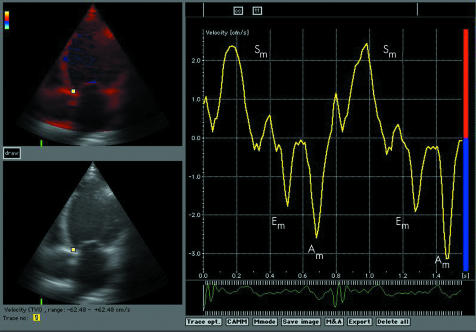
Methods: 185 patients with a mean (SD) age of 67 (11) years with CHF and LV ejection fraction < 45% despite optimal pharmacological treatment were prospectively enrolled. The patients underwent two dimensional echocardiography with tissue harmonic imaging to assess global LV systolic function and obtain volumetric data. Transmitral flow was assessed with conventional pulse wave Doppler. Systolic (Sm), early, and late diastolic mitral annular velocities were measured with the use of colour coded Doppler tissue imaging.
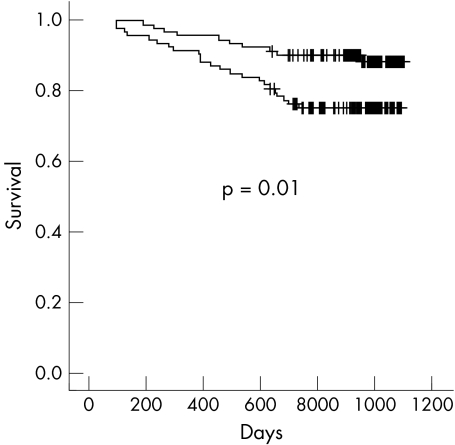
Results: During a median follow up of 32 months (range 24-38 months in survivors), 34 patients died and one underwent heart transplantation. Sm velocity (hazard ratio (HR) 0.648, 95% confidence interval (CI) 0.463 to 0.907, p = 0.011), diastolic arterial pressure (HR 0.965, 95% CI 0.938 to 0.993, p = 0.015), serum creatinine (HR 1.006, 95% CI 1.001 to 1.011, p = 0.023), LV ejection fraction (HR 0.945, 95% CI 0.899 to 0.992, p = 0.024), age (HR 1.035, 95% CI 1.000 to 1.071, p = 0.052), LV end systolic volume index (HR 1.009, 95% CI 0.999 to 1.019, p = 0.067), and restrictive pattern of transmitral flow (HR 0.543, 95% CI 0.278 to 1.061, p = 0.074) predicted the outcome of death or transplantation on univariate analysis. On multivariate analysis, only Sm velocity (HR 0.648, 95% CI 0.460 to 0.912, p = 0.013) and diastolic arterial pressure (HR 0.966, 95% CI 0.938 to 0.994, p = 0.016) emerged as independent predictors of outcome.
Conclusions: In patients with CHF and LV systolic dysfunction despite optimal pharmacological treatment, the strongest independent echocardiographic predictor of prognosis was Sm velocity measured with quantitative colour coded Doppler tissue imaging.
Conflict of interest statement
Competing interest statement: There are no competing interests to report
References
-
- Cleland J G F, Clark A. Has the survival of the heart failure population changed? Lessons from trials. Am J Cardiol 199983112–119. - PubMed
-
- Remme W J, Swedberg K, Cleland J G F.et al Guidelines for the diagnosis and treatment of chronic heart failure (task force report). Eur Heart J 2001221527–1560. - PubMed
-
- Hunt S A, Baker D W, Chin M H.et al ACC/AHA guidelines for the evaluation and management of chronic heart failure in the adult: executive summary. A report of the American College of Cardiology/American Heart Association task force on practice guidelines. Circulation 20011042996–3007. - PubMed
-
- Cowburn P J, Cleland J G, Coats A J.et al Risk stratification in chronic heart failure. Eur Heart J 199819696–710. - PubMed
-
- Parameshwar J, Keegan J, Sparrow J. Predictors of prognosis in severe chronic heart failure. Am Heart J 1992123421–426. - PubMed
MeSH terms
LinkOut - more resources
Full Text Sources
Medical
