. 2005 Dec;11(12):1777-87.
doi: 10.1261/rna.2660805. Epub 2005 Oct 26.

Characteristics and regulatory elements defining constitutive splicing and different modes of alternative splicing in human and mouse

Affiliations

Characteristics and regulatory elements defining constitutive splicing and different modes of alternative splicing in human and mouse

Christina L Zheng et al. RNA. 2005 Dec.

Abstract

Alternative splicing is a major contributor to genomic complexity, disease, and development. Previous studies have captured some of the characteristics that distinguish alternative splicing from constitutive splicing. However, most published work only focuses on skipped exons and/or a single species. Here we take advantage of the highly curated data in the MAASE database (see related paper in this issue) to analyze features that characterize different modes of splicing. Our analysis confirms previous observations about alternative splicing, including weaker splicing signals at alternative splice sites, higher sequence conservation surrounding orthologous alternative exons, shorter exon length, and more frequent reading frame maintenance in skipped exons. In addition, our study reveals potentially novel regulatory principles underlying distinct modes of alternative splicing and a role of a specific class of repeat elements (transposons) in the origin/evolution of alternative exons. These features suggest diverse regulatory mechanisms and evolutionary paths for different modes of alternative splicing.


Figures
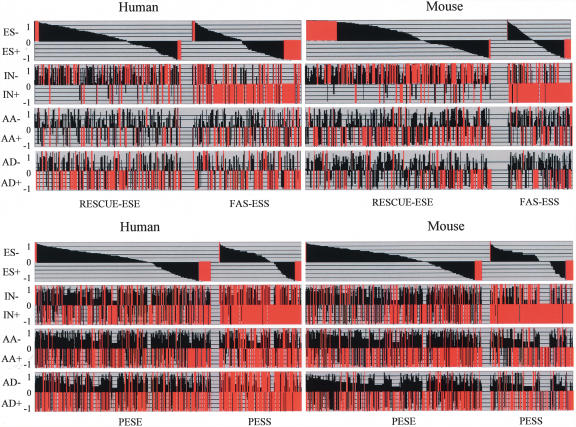
FIGURE 1.
FIGURE 1.
Mapping of previously computationally predicted ESEs and ESSs to different modes of AS. RESCUE-ESEs and FAS-ESSs (Fairbrother et al. 2002; Wang et al. 2004) are hexamers. PESEs and PESSs (Zhang and Chasin 2004) are octamers. Because alternative exons vary greatly in length, we normalized counts of ESEs and ESSs to their frequencies in 100 nt. Each element was mapped onto each exon of each exon class. The distribution of each element from an AS class was compared with the distribution from CS using the Wilcoxon rank sum test to determine the significance of the difference (P-value). To efficiently illustrate the comparison, the value of (1-p) was plotted for each element, a positive value indicates enrichment in CS and a negative value indicates enrichment in AS. Values of (1-p) ≥ 0.95 or ≤ −0.95 are displayed in red. Each bar represents one element and elements are ordered from least to the most frequent in ES. This ES-referenced order was used to display individual bars for each AS mode. Different modes of splicing are associated with different frequencies and distinct identities of ESEs and ESSs. Results from both sets of enhancer and silencer elements and from human and mouse are consistent, suggesting the potential for mode-specific regulation.
FIGURE 2.
FIGURE 2.
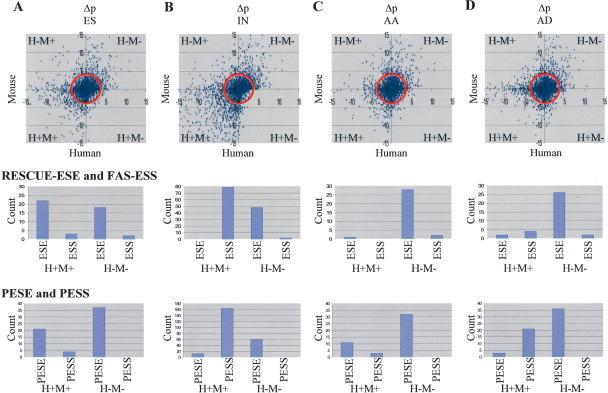
Identification of potentially mode-specific regulatory motifs. Panels A–D are analyses of motif distribution between constitutive splicing (CS) and different modes of alternative splicing (ES, IN, AA, and AD). All 4096 possible hexamers were counted for each exon class in both human and mouse obtaining a Z-score (compared with a third-order Markov background model based on the combined CS and AS) describing the standard deviation of each hexamer frequency. P-values were then obtained from the Z-scores using the standard normal curve. Over- and under-represented hexamers in each AS class were identified by comparing the P-values of hexamers from each AS class with the P-values of corresponding hexamers in the CS class (Δp = −log pCS– −log pAS ). A positive Δp represents a hexamer that is under-represented in an AS class, while a negative Δp represents a hexamer that is over-presented in an AS class. The plot shows Δp for each AS exon class for human and mouse. H+M+ represents hexamers that are over-represented in an AS class compared with CS in both human and mouse. H−M− represents hexamers that are under-represented in an AS class compared with CS in both human and mouse. H−M+ and H+M− represent species-specific differences. Because species-specific differences are expected to be low, we made a cut-off based on minimal species-specific differences (shown in red) to retrieve significantly over- and under-represented hexamers in each class of AS. These hexamers were then compared with previously predicted ESEs and ESSs. These hexamers were directly comparable to the RESCUE-ESEs and FAS-ESSs hexamers. However, with the PESE and PESS octamers, the hexamers were compared with hexamers that were represented at least three times within the octamers (Wang et al. 2004). The number of previously predicted motifs is displayed in the bar graphs below each Δp plot. Strikingly, the motifs enriched in different AS modes belong to distinct sets with little overlap, indicating that we may have identified mode-specific cis-acting regulatory elements.
FIGURE 3.
FIGURE 3.
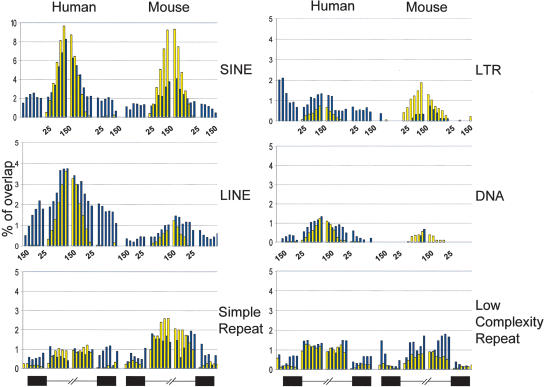
Contribution of transposable elements (SINEs, LINEs, LTRs, DNAs) in the evolution of alternative splicing. Exon regions are depicted as black boxes and intron regions are depicted as black lines at the bottom. The 300-nucleotide (nt) regions surrounding each acceptor and donor splice site were divided into 25-nt bins. Each bin represents a collection of sequences at a defined position surrounding the splice sites. The height of each bar indicates the percentage of those sequences overlapping the repeat elements. Blue bars represent the association of individual repeat elements with AS; yellow bars represent the association of individual repeat elements with CS. Results show that only transposable elements, not other classes of repeat elements (i.e., simple repeats and low complexity repeats), are specifically associated with alternative exons.

References

    1. Baelde, H.J., Eikmans, M., Doran, P.P., Lappin, D.W., de Heer, E., and Bruijn, J.A. 2004a. Gene expression profiling in glomeruli from human kidneys with diabetic nephropathy. Am. J. Kidney Dis. 43: 636–650. - PubMed
    1. Baelde, H.J., Eikmans, M., van Vliet, A.I., Bergijk, E.C., de Heer, E., and Bruijn, J.A. 2004b. Alternatively spliced isoforms of fibronectin in immune-mediated glomerulosclerosis: The role of TGFβ and IL-4. J. Pathol. 204: 248–257. - PubMed
    1. Berget, S.M. 1995. Exon recognition in vertebrate splicing. J. Biol. Chem. 270: 2411–2414. - PubMed
    1. Brett, D., Pospisil, H., Valcarcel, J., Reich, J., and Bork, P. 2002. Alternative splicing and genome complexity. Nat. Genet. 30: 29–30. - PubMed
    1. Caceres, J.F. and Kornblihtt, A.R. 2002. Alternative splicing: Multiple control mechanisms and involvement in human disease. Trends Genet. 18: 186–193. - PubMed

Publication types

LinkOut - more resources