. 2005 Nov;79(22):14330-8.
doi: 10.1128/JVI.79.22.14330-14338.2005.

Rational attenuation of a morbillivirus by modulating the activity of the RNA-dependent RNA polymerase

Affiliations

Rational attenuation of a morbillivirus by modulating the activity of the RNA-dependent RNA polymerase

David D Brown et al. J Virol. 2005 Nov.

Abstract

Negative-strand RNA viruses encode a single RNA-dependent RNA polymerase (RdRp) which transcribes and replicates the genome. The open reading frame encoding the RdRp from a virulent wild-type strain of rinderpest virus (RPV) was inserted into an expression plasmid. Sequences encoding enhanced green fluorescent protein (EGFP) were inserted into a variable hinge of the RdRp. The resulting polymerase was autofluorescent, and its activity in the replication/transcription of a synthetic minigenome was reduced. We investigated the potential of using this approach to rationally attenuate a virus by inserting the DNA sequences encoding the modified RdRp into a full-length anti-genome plasmid from which a virulent virus (rRPV(KO)) can be rescued. A recombinant virus, rRPV(KO)L-RRegfpR, which grew at an indistinguishable rate and to an identical titer as rRPV(KO) in vitro, was rescued. Fluorescently tagged polymerase was visible in large cytoplasmic inclusions and beneath the cell membrane. Subcutaneous injection of 10(4) TCID(50) of the rRPV(KO) parental recombinant virus into cattle leads to severe disease symptoms (leukopenia/diarrhea and pyrexia) and death by 9 days postinfection. Animals infected with rRPV(KO)L-RRegfpR exhibited transient leukopenia and mild pyrexia, and the only noticeable clinical signs were moderate reddening of one eye and a slight ocular-nasal discharge. Viruses that expressed the modified polymerase were isolated from peripheral blood lymphocytes and eye swabs. This demonstrates that a virulent morbillivirus can be attenuated in a single step solely by modulating RdRp activity and that there is not necessarily a correlation between virus growth in vitro and in vivo.


Figures

FIG. 1.
FIG. 1.
Schematic representations of RPVKO RdRp expression constructs and the full-length plasmid used to rescue the recombinant virus rRPVKOL-RRegfpR. The positions of the T7 promoter, internal ribosome entry site (IRES), three domains of the RdRp (D1 to D3), hinge regions of the RdRp (H1 and H2), hepatitis delta ribozyme (δ), and T7 terminator (Tφ) are indicated (not to scale). The RdRp ORF is shown in gray and the EGFP ORF is black. (A) Unmodified RPVKO RdRp expression construct. (B) Expression construct engineered to include the EGFP ORF within the H2 region of the RPVKO RdRp. (C) Structure of pRPVKOL-RRegfpR encoding an antisense genome copy of RPVKO in which the EGFP ORF was inserted into H2 of the RdRp. Untranslated regions flanking ORFs are represented as open boxes, and solid lines indicate the positions of the intergenic trinucleotide spacers.
FIG. 2.
FIG. 2.
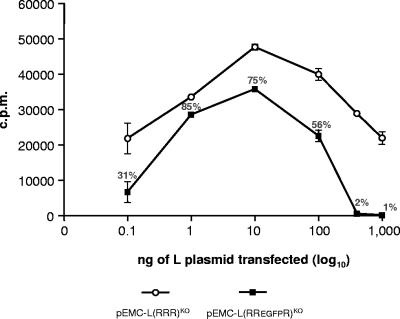
Relative activities of unmodified and EGFP-modified polymerase in a series of minigenome rescue experiments. Various amounts of pEMV-L(RRR)KO (open circles) and pEMV-L(RRegfpR)KO (filled circles) were used in minigenome transfection assays. The amount of acetylated 14C-chloramphenicol produced was determined by liquid scintillation counting and is expressed in counts per minute (c.p.m.). Percentage figures represent the relative activity of the structurally modified RdRp compared to the unmodified control.
FIG. 3.
FIG. 3.
Growth kinetics of recombinant RPVs. B95a cells were infected at an MOI of 0.5 with rRPVKO and rRPVKOL-RRegfpR. Titers were determined in triplicate and are expressed as TCID50/ml. Lines join the average titers obtained, and error bars reflect the variability of the TCID50 assay.
FIG. 4.
FIG. 4.
Localization of EGFP-tagged RPVKO polymerase and the H glycoprotein using CSLM. B95a cells were infected at an MOI of 0.01 with rRPVKOL-RRegfpR for 24 h. RPV H was detected on the surface of nonpermeabilized cells using a mouse monoclonal antibody and visualized by indirect immunofluorescence using an Alexa Fluor 568-conjugated secondary antibody (red). EGFP was visualized by virtue of its autofluorescence (green). Nuclei were counterstained with DAPI (blue). (A) Photomicrograph of a syncytium comprised of eight infected cells. Magnification, ×1,432. (B) Composite photomicrograph of singly infected cells. Magnification, ×1,841. The inset is a magnification of a small region of the cell membrane indicated by the box.
FIG. 5.
FIG. 5.
In vivo assessment of virulence of recombinant RPVs. Cattle were infected with 104 TCID50 with rRPVKO and rRPVKOL-RRegfpR. Rectal temperatures were measured daily 5 days preinfection and daily up to euthanasia. White cell counts were determined at 2- to 3-day intervals postinfection. (A) Two animals (animal 1, solid line; animal 2, dashed line) were infected with rRPVKOL-RRegfpR. The animals were euthanized at 9 dpi. (B) These data for rRPVKO represent control data which have been previously published (5) and have also been used as controls for an additional set of chimeric viruses (4).
FIG. 6.
FIG. 6.
Detection and virus isolation from clinical samples. (A) Phase-contrast and fluorescent photomicrographs of cytopathic effects due to rRPVKOL-RRegfpR isolated from PBMCs of infected cattle. PBMCs were isolated from cattle infected for 4 days with rRPVKOL-RRegfpR and overlaid onto B95a cells. Photomicrographs were taken 48 hpi using a digital CCQ camera (Hammatsu) attached to an Eclipse TE300 UV microscope (Nikon). Magnification, ×30. Total RNA was isolated from PBMCs and eye swabs obtained from rRPVKOL-RRegfpR infected cattle 0, 2, 4, 7, 8 and 9 dpi. PCR products were amplified using morbillivirus universal P and β-actin primers from cDNA prepared from the total RNA. Amplicons were examined by DNA gel electrophoresis. Arrows indicate 500-bp DNA size markers. (B) Amplicons obtained from PBMC samples using the morbillivirus universal P primers (upper panels) and β-actin controls (lower panels). (C) Amplicons obtained from eye swab samples using the morbillivirus universal P primers (upper panels) and β-actin controls (lower panels).
FIG. 7.
FIG. 7.
Histological assessment of postmortem tissues obtained from animals infected with either rRPVKOL-RRegfpR (sacrificed 9 dpi) or rRPVKO. Sections were stained with HE, mounted, and viewed using a Leitz Dialux 22 microscope. Images were collected using a Leica DC 300 camera. (A) Small intestine including Peyer's patches showing reactive changes from animal 2 infected with rRPVKOL-RRegfpR. The asterisk and inset frame indicate a focus of mucosal inflammation. Magnification, ×12. (B) Small intestine including Peyer's patches showing reactive changes from a control animal infected with rRPVKO. Magnification, ×12. (C) Lymph node (prescapular) medullary region showing apparently normal cellularity from animal 1 infected with rRPVKOL-RRegfpR. Magnification, ×75. (D) Lymph node (prescapular) medullary region showing a reduction in lymphocyte population from an animal infected with rRPVKO. Magnification, ×75.

References

    1. Anderson, J., and J. McKay. 1994. The detection of antibodies against peste des petits ruminants virus in cattle, sheep and goats and the possible implications to rinderpest control programs. Epidemiol. Infect. 112:225-231. - PMC - PubMed
    1. Auwaerter, P. G., P. A. Rota, W. R. Elkins, R. J. Adams, T. DeLozier, Y. Shi, W. J. Bellini, B. R. Murphy, and D. E. Griffin. 1999. Measles virus infection in rhesus macaques: altered immune responses and comparison of the virulence of six different virus strains. J. Infect. Dis. 180:950-958. - PubMed
    1. Bailey, D., A. Banyard, P. Dash, A. Ozkul, and T. Barrett. 2005. Full genome sequence of peste des petits ruminants virus, a member of the Morbillivirus genus. Virus Res. 110:119-124. - PubMed
    1. Banyard, A. C., M. D. Baron, and T. Barrett. 2005. A role for virus promoters in determining the pathogenesis of rinderpest virus in cattle. J Gen. Virol. 86:1083-1092. - PubMed
    1. Baron, M. D., A. C. Banyard, S. Parida, and T. Barrett. 2005. The Plowright vaccine strain of rinderpest virus has attenuating mutations in most genes. J Gen. Virol. 86:1093-1101. - PubMed

Publication types

MeSH terms