Comparative Study
. 2005 Oct;1(4):e56.
doi: 10.1371/journal.pgen.0010056. Epub 2005 Oct 28.

Discovery of human inversion polymorphisms by comparative analysis of human and chimpanzee DNA sequence assemblies

Affiliations
Comparative Study

Discovery of human inversion polymorphisms by comparative analysis of human and chimpanzee DNA sequence assemblies

Lars Feuk et al. PLoS Genet. 2005 Oct.

Abstract

With a draft genome-sequence assembly for the chimpanzee available, it is now possible to perform genome-wide analyses to identify, at a submicroscopic level, structural rearrangements that have occurred between chimpanzees and humans. The goal of this study was to investigate chromosomal regions that are inverted between the chimpanzee and human genomes. Using the net alignments for the builds of the human and chimpanzee genome assemblies, we identified a total of 1,576 putative regions of inverted orientation, covering more than 154 mega-bases of DNA. The DNA segments are distributed throughout the genome and range from 23 base pairs to 62 mega-bases in length. For the 66 inversions more than 25 kilobases (kb) in length, 75% were flanked on one or both sides by (often unrelated) segmental duplications. Using PCR and fluorescence in situ hybridization we experimentally validated 23 of 27 (85%) semi-randomly chosen regions; the largest novel inversion confirmed was 4.3 mega-bases at human Chromosome 7p14. Gorilla was used as an out-group to assign ancestral status to the variants. All experimentally validated inversion regions were then assayed against a panel of human samples and three of the 23 (13%) regions were found to be polymorphic in the human genome. These polymorphic inversions include 730 kb (at 7p22), 13 kb (at 7q11), and 1 kb (at 16q24) fragments with a 5%, 30%, and 48% minor allele frequency, respectively. Our results suggest that inversions are an important source of variation in primate genome evolution. The finding of at least three novel inversion polymorphisms in humans indicates this type of structural variation may be a more common feature of our genome than previously realized.


Conflict of interest statement

Competing interests. The authors have declared that no competing interests exist.

Figures
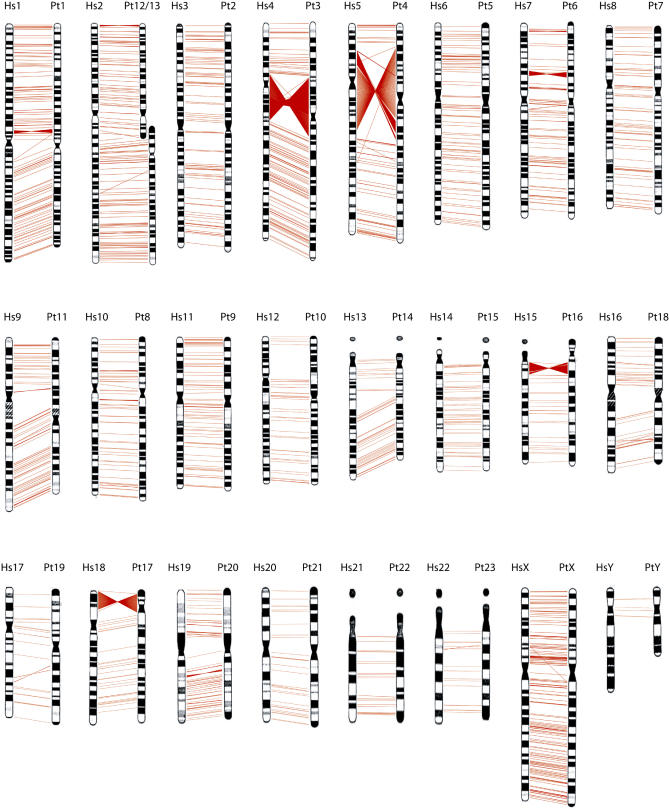
Figure 1
Figure 1. Genome-Wide Distribution of the 1,576 Putative Inversions Identified between the Human and Chimpanzee Assemblies
Human chromosomes are shown to the left and the syntenic chimpanzee chromosome to the right. Each red line corresponds to an inversion between the human and chimpanzee assemblies. Regions larger than 100 kb are represented with multiple lines. These include the large inversions on human Chromosome 4, 5, 15, and 18, while those on human Chromosomes 9, 12, and 17 were not identified. The karyotypically visible pericentric inversions on Chromosome 1 and 16 have not been described at the molecular level.
Figure 2
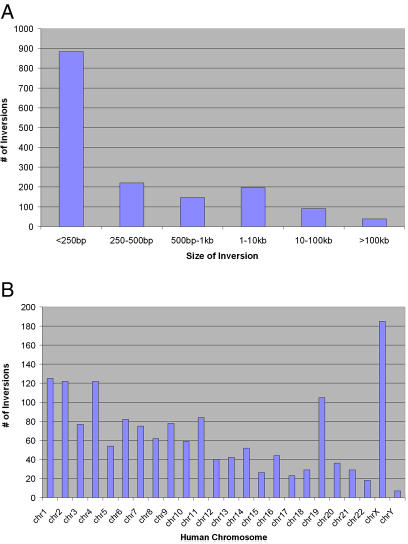
Figure 2. Size Distribution and Chromosomal Distribution of Putative Inversions
(A) Size distribution of inversions. The size of the inversion regions identified range from 23 bp to 62 Mb, but more than half of all regions identified are less then 250 bp. The algorithm used to create the net alignments is more prone to make errors and assign random orientation to very short regions (Table S1 and Figure S1). However, we did not see this trend in the regions chosen for experimental validation. Thirty-three of the regions identified were larger than 100 kb in size. (B) Chromosomal distribution of inversion regions. The autosomal chromosomes have a distribution of inversions roughly correlated to the size of the chromosome, except for Chromosome 19 which carries approximately the same number as Chromosomes 1 to 4. The X chromosome also shows an increase of inversions compared to autosomes of corresponding size.
Figure 3
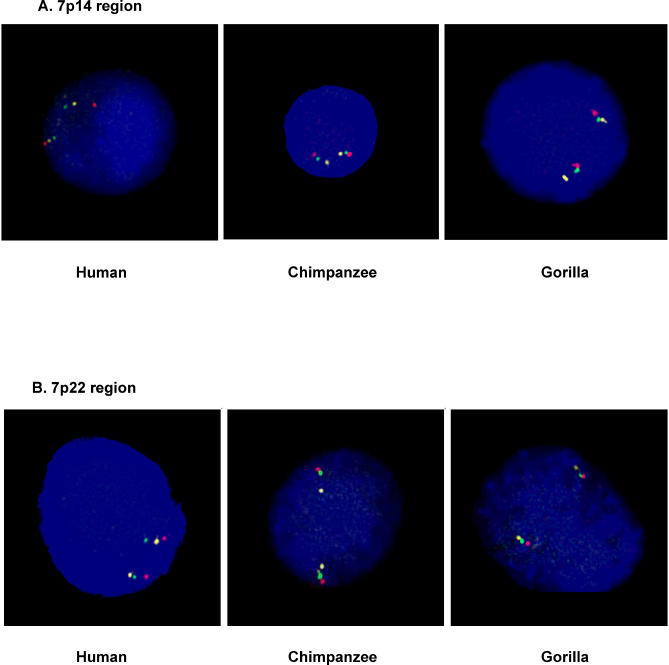
Figure 3. FISH Confirmation of Inversions
(A) Three-color interphase FISH targeting the largest novel inversion between human and chimpanzee identified in this study. The probe order based on the human assembly is RP11-91E16 (red), RP11-321C5 (yellow), and RP11-81F19 (green). The result for human interphase testing is shown to the left and shows the expected the probe order red-yellow-green. The result for chimpanzee and gorilla displays the inverted probe order, red-green-yellow, using identical probes. For this region, each of ten human controls showed the same probe order. (B) Results showing an interphase nucleus from a human control polymorphic for the 730-kb inversion at 7p22. The probe order is red-yellow-green in the human assembly, and red-green-yellow in the chimpanzee assembly. The probe order for gorilla matches that of the chimpanzee.
Figure 4
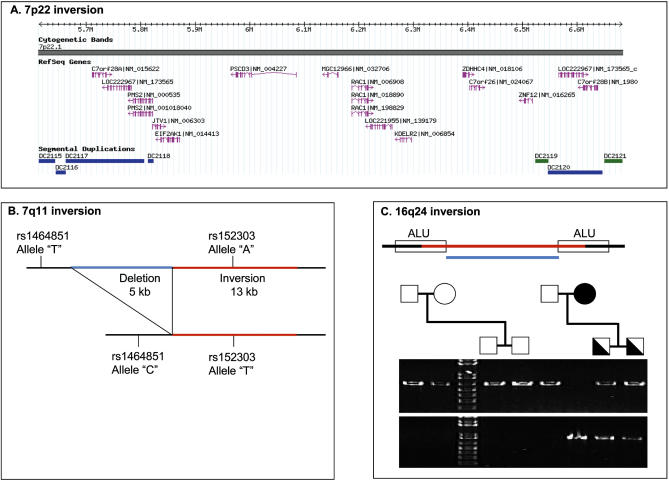
Figure 4. Overview of Polymorphic Regions
(A) Overview of the region at 7p22 harbouring a 730-kb inversion variant. Each side of the inversion is flanked by highly identical segmental duplications of inverted orientation extending for ~100 kb with an average identity of 99%. Blue bars indicate that the duplications are intra-chromosomal, while green bars harbour both intra- and inter-chromosomal duplications. It is currently not clear exactly where within these segmental duplications the breakpoints occur. The region is comparatively gene-rich and provides an interesting target for diseases with linkage to this region. (B) Inversion polymorphism at 7q11. The inversion (shown in red) also led to a deletion of 5 kb (blue). The inversion and deletion variant is now the major allele. Two SNPs in perfect linkage disequilibrium (LD) with the inversion are also shown. There are no genes overlapping this inversion variant. (C) Inversion polymorphism at 16q24. This 1-kb inversion may have been induced by the flanking ALU repeats. The inversion indicated by the net alignment between human and chimpanzee is shown in blue. Experimental data show that the actual inversion (red) is approximately 400 bp longer than indicated by the net alignment. PCR results for two CEPH families are shown to the right. The top PCR was designed for the Build 35 assembly (652 bp) and the lower PCR was designed for the chimpanzee sequence (900 bp). The variant is inherited and shows the expected pattern of inheritance.

References

    1. Fujiyama A, Watanabe H, Toyoda A, Taylor TD, Itoh T, et al. Construction and analysis of a human-chimpanzee comparative clone map. Science. 2002;295:131–134. - PubMed
    1. Li WH, Saunders MA. Initial sequence of the chimpanzee genome and comparison with the human genome. Nature. 2005;437:69–87. - PubMed
    1. Ebersberger I, Metzler D, Schwarz C, Paabo S. Genome-wide comparison of DNA sequences between humans and chimpanzees. Am J Hum Genet. 2002;70:1490–1497. - PMC - PubMed
    1. Hacia JG, Makalowski W, Edgemon K, Erdos MR, Robbins CM, et al. Evolutionary sequence comparisons using high-density oligonucleotide arrays. Nat Genet. 1998;18:155–158. - PubMed
    1. Thomas JW, Touchman JW, Blakesley RW, Bouffard GG, Beckstrom-Sternberg SM, et al. Comparative analyses of multi-species sequences from targeted genomic regions. Nature. 2003;424:788–793. - PubMed

Publication types