


Frontotemporal and dopaminergic control of idea generation and creative drive
- PMID: 16254989
- PMCID: PMC2571074
- DOI: 10.1002/cne.20768
Frontotemporal and dopaminergic control of idea generation and creative drive
Abstract
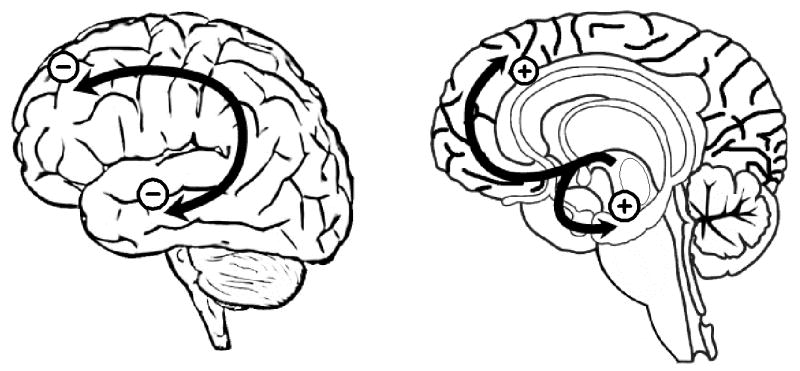
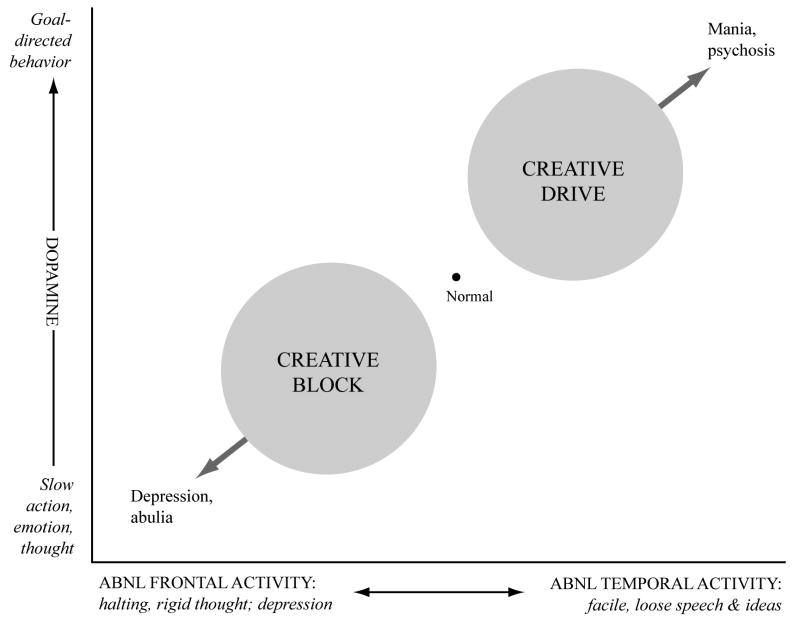
This article presents a three-factor anatomical model of human idea generation and creative drive, focusing on interactions between the temporal lobes, frontal lobes, and limbic system. Evidence is drawn from functional imaging, drug studies, and lesion analysis. Temporal lobe changes, as in hypergraphia, often increase idea generation, sometimes at the expense of quality. Frontal lobe deficits may decrease idea generation, in part because of rigid judgments about an idea's worth. These phenomena are clearest in verbal creativity, and roughly parallel the pressured communication of temporal lobe epilepsy, mania, and Wernicke's aphasia-compared to the sparse speech and cognitive inflexibility of depression, Broca's aphasia, and other frontal lobe lesions. The phenomena also shape non-linguistic creativity, as in that of frontotemporal dementia. The appropriate balance between frontal and temporal activity is mediated by mutually inhibitory corticocortical interactions. Mesolimbic dopamine influences novelty seeking and creative drive. Dopamine agonists and antagonists have opposite effects on goal-directed behavior and hallucinations. Creative drive is not identical to skill-the latter depends more on neocortical association areas. However, drive correlates better with successful creative output than skill does. Traditional neuroscientific models of creativity, such as the left brain - right brain hemispheric model, emphasize skills primarily, and stress art and musical skill at the expense of language and mathematics. The three-factor model proposed here predicts findings in a broad range of normal and pathological states and can be tested in many experimental paradigms.
(c) 2005 Wiley-Liss, Inc.
References
-
- Aharon I, Etcoff N, Ariely D, Chabris CF, O'Connor E, Breiter HC. Beautiful faces have variable reward value: fMRI and behavioral evidence. Neuron. 2001;32:537–551. - PubMed
-
- Andreasen NC. Creativity and mental illness: prevalence rates in writers and their first-degree relatives. American Journal of Psychiatry. 1987;144:1288–1292. - PubMed
-
- Bodis-Wollner I, Tzelepi A. The push-pull action of dopamine on spatial tuning of the monkey retina: the effects of dopaminergic deficiency and selective D1 and D2 receptor ligands on the pattern electroretinogram. Vision Res. 1998;38:1479–1487. - PubMed
-
- Bogen JE, Bogen GM. Creativity and the corpus callosum. Psychiatr Clin North Am. 1988;11:293–301. - PubMed
-
- Braun CM, Dumont M, Duval J, Hamel-Hebert I. Speech rate as a sticky switch: a multiple lesion case analysis of mutism and hyperlalia. Brain Lang. 2004;89:243–252. - PubMed
Publication types
MeSH terms
Substances
Grants and funding
LinkOut - more resources
Full Text Sources
Other Literature Sources
Medical
