


Effects of mobile telephones on the function of implantable cardioverter defibrillators
- PMID: 16255750
- PMCID: PMC6932492
- DOI: 10.1111/j.1542-474X.2005.00057.x
Effects of mobile telephones on the function of implantable cardioverter defibrillators
Abstract
Objective: We investigated whether mobile telephones affect the function of implantable cardioverter defibrillators (ICDs).
Background: It is well known that electromagnetic fields can affect medical devices.
Methods: The study included 43 patients with ventricular tachycardia and/or fibrillation treated with transvenous pectoral ICDs. Testing was done under continuous electrocardiograph monitoring under supervision of an ICD programmer. Initially, each patient was tested during spontaneous rhythm. Then the ICD was programmed to a pace rhythm higher than the patient's heart rate, and the tests were repeated at paced rhythm. In 7 patients, tests were performed during the implantation procedure as well. In 3 of the patients, only a single defibrillation zone was active. The other 40 patients had one or more active ventricular tachycardia zones. Two mobile phones (both GSM 900 MHz) were positioned 50 cm away from the implanted device in opposite directions and switched on. Communication was established between these phones, two investigators had a 20-second conversation, and then the phones were switched off. The same procedure was repeated at 30, 20, and 10 cm away from the implantation site, respectively. Finally, the procedure was performed with the antennae of both phones touching the device pocket. In the above-mentioned 7 cases where testing was done during implantation of the ICD, a call was made from one phone to the other, ringing occurred for 5 seconds, and then two investigators conversed while the device was implanted.
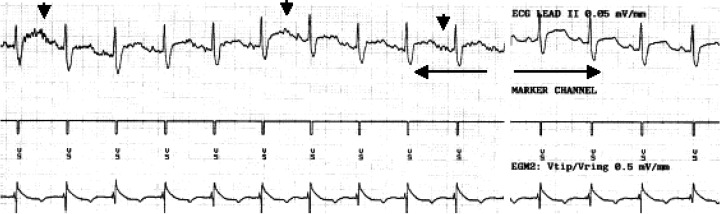
Results: There was no change in the function of the ICDs during any of the phone testing procedures. In 5 cases, artifacts were noted on the surface electrocardiographic (ECG) screen of the programmer during the tests, but no such changes were observed on the simultaneous intracardiac ECGs.
Conclusion: The results of the study suggest that mobile phones have no effects on ICD function.
Figures
Similar articles
-
[Do mobile telephones have adverse effects on the functions of implantable cardioverter defibrillators?].Anadolu Kardiyol Derg. 2002 Mar;2(1):45-8, AXVII. Anadolu Kardiyol Derg. 2002. PMID: 12101794 Turkish.
-
[The absence of interference between GSM mobile telephones and implantable defibrillators: an in-vivo study. Groupe Systèmes Mobiles].Rev Esp Cardiol. 1997 Oct;50(10):715-9. doi: 10.1016/s0300-8932(97)73287-1. Rev Esp Cardiol. 1997. PMID: 9417561 Spanish.
-
Implantable cardioverter defibrillators and cellular telephones: is there any interference?Pacing Clin Electrophysiol. 1999 Jul;22(7):983-9. doi: 10.1111/j.1540-8159.1999.tb00561.x. Pacing Clin Electrophysiol. 1999. PMID: 10456625
-
The dilemma of ICD implant testing.Pacing Clin Electrophysiol. 2007 May;30(5):675-700. doi: 10.1111/j.1540-8159.2007.00730.x. Pacing Clin Electrophysiol. 2007. PMID: 17461879 Review.
-
Ventricular arrhythmias in patients with implanted cardioverter defibrillators.Trends Cardiovasc Med. 2012 Oct;22(7):169-73. doi: 10.1016/j.tcm.2012.07.015. Epub 2012 Aug 14. Trends Cardiovasc Med. 2012. PMID: 22902094 Review.
Cited by
-
[Electromagnetic interference : Pacemakers, cardiac resynchronization therapy devices, implantable cardioverter-defibrillator].Herzschrittmacherther Elektrophysiol. 2022 Sep;33(3):297-304. doi: 10.1007/s00399-022-00875-7. Epub 2022 Jul 4. Herzschrittmacherther Elektrophysiol. 2022. PMID: 35781834 Review. German.
-
[Perioperative management of patients with implanted pacemakers or cardioverter/defibrillators. Recommendations of the Austrian Society for Anaesthesiology, Resuscitation and Intensive Care Medicine, the Austrian Society for Cardiology and the Austrian Society for Surgery].Anaesthesist. 2009 May;58(5):485-98. doi: 10.1007/s00101-009-1553-9. Anaesthesist. 2009. PMID: 19458974 Review. German.
-
Effects of external electrical and magnetic fields on pacemakers and defibrillators: from engineering principles to clinical practice.Circulation. 2013 Dec 24;128(25):2799-809. doi: 10.1161/CIRCULATIONAHA.113.005697. Circulation. 2013. PMID: 24366589 Free PMC article.
-
Electromagnetic interference and implanted cardiac devices: the nonmedical environment (part I).Clin Cardiol. 2012 May;35(5):276-80. doi: 10.1002/clc.21998. Epub 2012 Apr 26. Clin Cardiol. 2012. PMID: 22539305 Free PMC article. Review.
-
Electromagnetic energy radiated from mobile phone alters electrocardiographic records of patients with ischemic heart disease.Ann Med Health Sci Res. 2012 Jul;2(2):146-51. doi: 10.4103/2141-9248.105662. Ann Med Health Sci Res. 2012. PMID: 23440607 Free PMC article.
References
-
- Hayes DL, Carrillo RG, Findlay GK, et al State of the science: Pacemaker and defibrillator interference from wireless communication devices. Pacing Clin Electrophysiol 1996;19: 1419–1430. - PubMed
-
- Hanada E, Watanabe Y, Antoku Y, et al Hospital construction materials: Poor shielding capacity with respect to signals transmitted by mobile telephones. Biomed Instrum Technol 1998;32: 489–496. - PubMed
-
- May CD, Smith PR, Murdock CJ, et al The impact of the implantable cardioverter defibrillator on quality‐of‐life. Pacing Clin Electrophysiol 1995;18: 1411–1418. - PubMed
-
- Groh WJ, Boschee SA, Engelstein ED, et al Interactions between electronic article surveillance systems and implantable cardioverter‐defibrillators. Circulation 1999;100: 387–392. - PubMed
-
- Vlay SC. Fish pond electromagnetic interference resulting in an inappropriate implantable cardioverter defibrillator shock. Pacing Clin Electrophysiol 2002;25: 1532. - PubMed
Publication types
MeSH terms
LinkOut - more resources
Full Text Sources
Medical
Miscellaneous
