


Increasing duration of deep hypothermic circulatory arrest is associated with an increased incidence of postoperative electroencephalographic seizures
- PMID: 16256779
- PMCID: PMC2840401
- DOI: 10.1016/j.jtcvs.2005.02.065
Increasing duration of deep hypothermic circulatory arrest is associated with an increased incidence of postoperative electroencephalographic seizures
Abstract
Objective: Electroencephalographic seizures have been shown to occur in 5% to 20% of neonates and infants after biventricular repair of a variety of cardiac defects. Occurrence of a seizure is a predictor of adverse long-term neurodevelopmental sequelae. The contemporary incidence of postoperative seizures after repair of cardiac defects such as hypoplastic left heart syndrome and other forms of single ventricle is not known.
Methods: A prospective study of 178 patients less than 6 months of age undergoing cardiopulmonary bypass with or without deep hypothermic circulatory arrest (DHCA) was conducted at a single institution from September 2001 through March 2003 to identify postoperative seizures assessed by 48-hour continuous video electroencephalographic monitoring.
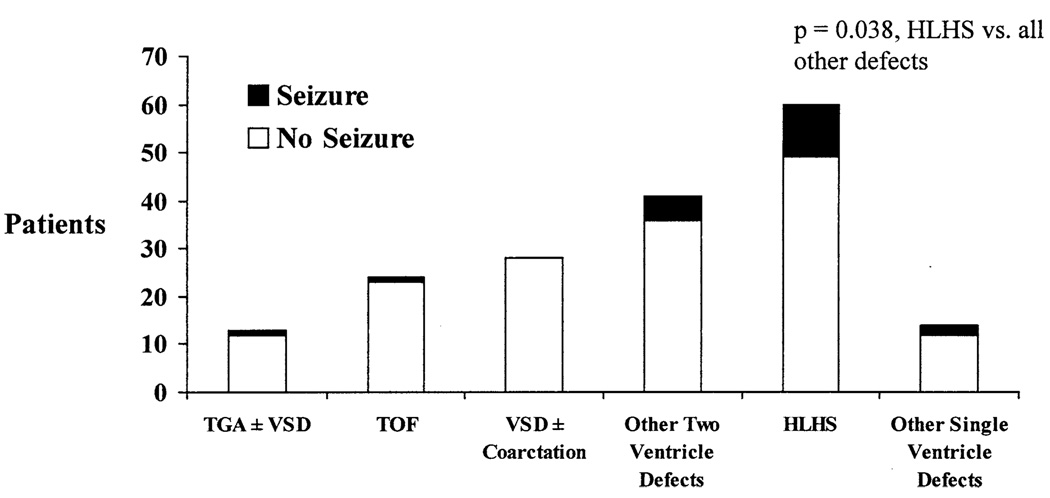
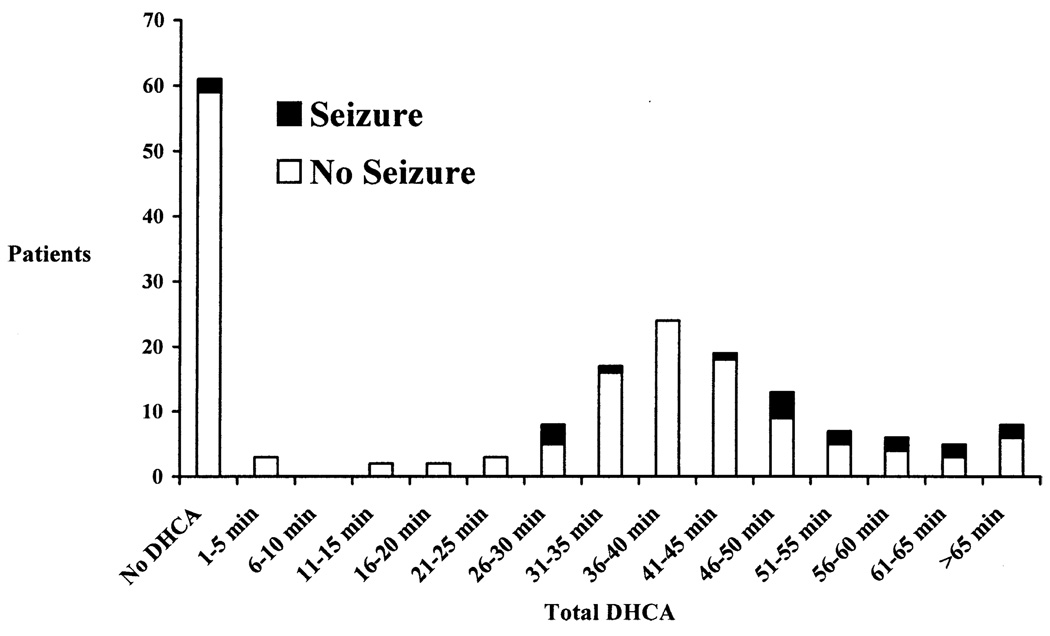
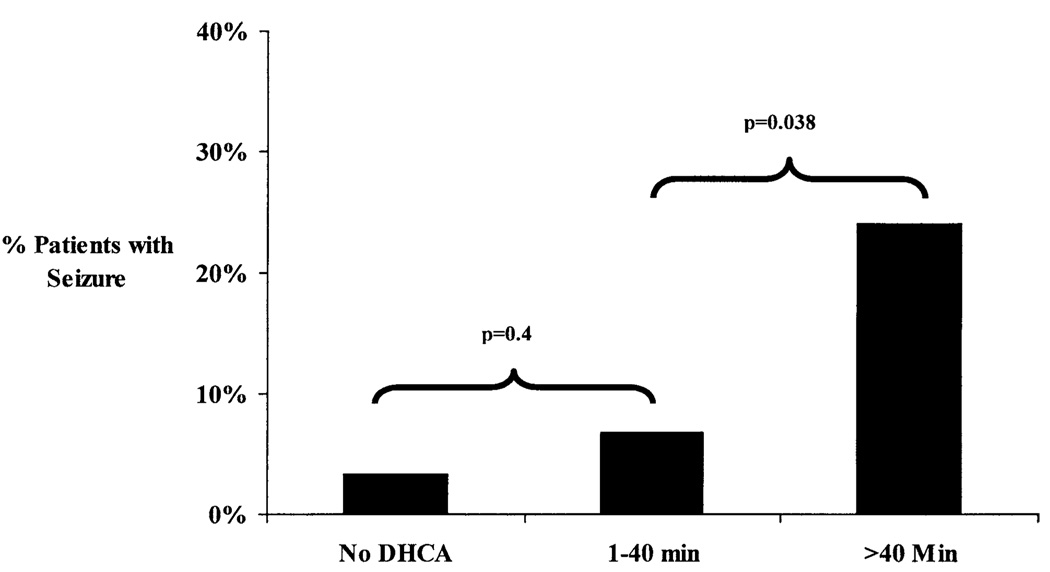
Results: Cardiac defects included transposition of the great arteries with or without a ventricular septal defect (n = 12), ventricular septal defect with or without coarctation (n = 28), tetralogy of Fallot (n = 24), hypoplastic left heart syndrome or variant (n = 60), other functional single ventricle (n = 14), and other defects suitable for biventricular repair (n = 40). Median age at the time of the operation was 7 days (range, 1-188 days) and was 30 days or less in 110 (62%) patients. DHCA was used in 117 (66%) patients, with multiple episodes in 9 patients. Median total duration of DHCA was 40 minutes (range, 1-90 minutes). Electroencephalographic seizures were identified in 20 (11.2%) patients. Seizures occurred in 15 (14%) of 110 neonates and 5 (7%) of 68 older infants. Seizures occurred in 1 (4%) of 24 patients with tetralogy of Fallot, 1 (8%) of 12 with transposition of the great arteries, and 11 (18%) of 60 with hypoplastic left heart syndrome or variant. By stepwise logistic regression analysis, once increasing duration of total DHCA (P = .001) was considered, no other variable improved prediction of occurrence of a seizure. Patients with DHCA duration of more than 40 minutes had an increased incidence of seizures (14/58 [24.1%]) compared with those with a DHCA duration of 40 minutes or less (4/59 [6.8%], P = .04). The incidence of seizures for patients with a DHCA duration of 40 minutes or less was not significantly different from those in whom DHCA was not used (2/61 [3.3%], P = .38).
Conclusions: In the current era, continuous electroencephalographic monitoring demonstrates early postoperative seizures in 11.2% of a heterogeneous cohort of neonates and infants with complex congenital heart defects. Increasing duration of DHCA was identified as a predictor of seizures. However, the incidence of seizures in children with limited duration of DHCA was similar to that in infants undergoing continuous cardiopulmonary bypass alone.
Figures
Comment in
-
Religion, politics...deep hypothermic circulatory arrest.J Thorac Cardiovasc Surg. 2005 Nov;130(5):1236. doi: 10.1016/j.jtcvs.2005.07.047. J Thorac Cardiovasc Surg. 2005. PMID: 16256773 No abstract available.
References
-
- Newburger JW, Jonas RA, Wernovsky G, Wypij D, Hickey PR, Karl CK, et al. Comparison of the perioperative neurologic effects of hypothermic circulatory arrest versus low-flow cardiopulmonary bypass in infant heart surgery. N Engl J Med. 1993;329:1057–1064. - PubMed
-
- Bellinger DC, Jonas RA, Rappaport LA, Wypij D, Wernovsky G, Kuban KCK, et al. Developmental and neurologic status of children after heart surgery with hypothermic circulatory arrest or low-flow cardiopulmonary bypass. N Engl J Med. 1995;332:549–555. - PubMed
-
- Bellinger DC, Wypij D, Kuban KC, Rappaport LA, Hickey PR, Wernovsky G, et al. Developmental and neurological status of children at 4 years of age after heart surgery with hypothermic circulatory arrest or low-flow cardiopulmonary bypass. Circulation. 1999;100:526–532. - PubMed
-
- du Plessis AJ, Jonas RA, Wypij D, Hickey PR, Riviello J, Wessel DL, et al. Perioperative effects of alpha-stat versus ph-stat stat strategies for deep hypothermic cardiopulmonary bypass in infants. J Thorac Cardiovasc Surg. 1997;114:991–1001. - PubMed
-
- Gaynor JW, Gerdes M, Zachai EH, Bernbaum J, Wernovsky G, Clancy RR, et al. Apolipoprotein E genotype and neurodevelopmental sequelae of infant cardiac surgery. J Thorac Cardiovasc Surg. 2003;126:1736–1745. - PubMed
Publication types
MeSH terms
Grants and funding
LinkOut - more resources
Full Text Sources
Medical
