. 2005 Nov 15;102(46):16579-83.
doi: 10.1073/pnas.0508377102. Epub 2005 Oct 31.

Dental senescence in a long-lived primate links infant survival to rainfall

Affiliations

Dental senescence in a long-lived primate links infant survival to rainfall

Stephen J King et al. Proc Natl Acad Sci U S A. .

Abstract

Primates tend to be long-lived, and, except for humans, most primate females are able to reproduce into old age. Although aging in most mammals is accompanied by dental senescence due to advanced wear, primates have low-crowned teeth that wear down before old age. Because tooth wear alters crown features gradually, testing whether early dental senescence causes reproductive senescence has been difficult. To identify whether and when low-crowned teeth compromise reproductive success, we used a 20-year field study of Propithecus edwardsi, a rainforest lemur from Madagascar with a maximum lifespan of >27 years. We analyzed tooth wear in three dimensions with dental topographic analysis by using Geographical Information Systems (GIS) technology. We report that tooth wear exposes compensatory shearing blades that maintain dental function for 18 years. Beyond this age, female fertility remains high; however infants survive only if lactation seasons have elevated rainfall. Therefore, low-crowned teeth accommodate wear to a point, after which reproductive success closely tracks environmental fluctuations. These results suggest a tooth wear-determined, but rainfall-mediated, onset of reproductive senescence. Additionally, our study indicates that even subtle changes in climate may affect reproductive success of rainforest species.


Figures
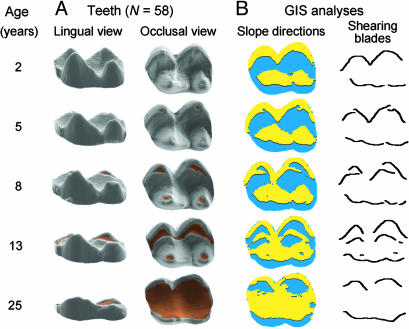
Fig. 1.
Fig. 1.
Low-crowned (brachydont) cheek teeth of Milne-Edwards' sifaka (P. edwardsi) lose high cusp relief quickly. (A) Lingual and occlusal views of right lower second molar show first signs of exposed dentine (brown color) at 5 years old, and by 25 years of age, the whole crown is worn away. (B) From 3D DEMs, GIS analyses were used to classify buccal and lingual slopes (yellow and blue color) from which shearing blades, including compensatory blades exposed by tooth wear, were delineated. Mean molar length is 7.4 mm.
Fig. 2.
Fig. 2.
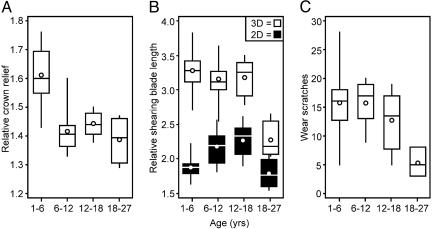
With wear, sifaka teeth quickly lose their crown relief but retain shearing blades and wear characteristics until 18 years of age. (A) The high cusp relief is mostly lost before 7 years of age, but the wear exposes dentine (Fig. 1) and compensatory shearing blades form (visible as an increase in 2D blade length in B), resulting in the maintenance of the overall 3D blade length. (B) Compensatory blades are present until the whole enamel crown is worn down at ≈18 years of age when, without the high crown relief, the 3D blade length plummets (P = 0.001, tested by using 1,000 randomizations). (C) The drop in blade lengths also marks a drop in low-magnification use wear scratches tabulated in a square that is 0.4 mm on each side (P = 0.002, tested by using 1,000 randomizations). The circles denote means. The boxes, with the median indicated, enclose 50% of the observations, and the whiskers denote range. The numbers of individuals in each age group (starting from the youngest) are 22, 10, 6, and 3, and the corresponding number of dental casts (due to multiple captures) are 29, 16, 9, and 4.
Fig. 3.
Fig. 3.
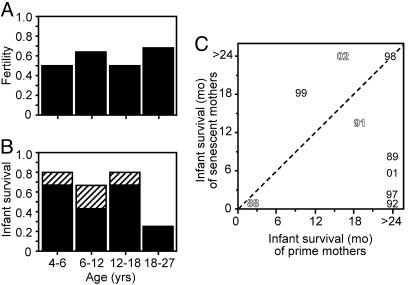
Fertility remained high, whereas infant survival declined in dentally senescent females. (A) Females in all age groups have had one infant in every other year. (B) More than half of these infants survived 24 months when born to dentally prime mothers, whereas a quarter survived when born to dentally senescent mothers (age 18 and above, P = 0.073, tested by using 1,000 randomizations). Calculating infant survival after excluding infanticidal mortality increases infant survival of only prime mothers (hatched, P = 0.009, tested by using 1,000 randomizations). (C) A pairwise comparison of years when both females in and past their dental prime had infants shows that in the majority of years, the dentally senescent mothers lost infants first (years with infanticide are in outline lettering). The dashed line represents equal infant longevity of dentally prime and dentally senescent females. The numbers of females in each age group (starting from the youngest) are 4, 5, 2, and 3, and the corresponding total observation years are 12, 25, 12, and 19.
Fig. 4.
Fig. 4.
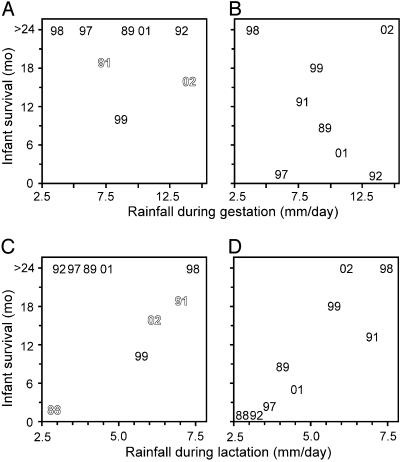
Rainfall during lactation correlates with infant survival in dentally senescent females. In dentally prime (A) and senescent (B) females, infants survive even during years with little rain during the gestation season. However, in dentally prime (C) and senescent (D) females, rain during lactation season is critical for infant survival of dentally senescent females (D). The correlations (rs) between rainfall and infant survival for A, B, C, and D, respectively, are –0.19, –0.16, 0.04, and 0.88, and the corresponding P values are 0.61, 0.68, 0.92, and 0.01. Correlations calculated separately for each age class in their dental prime range from –0.35 to 0.28, all not significant. In B and D, the infant survival data from –88 to –92 and from –97 to –02 are for two different females except in –02, which includes infant survival for a third female as well. Years with infanticide are in outline lettering.

Comment in

References

    1. Lucas, P. W. (2004) Dental Functional Morphology (Cambridge Univ. Press, Cambridge, U.K.).
    1. Janis, C. M. & Fortelius, M. (1988) Biol. Rev. 63, 197–230. - PubMed
    1. Williams, S. H. & Kay, R. F. (2001) J. Mammal. Evol. 8, 207–229.
    1. Jernvall, J. & Fortelius, M. (2002) Nature 417, 538–540. - PubMed
    1. Kay, R. F. (1975) Am. J. Phys. Anthropol. 43, 195–216. - PubMed

Publication types