. 2005 Nov 8;102(45):16507-11.
doi: 10.1073/pnas.0506463102. Epub 2005 Oct 31.

Semantic congruity affects numerical judgments similarly in monkeys and humans

Affiliations

Semantic congruity affects numerical judgments similarly in monkeys and humans

Jessica F Cantlon et al. Proc Natl Acad Sci U S A. .

Abstract

Monkeys (Macaca mulatta) were trained to order visual arrays based on their number of elements and to conditionally choose the array with the larger or smaller number of elements dependent on a color cue. When the screen background was red, monkeys were reinforced for choosing the smaller numerical value first. When the screen background was blue, monkeys were reinforced for choosing the larger numerical value first. Monkeys showed a semantic congruity effect analogous to that reported for human comparison judgments. Specifically, decision time was systematically influenced by the semantic congruity between the cue ("choose smaller" or "choose larger") and the magnitude of the choice stimuli (small or large numbers of dots). This finding demonstrates a semantic congruity effect in a nonlinguistic animal and provides strong evidence for an evolutionarily primitive magnitude-comparison algorithm common to humans and monkeys.


Figures
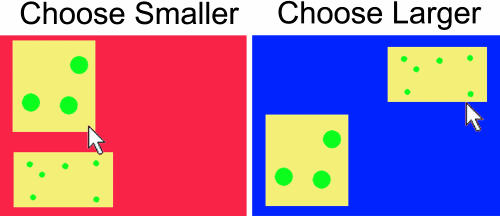
Fig. 1.
Fig. 1.
Illustration of the task design. When the background color was red, monkeys were rewarded for pressing the stimulus with the smaller number of dots. When the background was blue, monkeys were rewarded for pressing the stimulus with the larger number of dots.
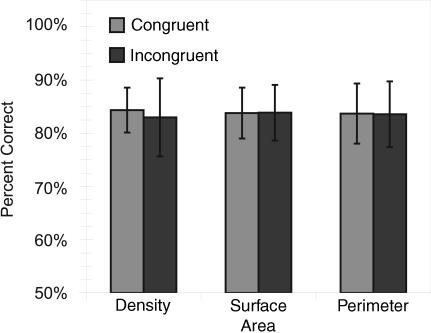
Fig. 2.
Fig. 2.
Accuracy when the number of dots in a stimulus was congruent (smaller number has smaller density, perimeter, or surface area) and incongruent (larger number has smaller density, perimeter, or surface area or when stimuli are equated on dimension) with density, cumulative surface area, and cumulative perimeter. Accuracy was not affected by these stimulus controls. The error bars reflect standard error between monkeys.
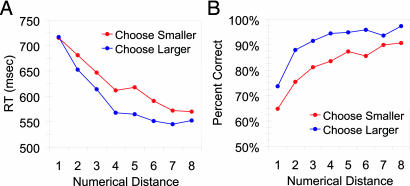
Fig. 3.
Fig. 3.
The numerical distance effect. (A) RT as a function of numerical distance between the numerosities in a pair for all 36 numerical pairs during choose larger and choose smaller trials. Monkeys were faster as the distance between numerical values increased. (B) Accuracy as a function of numerical distance for all 36 numerical pairs during choose larger and choose smaller trials. Monkeys were more accurate as numerical distance increased.
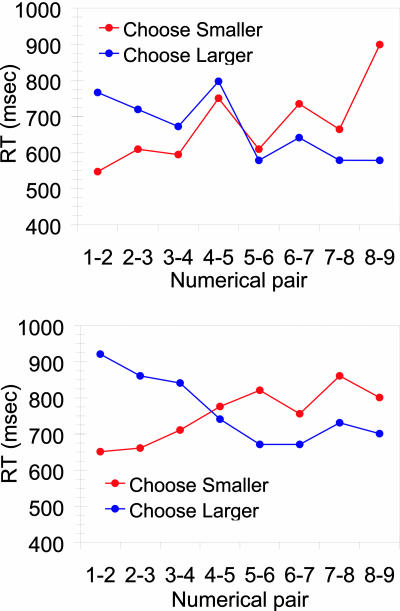
Fig. 4.
Fig. 4.
The semantic congruity effect. RT for Feinstein (Upper) and Mikulski (Lower) for each numerical pair at a constant distance of 1 during choose smaller and choose larger trials. The crossover pattern reflects the effect of semantic congruity on monkeys' numerical comparisons.

References

    1. Cantlon, J. F. & Brannon, E. M. (2006) Psychol. Sci., in press. - PubMed
    1. Whalen, J., Gallistel, C. R. & Gelman, R. (1999) Psychol. Sci. 10, 130-137.
    1. Beran, M. (2001) J. Comp. Psychol. 115, 181-191. - PubMed
    1. Brannon, E. M. & Terrace, H. S. (1998) Science 282, 746-749. - PubMed
    1. Hauser, M. D., Tsao, F., Garcia, P. & Spelke, E. S. (2003) Proc. Biol. Sci. 270, 1441-1446. - PMC - PubMed

Publication types

LinkOut - more resources