


Infection patterns in barley and wheat spikes inoculated with wild-type and trichodiene synthase gene disrupted Fusarium graminearum
- PMID: 16263921
- PMCID: PMC1283850
- DOI: 10.1073/pnas.0508467102
Infection patterns in barley and wheat spikes inoculated with wild-type and trichodiene synthase gene disrupted Fusarium graminearum
Abstract
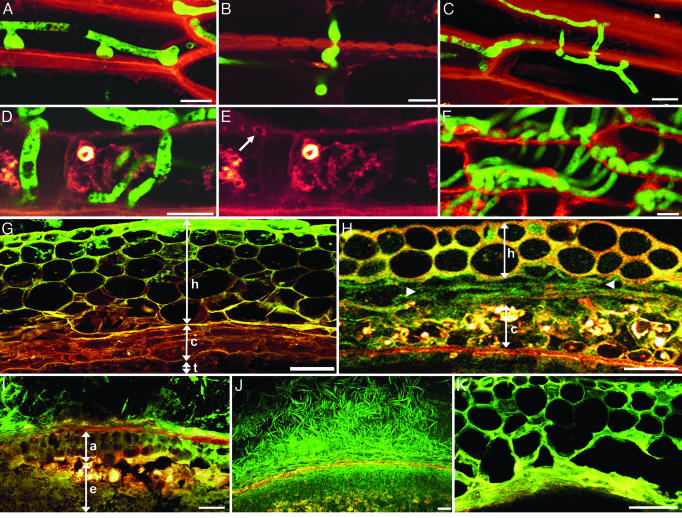
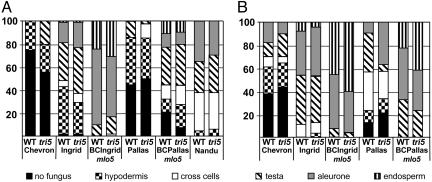
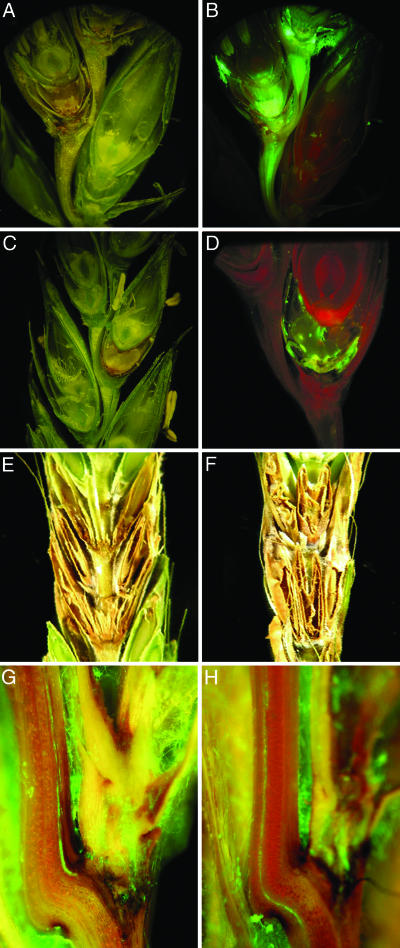
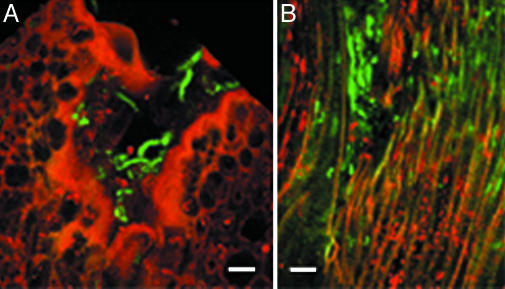
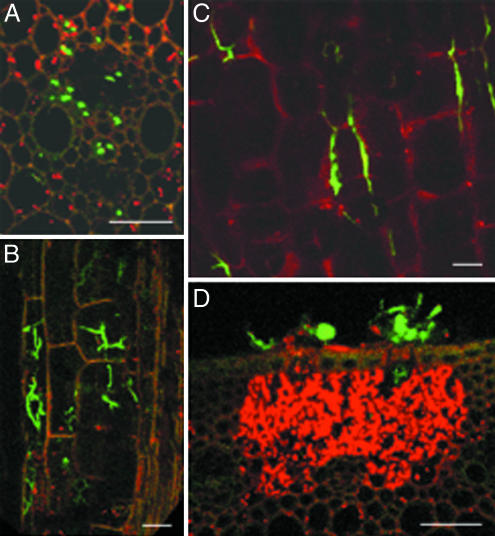
Fusarium head blight epidemics of wheat and barley cause heavy economic losses to farmers due to yield decreases and production of mycotoxin that renders the grain useless for flour and malt products. No highly resistant cultivars are available at present. Hyphae of germinating fungal spores use different paths of infection: After germination at the extruded tip of an ovary, the hyphae travel along the epicarp in the space between the lemma and palea. Infection of the developing kernel proceeds through the epicarp, successively destroying the layers of the fruit coat and finally the starch and protein accumulating endosperm. Hyphae reaching the rachis proceed to apically located developing kernels. Using a constitutively green fluorescence protein-expressing Fusarium wild-type strain, and its knockout mutant, preventing trichothecene synthesis, we demonstrate that trichothecenes are not a virulence factor during infection through the fruit coat. In the absence of trichothecenes, the fungus is blocked by the development of heavy cell wall thickenings in the rachis node of Nandu wheat, a defense inhibited by the mycotoxin. In barley hyphae of both wild-type and the trichothecene knockout mutant, are inhibited at the rachis node and rachilla, limiting infection of adjacent florets through the phloem and along the surface of the rachis. Effective resistance to Fusarium head blight requires expression of genes that combat these different pathways of infection.
Figures
References
-
- Windels, C. E. (2000) Phytopathology 90, 17-21. - PubMed
-
- National Agricultural Statistics Service (1993-1999) Annual Reports: Minnesota Agricultural Statistics, Minnesota Office, St. Paul and North Dakota Agricultural Statistics, North Dakota Office, Fargo (United States Department of Agriculture, Washington, DC).
-
- Placinta, C. M., D'Mello, J. P. F. & Macdonald, A. M. C. (1999) Anim. Feed Sci. Tech. 78, 21-37.
-
- Bai, G. & Shaner, G. (2004) Annu. Rev. Phytopathol. 42, 135-161. - PubMed
Publication types
MeSH terms
Substances
LinkOut - more resources
Full Text Sources
Other Literature Sources
Molecular Biology Databases
