


Child deaths resulting from inflicted injuries: household risk factors and perpetrator characteristics
- PMID: 16263983
- PMCID: PMC1360186
- DOI: 10.1542/peds.2005-0296
Child deaths resulting from inflicted injuries: household risk factors and perpetrator characteristics
Abstract
Objective: To determine the role of household composition as an independent risk factor for fatal inflicted injuries among young children and describe perpetrator characteristics.
Design, setting, and population: A population-based, case-control study of all children < 5 years of age who died in Missouri between January 1, 1992, and December 31, 1999. Missouri Child Fatality Review Program data were analyzed. Cases all involved children with injuries inflicted by a parent or caregiver. Two age-matched controls per case child were selected randomly from children who died of natural causes.
Main outcome measure: Inflicted-injury death. Household composition of case and control children was compared by using multivariate logistic regression. We hypothesized that children residing in households with adults unrelated to them are at higher risk of inflicted-injury death than children residing in households with 2 biological parents.
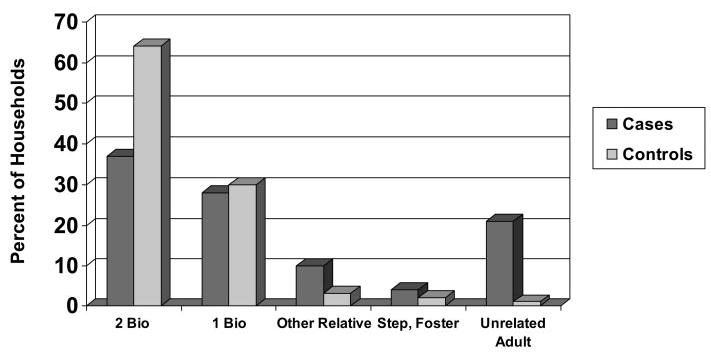
Results: We identified 149 inflicted-injury deaths in our population during the 8-year study period. Children residing in households with unrelated adults were nearly 50 times as likely to die of inflicted injuries than children residing with 2 biological parents (adjusted odds ratio: 47.6; 95% confidence interval: 10.4-218). Children in households with a single parent and no other adults in residence had no increased risk of inflicted-injury death (adjusted odds ratio: 0.9; 95% confidence interval: 0.6-1.9). Perpetrators were identified in 132 (88.6%) of the cases. The majority of known perpetrators were male (71.2%), and most were the child's father (34.9%) or the boyfriend of the child's mother (24.2%). In households with unrelated adults, most perpetrators (83.9%) were the unrelated adult household member, and only 2 (6.5%) perpetrators were the biological parent of the child.
Conclusions: Young children who reside in households with unrelated adults are at exceptionally high risk for inflicted-injury death. Most perpetrators are male, and most are residents of the decedent child's household at the time of injury.
Conflict of interest statement
No conflict of interest declared.
Figures
References
-
- Overpeck MD, Brenner RA, Trumble AC, Trifiletti LB, Berendes HW. Risk factors for infant homicide in the United States. N Engl J Med. 1998;339:1211–1216. - PubMed
-
- Stiffman MN, Schnitzer PG, Adam P, Kruse RL, Ewigman BG. Household composition and risk of fatal child maltreatment. Pediatrics. 2002;109:615–621. - PubMed
-
- Herman-Giddens ME, Brown G, Verbiest S, et al. Underascertainment of child abuse mortality in the United States. JAMA. 1999;282:463–467. - PubMed
-
- Herman-Giddens ME. Underrecoding of child abuse and neglect fatalities in North Carolina. N C Med J. 1991;52:634–639. - PubMed
-
- Ewigman B, Kivlahan C, Land G. The Missouri child fatality study: underreporting of maltreatment fatalities among children younger than five years of age, 1983 through 1986. Pediatrics. 1993;91:330–337. - PubMed
Publication types
MeSH terms
Grants and funding
LinkOut - more resources
Full Text Sources
Medical
