


The contribution of leading diseases and risk factors to excess losses of healthy life in Eastern Europe: burden of disease study
- PMID: 16269084
- PMCID: PMC1298310
- DOI: 10.1186/1471-2458-5-116
The contribution of leading diseases and risk factors to excess losses of healthy life in Eastern Europe: burden of disease study
Abstract
Background: The East/West gradient in health across Europe has been described often, but not using metrics as comprehensive and comparable as those of the Global Burden of Disease 2000 and Comparative Risk Assessment studies.
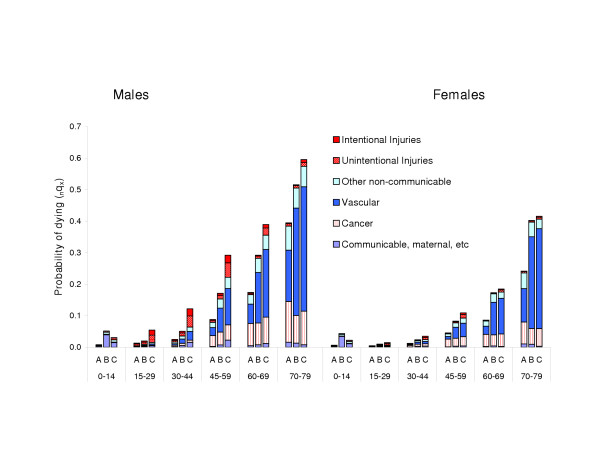
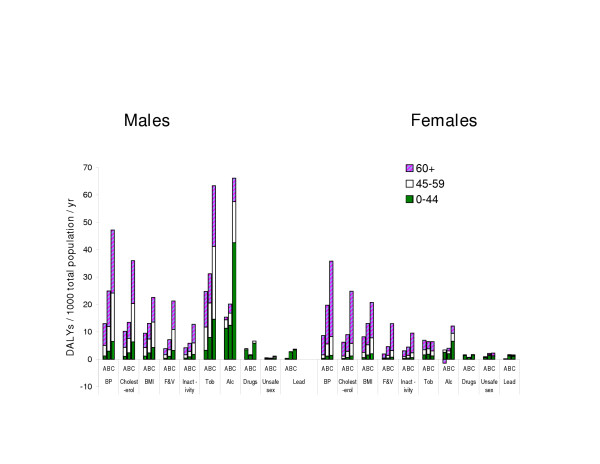
Methods: Comparisons are made across 3 epidemiological subregions of the WHO region for Europe--A (very low child and adult mortality), B (low child and low adult mortality) and C (low child and high adult mortality)--with populations in 2000 of 412, 218 and 243 millions respectively, and using the following measures: 1. Probabilities of death by sex and causal group across 7 age intervals; 2. Loss of healthy life (DALYs) to diseases and injuries per thousand population; 3. Loss of healthy life (DALYs) attributable to selected risk factors across 3 age ranges.
Results: Absolute differences in mortality are most marked in males and in younger adults, and for deaths from vascular diseases and from injuries. Dominant contributions to east-west differences come from the nutritional/physiological group of risk factors (blood pressure, cholesterol concentration, body mass index, low fruit and vegetable consumption and inactivity) contributing to vascular disease and from the legal drugs--tobacco and alcohol.
Conclusion: The main requirements for reducing excess health losses in the east of Europe are: 1) favorable shifts in all amenable vascular risk factors (irrespective of their current levels) by population-wide and personal measures; 2) intensified tobacco control; 3) reduced alcohol consumption and injury control strategies (for example, for road traffic injuries). Cost effective strategies are broadly known but local institutional support for them needs strengthening.
Figures

References
-
- Chenet L, McKee M, Fulop N, Bojan F, Brand H, Hort A, Kalbarczyk P. Changing life expectancy in central Europe: is there a single reason? Journal of public health medicine. 1996;18:329–336. - PubMed
-
- Cornia GA, Paniccia R, eds . The mortality crisis in transitional economies. Oxford, Oxford University Press; 2000.
-
- Mathers CD, Stein C, Ma Fat D, Rao C, Inoue M, Tomijima N, Bernard C, Lopez AD, Murray CJL. Global Burden of Disease 2000: Version 2 methods and results. Geneva, World Health Organization; 2002. (Global Programme on Evidence for Health Policy Discussion Paper No. 50).
Publication types
MeSH terms
LinkOut - more resources
Full Text Sources
