


Prevalence of Borrelia burgdorferi sensu lato genospecies in Ixodes ricinus ticks in Europe: a metaanalysis
- PMID: 16269760
- PMCID: PMC1287732
- DOI: 10.1128/AEM.71.11.7203-7216.2005
Prevalence of Borrelia burgdorferi sensu lato genospecies in Ixodes ricinus ticks in Europe: a metaanalysis
Abstract
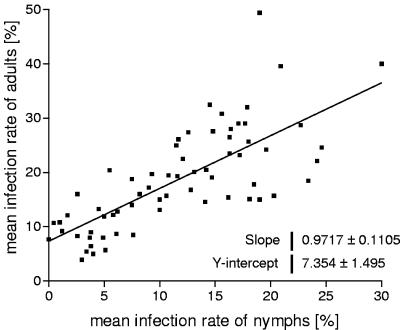
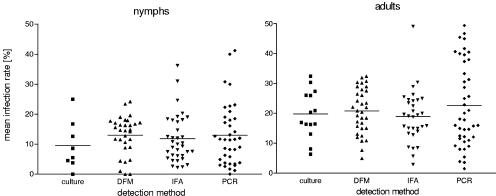
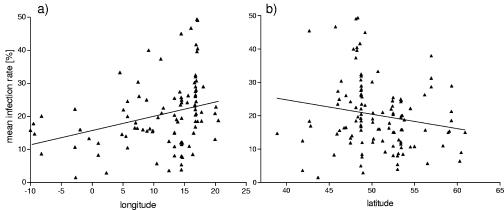
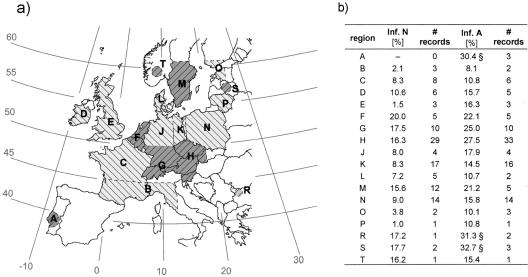
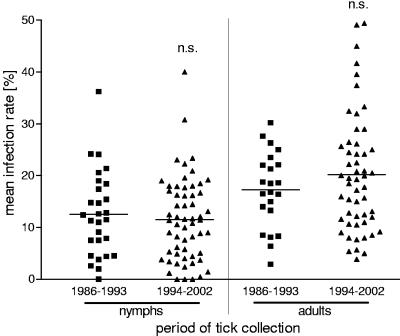
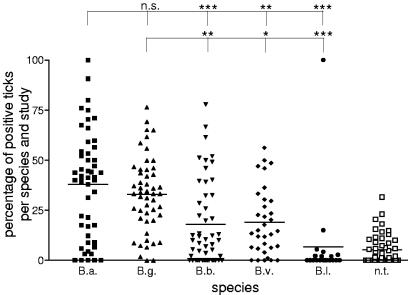
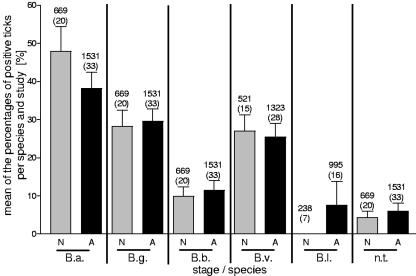
In Europe, Borrelia burgdorferi genospecies causing Lyme borreliosis are mainly transmitted by the tick Ixodes ricinus. Since its discovery, B. burgdorferi has been the subject of many epidemiological studies to determine its prevalence and the distribution of the different genospecies in ticks. In the current study we systematically reviewed the literature on epidemiological studies of I. ricinus ticks infected with B. burgdorferi sensu lato. A total of 1,186 abstracts in English published from 1984 to 2003 were identified by a PubMed keyword search and from the compiled article references. A multistep filter process was used to select relevant articles; 110 articles from 24 countries contained data on the rates of infection of I. ricinus with Borrelia in Europe (112,579 ticks), and 44 articles from 21 countries included species-specific analyses (3,273 positive ticks). These data were used to evaluate the overall rate of infection of I. ricinus with Borrelia genospecies, regional distributions within Europe, and changes over time, as well as the influence of different detection methods on the infection rate. While the infection rate was significantly higher in adults (18.6%) than in nymphs (10.1%), no effect of detection method, tick gender, or collection period (1986 to 1993 versus 1994 to 2002) was found. The highest rates of infection of I. ricinus were found in countries in central Europe. B. afzelii and B. garinii are the most common Borrelia species, but the distribution of genospecies seems to vary in different regions in Europe. The most frequent coinfection by Borrelia species was found for B. garinii and B. valaisiana.
Figures

References
-
- Balmelli, T., and J. C. Piffaretti. 1995. Association between different clinical manifestations of Lyme disease and different species of Borrelia burgdorferi sensu lato. Res. Microbiol. 146:329-340. - PubMed
-
- Baranton, G., D. Postic, I. Saint Girons, P. Boerlin, J. C. Piffaretti, M. Assous, and P. A. Grimont. 1992. Delineation of Borrelia burgdorferi sensu stricto, Borrelia garinii sp. nov., and group VS461 associated with Lyme borreliosis. Int J. Syst. Bacteriol. 42:378-383. - PubMed
-
- Barral, M., A. L. Garcia-Perez, R. A. Juste, A. Hurtado, R. Escudero, R. E. Sellek, and P. Anda. 2002. Distribution of Borrelia burgdorferi sensu lato in Ixodes ricinus (Acari: Ixodidae) ticks from the Basque country, Spain. J. Med. Entomol. 39:177-184. - PubMed
-
- Basta, J., J. Plch, D. Hulinska, and M. Daniel. 1999. Incidence of Borrelia garinii and Borrelia afzelii in Ixodes ricinus ticks in an urban environment, Prague, Czech Republic, between 1995 and 1998. Eur. J. Clin. Microbiol. Infect. Dis. 18:515-517. - PubMed
-
- Berglund, J., and R. Eitrem. 1993. Tick-borne borreliosis in the archipelago of southern Sweden. Scand. J. Infect. Dis. 25:67-72. - PubMed
Publication types
MeSH terms
LinkOut - more resources
Full Text Sources
