. 2005 Nov;71(11):7461-71.
doi: 10.1128/AEM.71.11.7461-7471.2005.

Proof that Burkholderia strains form effective symbioses with legumes: a study of novel Mimosa-nodulating strains from South America

Affiliations

Proof that Burkholderia strains form effective symbioses with legumes: a study of novel Mimosa-nodulating strains from South America

Wen-Ming Chen et al. Appl Environ Microbiol. 2005 Nov.

Abstract

Twenty Mimosa-nodulating bacterial strains from Brazil and Venezuela, together with eight reference Mimosa-nodulating rhizobial strains and two other beta-rhizobial strains, were examined by amplified rRNA gene restriction analysis. They fell into 16 patterns and formed a single cluster together with the known beta-rhizobia, Burkholderia caribensis, Burkholderia phymatum, and Burkholderia tuberum. The 16S rRNA gene sequences of 15 of the 20 strains were determined, and all were shown to belong to the genus Burkholderia; four distinct clusters could be discerned, with strains isolated from the same host species usually clustering very closely. Five of the strains (MAP3-5, Br3407, Br3454, Br3461, and Br3469) were selected for further studies of the symbiosis-related genes nodA, the NodD-dependent regulatory consensus sequences (nod box), and nifH. The nodA and nifH sequences were very close to each other and to those of B. phymatum STM815, B. caribensis TJ182, and Cupriavidus taiwanensis LMG19424 but were relatively distant from those of B. tuberum STM678. In addition to nodulating their original hosts, all five strains could also nodulate other Mimosa spp., and all produced nodules on Mimosa pudica that had nitrogenase (acetylene reduction) activities and structures typical of effective N2-fixing symbioses. Finally, both wild-type and green fluorescent protein-expressing transconjugant strains of Br3461 and MAP3-5 produced N2-fixing nodules on their original hosts, Mimosa bimucronata (Br3461) and Mimosa pigra (MAP3-5), and hence this confirms strongly that Burkholderia strains can form effective symbioses with legumes.


Figures
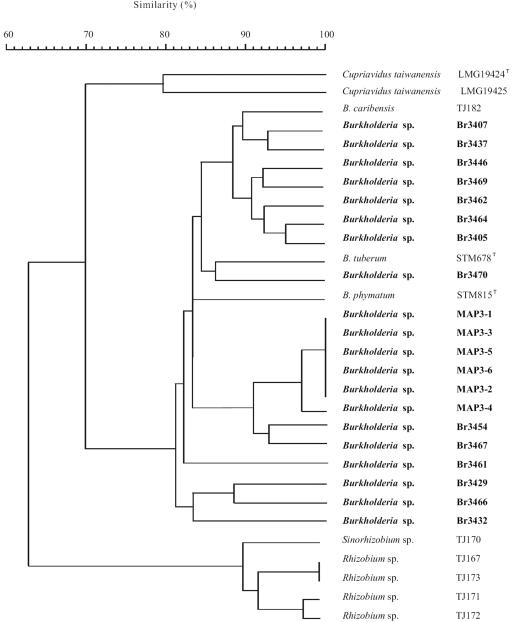
FIG. 1.
FIG. 1.
Dendrogram derived from the unweighted-pair group method average linkages of Dice similarity coefficients (SD) between the combined ARDRA patterns of all strains studied. The coefficient is expressed as the percentage of similarity for convenience.
FIG. 2.
FIG. 2.
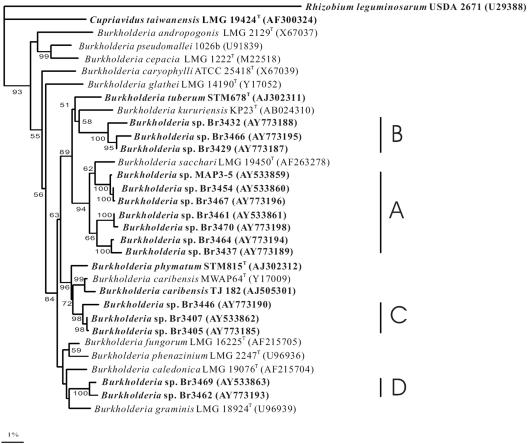
Neighbor-joining tree showing phylogenetic positions of South American Mimosa-nodulating strains and Burkholderia species within the β-proteobacteria based on 16S rRNA gene sequence comparisons. Rhizobium leguminosarum USDA 2671 was used as an outgroup. Legume symbionts are shown in bold. Bootstrap values are indicated on branches. Only bootstrap values of >50% are shown. Scale bar, 1% sequence divergence (one substitution per 100 nucleotides). Representative sequences in the dendrogram were obtained from GenBank (accession numbers are given in parentheses).
FIG. 3.
FIG. 3.
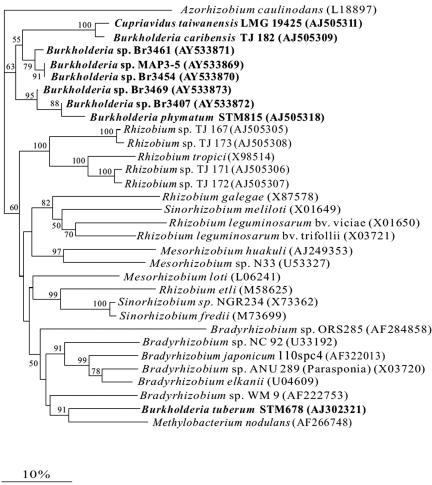
NodA phylogenetic tree of α- and β-rhizobia. β-Proteobacterial strains are shown in bold. The tree was reconstructed by using a neighbor-joining approach based on a 116-amino-acid sequence alignment. Values along branches indicate bootstrap percentages of >50%, based on 1,000 replicates. nodA sequences for representative sequences are available from GenBank (accession numbers are given in parentheses).
FIG. 4.
FIG. 4.
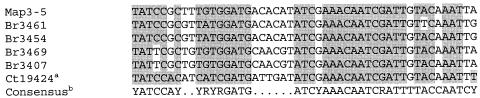
Comparison of nod box sequences in promoter regions of nodulation genes from five South American Burkholderia strains and C. taiwanensis strain LMG19424. Footnotes: a, Cupriavidus taivanensis LMG19424; b, the consensus nod box sequence (30) is located in the promoter regions of nodulation genes of various rhizobia, including Rhizobium, Sinorhizobium, Mesorhizobium, Bradyrhizobium, and Azorhizobium spp.
FIG. 5.
FIG. 5.
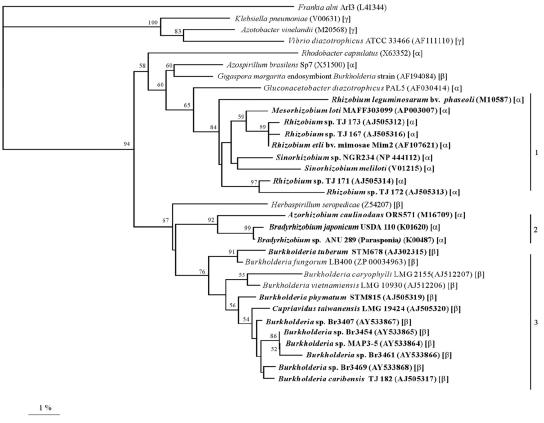
NifH phylogenetic tree. The tree was reconstructed by neighbor joining based on a 218-amino-acid alignment. Values along branches indicate bootstrap percentages of >50%, based on 1,000 replicates. The tree was rooted using sequences from Frankia alni, Vibrio diazotrophicus, Klebsiella pneumoniae, and Azotobacter vinelandii. Rhizobia are shown in bold, and the α-, β-, or γ-proteobacterial classification is indicated in parentheses. Clusters 1 and 2 contain α-rhizobia only, while cluster 3 includes both symbiotic and nonsymbiotic diazotrophic β-proteobacteria. nifH sequences for published bacteria are available from GenBank (accession numbers are given in parentheses).
FIG. 6.
FIG. 6.
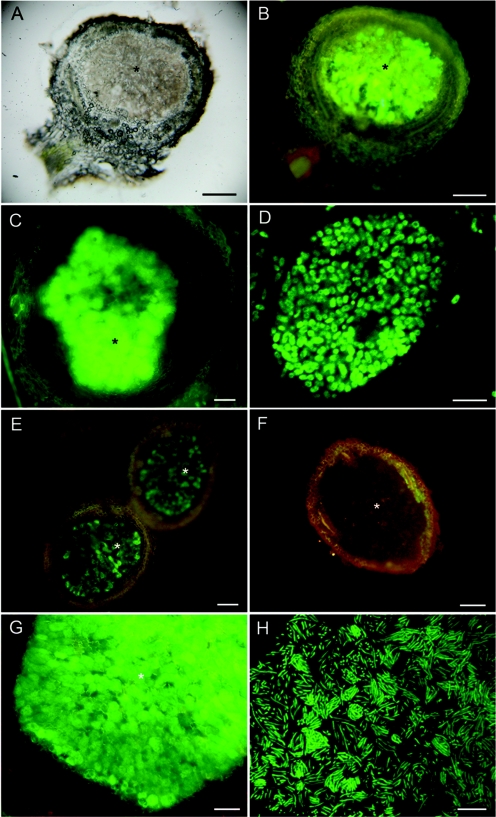
Light microscopy of fresh nodules of Mimosa spp. inoculated with gfp-tagged or wild-type (WT) Burkholderia strains Br3461 (A to D) and MAP3-5 (E to H). A Mimosa pudica nodule infected with Br3461-gfp was viewed with transmitted light (A) or epifluorescence (B). Panels C and D show a Mimosa bimucronata nodule infected with Br3461-gfp viewed under epifluorescence (C) and an infected cell from the same nodule containing fluorescent bacteroids viewed using CLSM (D). (E and F) Mimosa pudica nodules infected with MAP3-5-gfp (E) or MAP3-5 WT (F) viewed under epifluorescence. Note that the nodule containing WT MAP3-5 does not fluoresce (F). (G) Mimosa pigra nodule infected with MAP3-5-gfp viewed with epifluorescence. Note that the infected zone fluoresces intensely green (*), but also that the meristematic region has red fluorescence, possibly due to the presence of polyphenolic compounds. (H) CLSM of fluorescent bacteroids within an infected cell from an M. pigra nodule infected with MAP3-5-gfp. Bars, 100 μm (A, B, C, E, and F), 5 μm (D), 50 μm (G), and 10 μm (H).
FIG. 7.
FIG. 7.
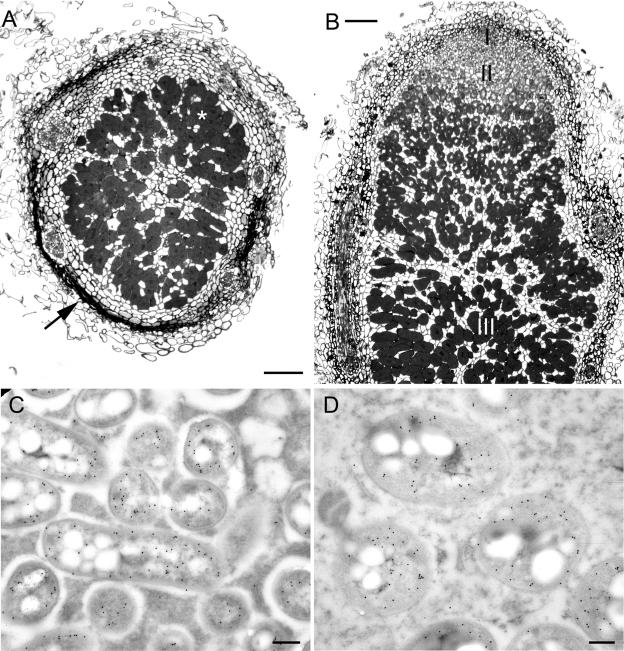
Transverse (A) and longitudinal (B) sections of fixed and embedded Mimosa bimucronata (A) and M. pigra (B) nodules formed after inoculation with Burkholderia strains Br3461 and MAP3-5, respectively. Both nodules are indeterminate (see panel B), with a meristem (zone I), an invasion zone (zone II), and a N2-fixing zone (zone III and * in panel A). Note the heavily lignified cortex in panel A (arrow). (C and D) Transmission electron micrographs of bacteroids from nodules of M. pudica plus Br3461 (C) and M. pigra plus MAP3-5 (D). Both panels C and D were immunogold labeled with an antibody against the NifH protein of nitrogenase. Bars, 100 μm (A and B) and 300 nm (C and D).

References

    1. Allen, O. N., and E. K. Allen. 1981. The Leguminosae: a source book of characteristics, uses, and nodulation. University of Wisconsin Press, Madison, Wis.
    1. Barneby, R. C. 1991. Sensitivae censitae: a description of the genus Mimosa Linnaeus (Mimosaceae) in the New World. Mem. N. Y. Botanic. Garden 65:1-835.
    1. Barrett, C. F., and M. A. Parker. 2005. Prevalence of Burkholderia sp. nodule symbionts on four mimosoid legumes from Barro Colorado Island, Panama. Syst. Appl. Microbiol. 28:57-65. - PubMed
    1. Barrios, E., and R. Herrera. 1994. Nitrogen cycling in a Venezuelan tropical seasonally flooded forest: soil nitrogen mineralization and nitrification. J. Trop. Ecol. 10:399-416.
    1. Barrios, S., and V. Gonzalez. 1971. Rhizobial symbioses on Venezuelan savannas. Plant Soil 34:707-719.

Publication types

Associated data