


doi: 10.1128/AEM.71.11.7542-7547.2005.
Construction of an alpha toxin gene knockout mutant of Clostridium perfringens type A by use of a mobile group II intron
Affiliations
- PMID: 16269799
- PMCID: PMC1287605
- DOI: 10.1128/AEM.71.11.7542-7547.2005
Item in Clipboard
Construction of an alpha toxin gene knockout mutant of Clostridium perfringens type A by use of a mobile group II intron
Appl Environ Microbiol.
2005 Nov.
Abstract
In developing Clostridium perfringens as a safe vaccine vector, the alpha toxin gene (plc) in the bacterial chromosome must be permanently inactivated. Disrupting genes in C. perfringens by traditional mutagenesis methods is very difficult. Therefore, we developed a new strategy using group II intron-based Target-Tron technology to inactivate the plc gene in C. perfringens ATCC 3624. Western blot analysis showed no production of alpha toxin protein in the culture supernatant of the plc mutant. Advantages of this technology, such as site specificity, relatively high frequency of insertion, and introduction of no antibiotic resistance genes into the chromosome, could facilitate construction of other C. perfringens mutants.
Figures
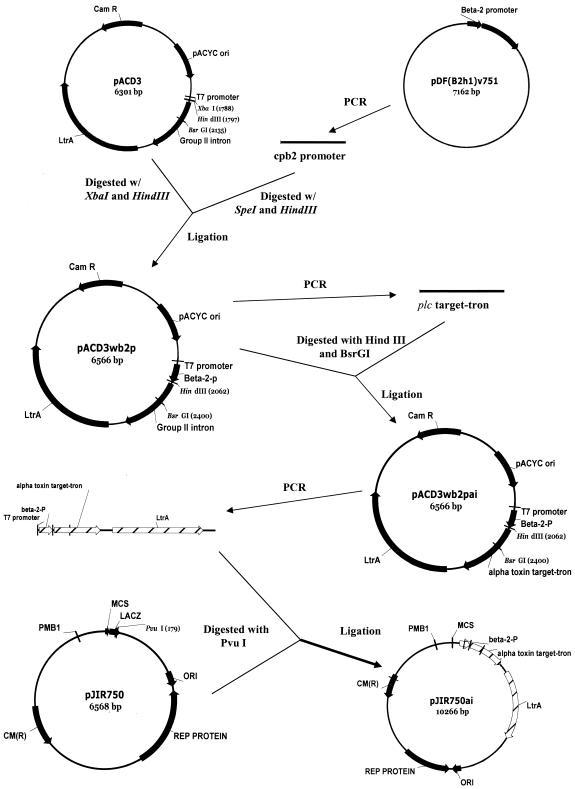
Schematic diagram of construction of an E. coli-C. perfringens shuttle plasmid containing a plc targetron. See the text for a detailed description.

Screening of plc gene knockout C. perfringens mutants. (A) Diagram of the plc gene with and without insertion of the targetron. →, forward primer; ←, reverse primer. (B) Screening of CM-resistant C. perfringens colonies for targetron insertion by PCR. The numbers at the top are bacterial colony numbers. NC, negative control. Colonies 5 and 7 (lanes 5 and 7 showing both 1.1-kb and 200-bp bands) have been used for subsequent characterization of the plc knockout. (C) Confirmation of plc gene inactivation in plc mutant clones by PCR. The numbers at the top are numbers of bacterial clones lacking a white halo.

Characterization of plc knockout C. perfringens (KO C.P.). (A) Western blot analysis of alpha toxin production in bacterial culture of wild-type (WT C.P.) or plc mutant C. perfringens. (B) Growth of wild-type and plc mutants on egg yolk BHI agar plates after 24 h of incubation in anaerobic conditions. (C) Southern blot analysis of chromosomal DNA of C. perfringens with and without (w/o) the targetron insertion and the plasmid containing the targetron.

Western blot analysis of SIV p27 expression in transformed plc C. perfringens mutants. wt C.P., wild-type C. perfringens.
References
-
- Chen, Y., R. Helmus, B. McClane, R. Hoffman, S. Watkins, T. Wehrli, and P. Gupta. 2004. Use of a Clostridium perfringens vector to express high levels of SIV p27 protein for the development of an oral SIV vaccine. Virology 329:226-233. - PubMed
-
- Cousineau, B., D. Smith, S. Lawrence-Cavanagh, J. E. Mueller, J. Yang, D. Mills, D. Manias, G. Dunny, A. M. Lambowitz, and M. Belfort. 1998. Retrohoming of a bacterial group II intron: mobility via complete reverse splicing, independent of homologous DNA recombination. Cell 94:451-462. - PubMed
-
- Fisher, D. J., K. Miyamoto, B. Harrison, S. Akimoto, M. R. Sarker, and B. A. McClane. 2005. Association of beta2 toxin production with Clostridium perfringens type A human gastrointestinal disease isolates carrying a plasmid enterotoxin gene. Mol. Microbiol. 56:747-762. - PubMed
Publication types
MeSH terms
Substances
Grants and funding
LinkOut - more resources
Full Text Sources
Other Literature Sources
Molecular Biology Databases
