. 2005 Dec;112(1):114-30.
doi: 10.1007/s00122-005-0112-2. Epub 2005 Nov 5.

Coffee and tomato share common gene repertoires as revealed by deep sequencing of seed and cherry transcripts

Affiliations

Coffee and tomato share common gene repertoires as revealed by deep sequencing of seed and cherry transcripts

Chenwei Lin et al. Theor Appl Genet. 2005 Dec.

Abstract

An EST database has been generated for coffee based on sequences from approximately 47,000 cDNA clones derived from five different stages/tissues, with a special focus on developing seeds. When computationally assembled, these sequences correspond to 13,175 unigenes, which were analyzed with respect to functional annotation, expression profile and evolution. Compared with Arabidopsis, the coffee unigenes encode a higher proportion of proteins related to protein modification/turnover and metabolism-an observation that may explain the high diversity of metabolites found in coffee and related species. Several gene families were found to be either expanded or unique to coffee when compared with Arabidopsis. A high proportion of these families encode proteins assigned to functions related to disease resistance. Such families may have expanded and evolved rapidly under the intense pathogen pressure experienced by a tropical, perennial species like coffee. Finally, the coffee gene repertoire was compared with that of Arabidopsis and Solanaceous species (e.g. tomato). Unlike Arabidopsis, tomato has a nearly perfect gene-for-gene match with coffee. These results are consistent with the facts that coffee and tomato have a similar genome size, chromosome karyotype (tomato, n=12; coffee n=11) and chromosome architecture. Moreover, both belong to the Asterid I clade of dicot plant families. Thus, the biology of coffee (family Rubiacaeae) and tomato (family Solanaceae) may be united into one common network of shared discoveries, resources and information.


Figures
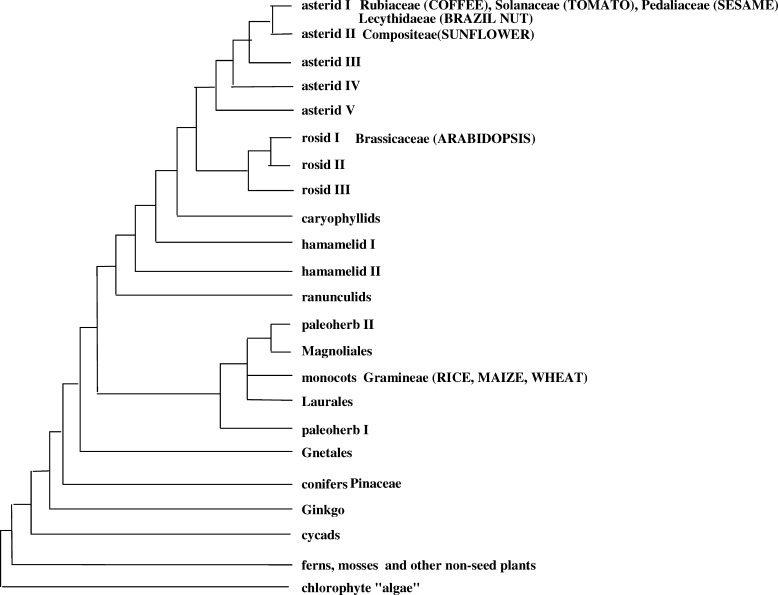
Fig. 1
Fig. 1
Dendrogram depicting phylogenetic relationships of coffee to other higher plant taxa (based on Chase et al. 1993)
Fig. 2
Fig. 2
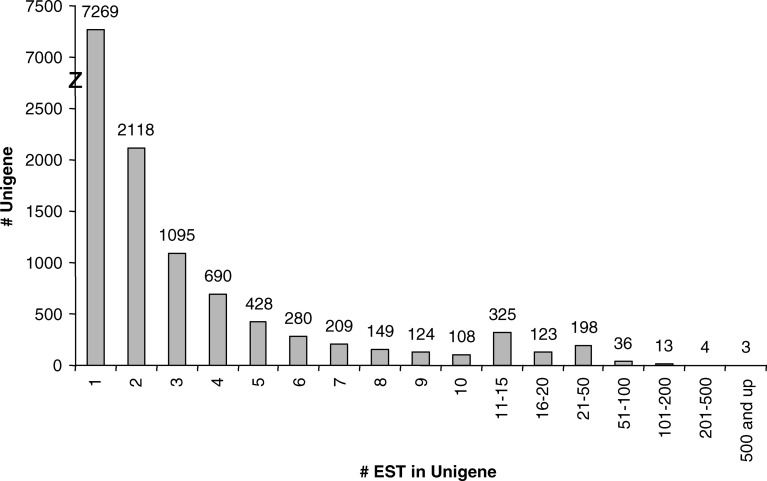
Histogram depicting the distribution of EST content for all coffee unigenes. Numbers above bars equals the number of unigenes represented in each
Fig. 3
Fig. 3
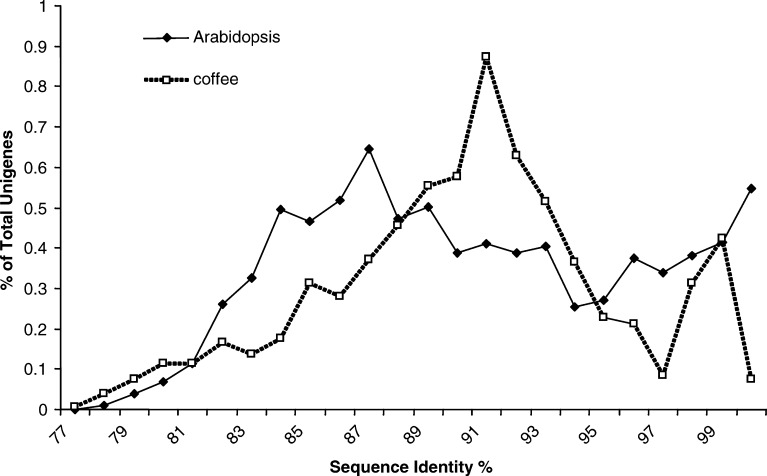
Plot depicting the sequence identify of the most similar match for each coffee unigene as compared with all other coffee unigenes. As a control, a similar analysis is shown for Arabidopsis genes (see Results for details)
Fig. 4
Fig. 4
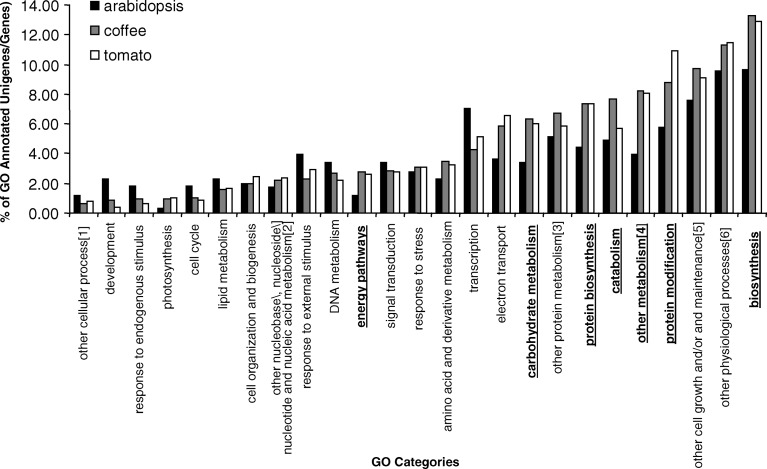
Comparison of the gene ontology-based gene annotation categories for the coffee EST-derived unigene set, tomato EST-derived unigene set and the Arabidopsis proteome. Figure contains only categories in which more than 1% of the coffee unigenes were assigned. Categories for which coffee differs most significantly from Arabidopsis are shown in underline bold. (1) Cellular processes other than signal transduction and cell growth and/or maintenance. (2) Nucleobase/nucleoside/nucleotide and nucleic acid metabolism other than DNA metabolism and transcription. (3) Protein metabolism other than protein biosynthesis and protein modification. (4) Metabolism other than amino acid and derivative metabolism, biosynthesis, carbohydrate metabolism, catabolism, electron transport, lipid metabolism, nucleobase/nucleoside/nucleotide and nucleic acid metabolism and protein metabolism. (5) Cell growth and/or maintenance other than cell cycle and cell organization and biogenesis. (6) Physiological processes other than photosynthesis, response to stress, response to endogenous stimulus, response to external stimulus and metabolism
Fig. 5
Fig. 5
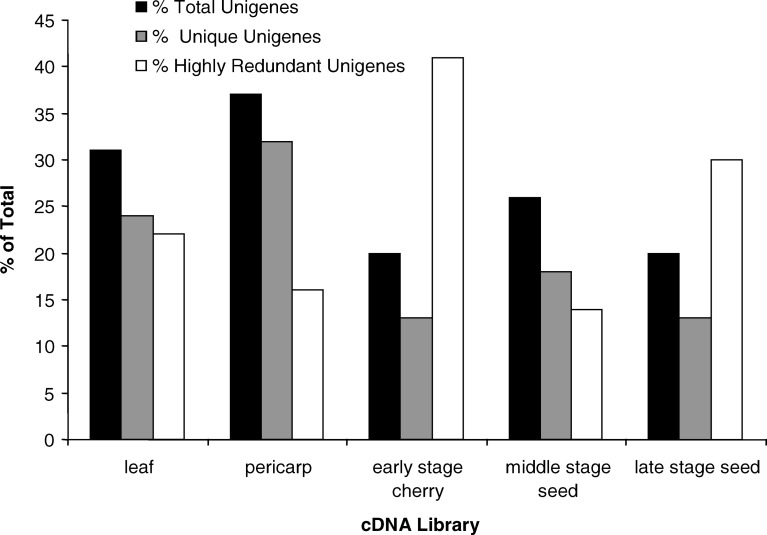
Characteristics of each coffee cDNA library in comparison to the entire coffee EST-derived unigene set. The total unigene and highly expressed unigene categories sum to greater 100% since the same unigene may contain ESTs from more than one library
Fig. 6
Fig. 6
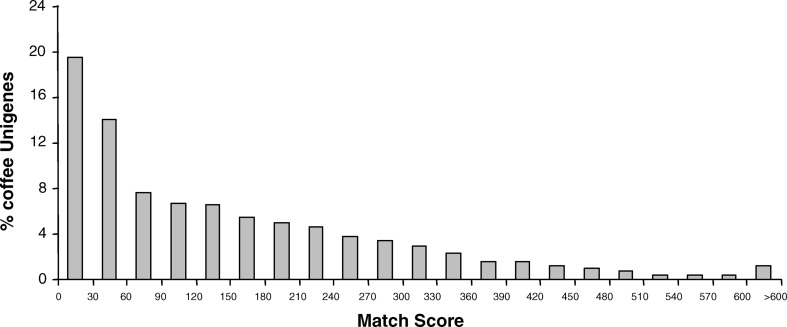
Histogram showing match scores for each coffee unigene as compared with its best match in the Arabidopsis proteome
Fig. 7
Fig. 7
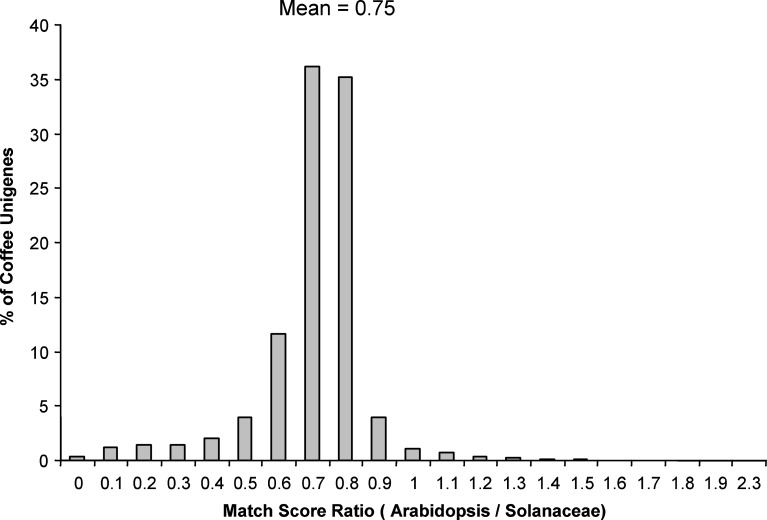
Ratio of highest Arabidopsis match score to highest Solanaceae match score for individual coffee unigene. The analysis restricted to coffee unigenes with a Solanaceae match score >100

References

    1. Altschul SF, Madden TL, Schaffer AA, Zhang J, Zhang Z, Miller W, Lipman D. Gapped BLAST and PSI-BLAST: a new generation of protein database search programs. Nucleic Acids Res. 1997;25:3389–3402. doi: 10.1093/nar/25.17.3389. - DOI - PMC - PubMed
    1. Apweiler R, Attwood TK, Bairoch A, Bateman A, Birney E, et al. The InterPro database, an intergrated documentation resource for protein families, domains and functional sites. Nucleic Acids Res. 2001;29:37–40. doi: 10.1093/nar/29.1.37. - DOI - PMC - PubMed
    1. Audic S, Claverie J-M. The significance of digital gene expression profiles. Genome Res. 1997;7:986–995. - PubMed
    1. Chase MW, Soltis DE, et al. Phylogenetics of seed plants—an analysis of nucleotide-sequences from the plastid gene rbcl. Ann Mo Bot Gard. 1993;80:528–580. doi: 10.2307/2399846. - DOI
    1. Chen ZJ, Ribeiro R, Silva MC. Heat shock-induced susceptibility of green coffee leaves and berries to Colletotrichum gloeosporioides and its association to PR and hsp70 gene expression. Physiol Mol Plant P. 2003;63:181–190. doi: 10.1016/j.pmpp.2003.11.004. - DOI

Publication types