Expression of procyclin mRNAs during cyclical transmission of Trypanosoma brucei
- PMID: 16276404
- PMCID: PMC1277927
- DOI: 10.1371/journal.ppat.0010022
Expression of procyclin mRNAs during cyclical transmission of Trypanosoma brucei
Abstract
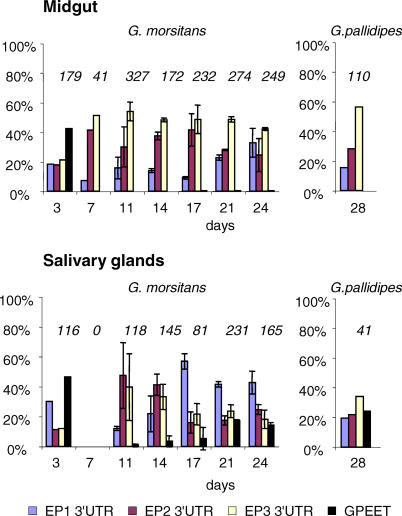
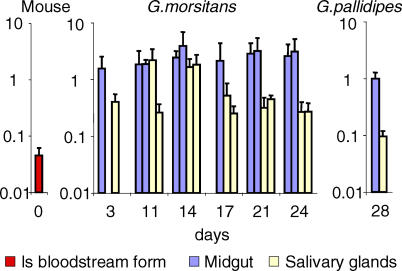
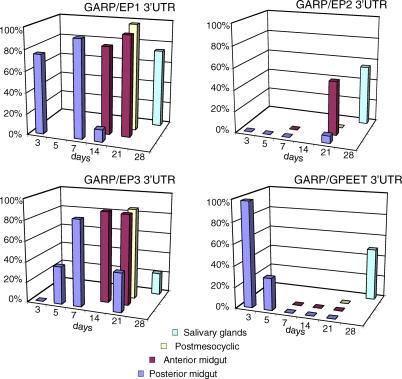
Trypanosoma brucei, the parasite causing human sleeping sickness, relies on the tsetse fly for its transmission. In the insect, EP and GPEET procyclins are the major surface glycoproteins of procyclic (midgut) forms of the parasite, with GPEET predominating in the early procyclic form and two isoforms of EP in the late procyclic form. EP procyclins were previously detected on salivary gland trypanosomes, presumably epimastigotes, by immunoelectron microscopy. However, no procyclins could be detected by mass spectrometry when parasites were isolated from infected glands. We have used qualitative and quantitative RT-PCR to analyse the procyclin mRNAs expressed by trypanosomes in the tsetse midgut and salivary glands at different time points after infection. The coding regions of the three EP isoforms (EP1, EP2 and EP3) are extremely similar, but their 3' untranslated regions contain unique sequences that make it possible to assign the cDNAs amplified by this technique. With the exception of EP2, we found that the spectrum of procyclin mRNAs expressed in the midgut mirrors the protein repertoire of early and established procyclic forms. Surprisingly, procyclin mRNAs, including that of GPEET, are present at relatively high levels in salivary gland trypanosomes, although the proteins are rarely detected by immunofluorescence. Additional experiments using transgenic trypanosomes expressing reporter genes or mutant forms of procyclin point to a mechanism of translational or post-translational control, involving the procyclin coding regions, in salivary gland trypanosomes. It is widely accepted that T. brucei always has a coat of either variant surface glycoprotein or procyclin. It has been known for many years that the epimastigote form does not have a variant surface glycoprotein coat. The finding that this life cycle stage is usually negative for procyclin as well is new, and means that the paradigm will need to be revised.
Conflict of interest statement
Figures
References
-
- Imbuga MO, Osir EO, Labongo VL, Darji N, Otieno LH. Studies on tsetse midgut factors that induce differentiation of blood-stream Trypanosoma brucei in vitro. Parasitol Res. 1992;78:10–15. - PubMed
-
- Sbicego S, Vassella E, Kurath U, Blum B, Roditi I. The use of transgenic Trypanosoma brucei to identify compounds inducing the differentiation of bloodstream forms to procyclic forms. Mol Biochem Parasitol. 1999;104:311–322. - PubMed
-
- Van Den Abbeele J, Claes Y, Van Bockstaele D, Le Ray D, Coosemans M. Trypanosoma brucei spp. development in the tsetse fly: Characterization of the post-mesocyclic stages in the foregut and proboscis. Parasitology. 1999;118:469–478. - PubMed
-
- Barry JD, McCulloch R. Antigenic variation in trypanosomes: Enhanced phenotypic variation in a eukaryotic parasite. Adv Parasitol. 2001;49:1–70. - PubMed
Publication types
MeSH terms
Substances
Grants and funding
LinkOut - more resources
Full Text Sources