


Loss of PKD1 and loss of Bcl-2 elicit polycystic kidney disease through distinct mechanisms
- PMID: 16282979
- PMCID: PMC2795698
- DOI: 10.1038/sj.cdd.4401815
Loss of PKD1 and loss of Bcl-2 elicit polycystic kidney disease through distinct mechanisms
Abstract
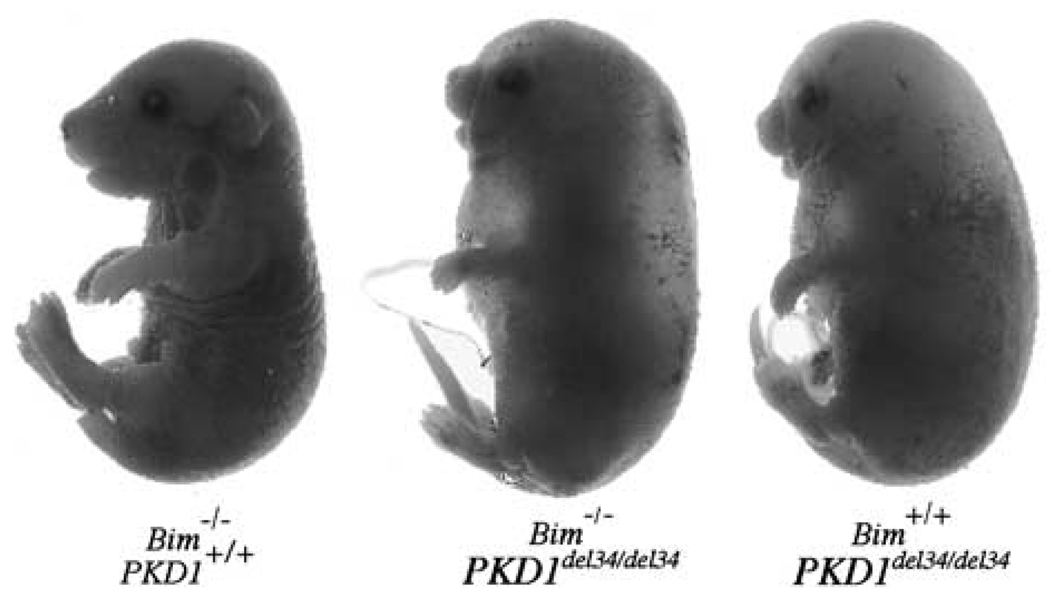
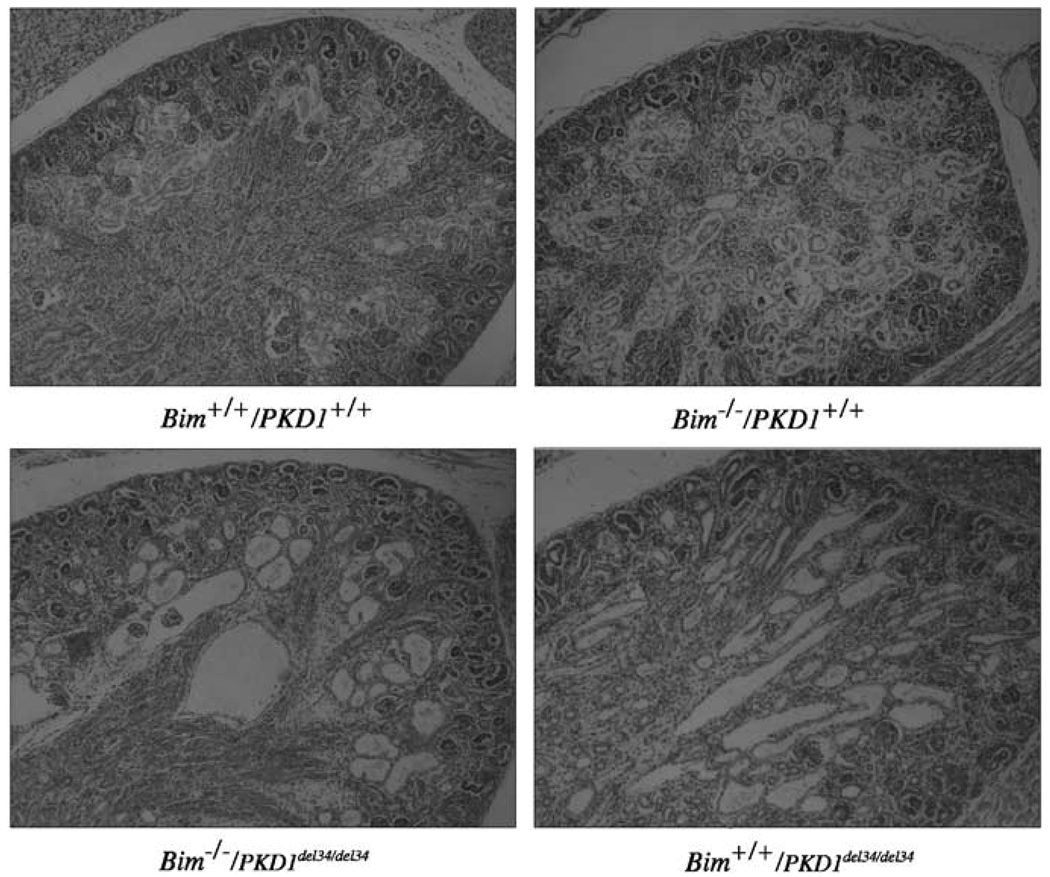
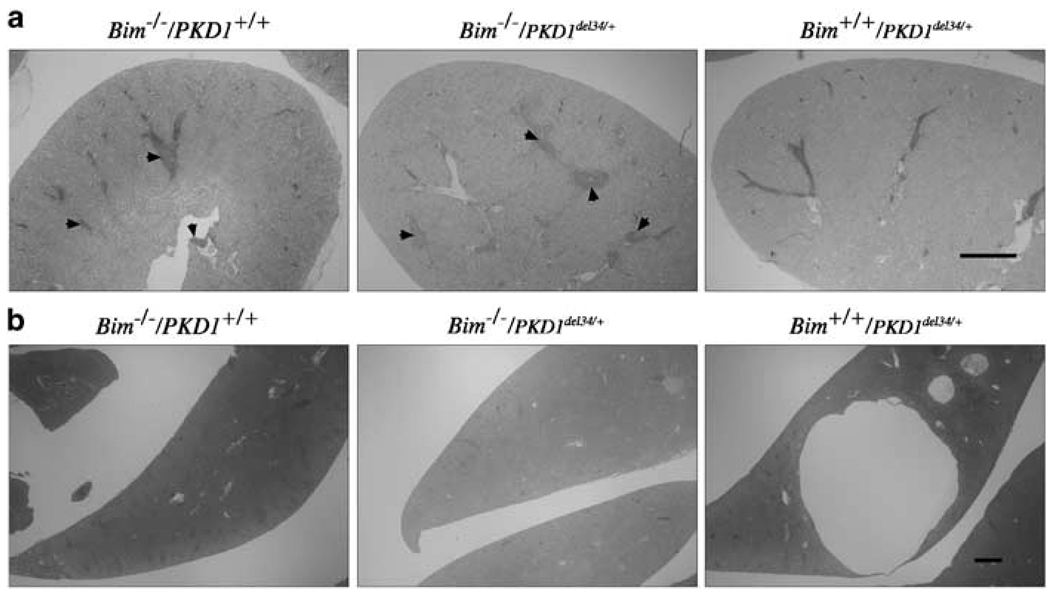
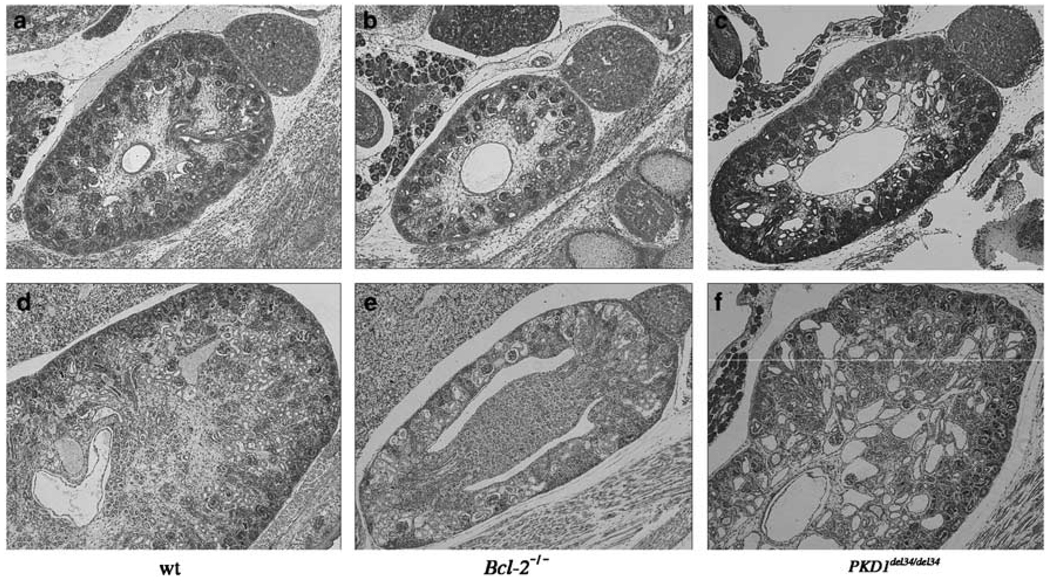
We have recently demonstrated that ablation of one or both alleles of the proapoptotic gene Bim prevents the polycystic kidney disease (PKD) that develops in mice deficient for the prosurvival protein Bcl-2. The aim of the present study was to investigate whether loss of Bim or Bcl-2 could influence the disease in the PKD1del34/del34 mutant mice, a model of autosomal dominant PKD. PKD1del34/del34 mice were intercrossed with Bim-deficient mice and Bcl-2+/- mice to generate double mutants. Loss of Bim does not prevent the development of PKD in PKD1del34/del34 mice. On the C57BL/6 genetic background, most older PKD1del34/+ mice do not develop PKD, but present with liver cysts. Surprisingly, loss of Bim completely prevented liver cysts formation in PKD1del34/+ mice. Loss of one Bcl-2 allele did not influence the PKD1del34 phenotype significantly. We conclude that loss of PKD1 and loss of Bcl-2 elicit PKD through distinct mechanisms.
Figures
References
-
- Wilson PD. Polycystic kidney disease. N. Engl. J. Med. 2004;350:151–164. - PubMed
-
- The European Polycystic Kidney Disease Consortium. The polycystic kidney disease 1 gene encodes a 14 kb transcript and lies within a duplicated region on chromosome 16. Cell. 1994;78:725. - PubMed
-
- The European Polycystic Kidney Disease Consortium. The polycystic kidney disease 1 gene encodes a 14 kb transcript and lies within a duplicated region on chromosome 16. Cell. 1994;77:881–894. - PubMed
-
- Mochizuki T, Wu G, Hayashi T, Xenophontos SL, Veldhuisen B, Saris JJ, Reynolds DM, Cai Y, Gabow PA, Pierides A, Kimberling WJ, Breuning MH, Deltas CC, Peters DJ, Somlo S. PKD2, a gene for polycystic kidney disease that encodes an integral membrane protein. Science. 1996;272:1339–1342. - PubMed
-
- Saunier S, Salomon R, Antignac C. Nephronophthisis. Curr. Opin. Genet. Dev. 2005;15:324–331. - PubMed
Publication types
MeSH terms
Substances
Grants and funding
LinkOut - more resources
Full Text Sources
Molecular Biology Databases
