. 2005 Nov 9:6:270.
doi: 10.1186/1471-2105-6-270.

Commensurate distances and similar motifs in genetic congruence and protein interaction networks in yeast

Affiliations

Commensurate distances and similar motifs in genetic congruence and protein interaction networks in yeast

Ping Ye et al. BMC Bioinformatics. .

Abstract

Background: In a genetic interaction, the phenotype of a double mutant differs from the combined phenotypes of the underlying single mutants. When the single mutants have no growth defect, but the double mutant is lethal or exhibits slow growth, the interaction is termed synthetic lethality or synthetic fitness. These genetic interactions reveal gene redundancy and compensating pathways. Recently available large-scale data sets of genetic interactions and protein interactions in Saccharomyces cerevisiae provide a unique opportunity to elucidate the topological structure of biological pathways and how genes function in these pathways.

Results: We have defined congruent genes as pairs of genes with similar sets of genetic interaction partners and constructed a genetic congruence network by linking congruent genes. By comparing path lengths in three types of networks (genetic interaction, genetic congruence, and protein interaction), we discovered that high genetic congruence not only exhibits correlation with direct protein interaction linkage but also exhibits commensurate distance with the protein interaction network. However, consistent distances were not observed between genetic and protein interaction networks. We also demonstrated that congruence and protein networks are enriched with motifs that indicate network transitivity, while the genetic network has both transitive (triangle) and intransitive (square) types of motifs. These results suggest that robustness of yeast cells to gene deletions is due in part to two complementary pathways (square motif) or three complementary pathways, any two of which are required for viability (triangle motif).

Conclusion: Genetic congruence is superior to genetic interaction in prediction of protein interactions and function associations. Genetically interacting pairs usually belong to parallel compensatory pathways, which can generate transitive motifs (any two of three pathways needed) or intransitive motifs (either of two pathways needed).


Figures
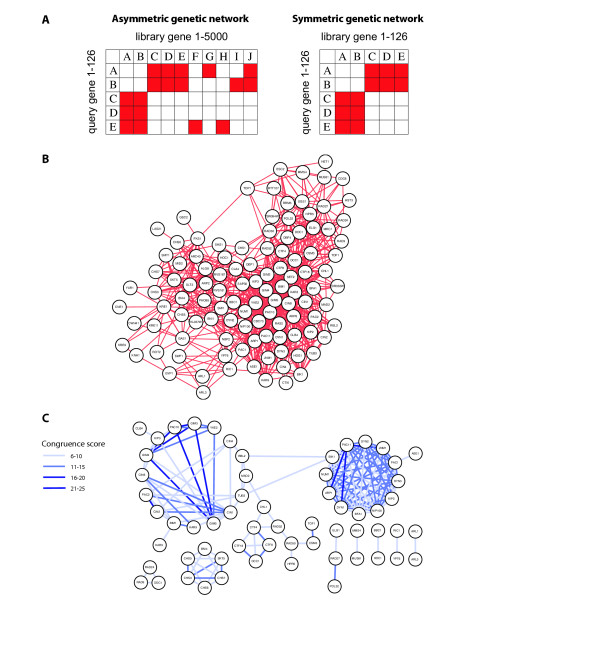
Figure 1
Figure 1
Schematic illustration of genetic and congruence networks. A. Asymmetric and symmetric genetic networks are represented in matrix form; filled squares represent observed genetic interactions. The symmetric network includes only genes used as queries. B. The symmetric genetic interaction network contains 126 genes. C. A congruence network was calculated from the symmetric genetic interaction network using a threshold congruence score of 6.
Figure 2
Figure 2
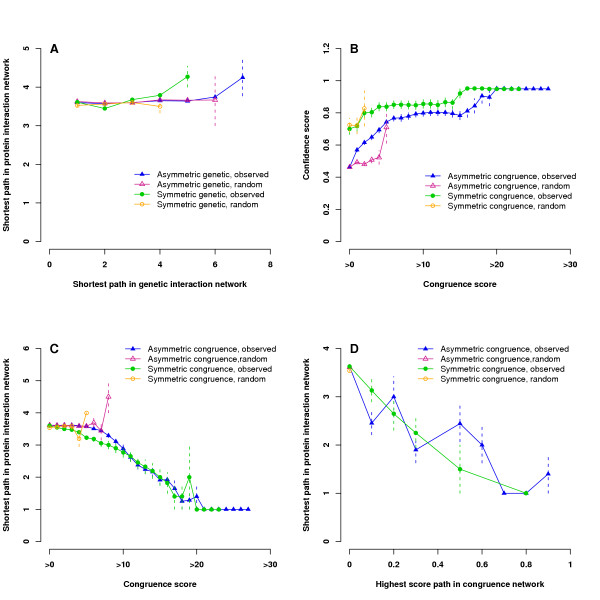
Path length comparison for genetic, congruence, and protein networks. A. There is little correlation between short paths in the genetic interaction network and short paths in the protein interaction network. B. Protein interaction confidence increases with congruence score. C. The path length in the protein network decreases monotonically with the congruence score. D. High-scoring paths in the congruence network are correlated with short distances in the protein interaction network, indicating that these networks are commensurate. Results are displayed for the observed and randomized networks. Error bars indicate one standard error. The random value if present is comparable to the observed value (P-value > 0.05).
Figure 3
Figure 3
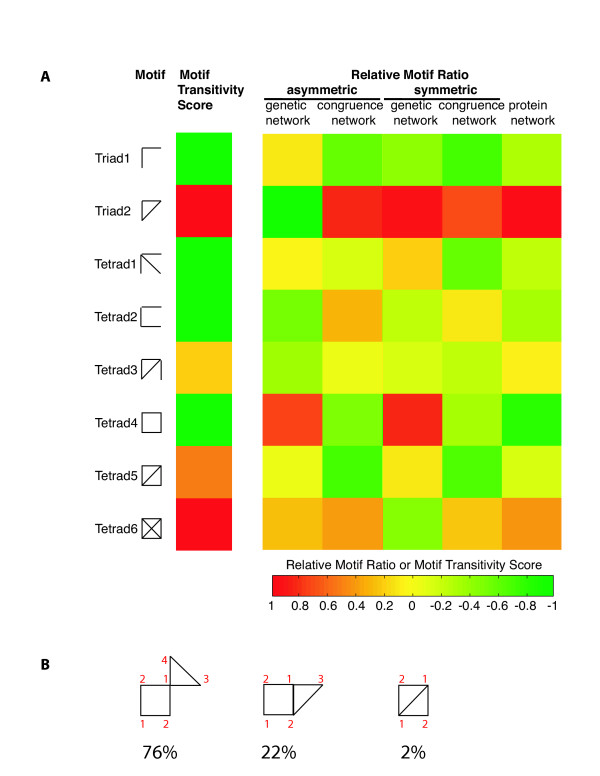
Motif characterization for genetic, congruence, and protein networks. A. Both transitive and intransitive motifs are enriched in the genetic network, tetrad4 and tetrad6 for the asymmetric network and triad2, tetrad1 and tetrad4 for the symmetric network. Only transitive motifs are enriched in congruence and protein networks, triad2 and tetrad6 for symmetric and asymmetric congruence networks, triad2, tetrad3, and tetrad6 for the protein network. Motif enrichment criteria are as defined in [17] (see Methods). B. The connections between triangle and square motifs in the symmetric genetic network. Three types of relationships exist between triangles and squares and the percentage of each scenario is labeled. The red numbers indicate individual pathways.
Figure 4
Figure 4
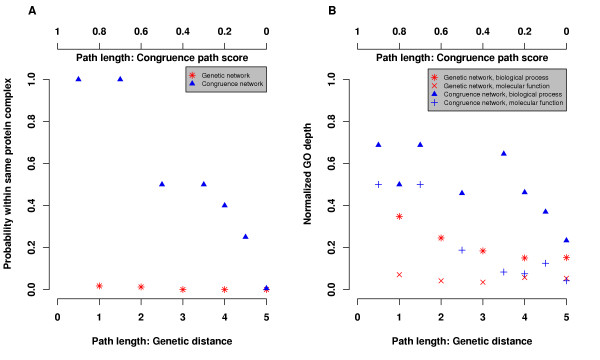
Congruence network but not genetic network predicts protein complex membership and functional association. A. Short distance in congruence network implies protein complex membership. B. Close distance in congruence network suggests similar function. GO [28] hierarchy depth is normalized to the range of 0 and 1 by [depth-min(depths)]/[max(depths)-min(depths)], where depths are calculated for each GO category, biological process and molecular function. As distance results are similar for symmetric and asymmetric networks, we only present those for the symmetric network.

References

    1. Hartman JL, Garvik B, Hartwell L. Principles for the buffering of genetic variation. Science. 2001;291:1001–1004. doi: 10.1126/science.291.5506.1001. - DOI - PubMed
    1. Tucker CL, Fields S. Lethal combinations. Nat Genet. 2003;35:204–205. doi: 10.1038/ng1103-204. - DOI - PubMed
    1. Ooi SL, Shoemaker DD, Boeke JD. DNA helicase gene interaction network defined using synthetic lethality analyzed by microarray. Nat Genet. 2003;35:277–286. doi: 10.1038/ng1258. - DOI - PubMed
    1. Pan X, Yuan DS, Xiang D, Wang X, Sookhai-Mahadeo S, Bader JS, Hieter P, Spencer F, Boeke JD. A robust toolkit for functional profiling of the yeast genome. Mol Cell. 2004;16:487–496. doi: 10.1016/j.molcel.2004.09.035. - DOI - PubMed
    1. Tong AH, Evangelista M, Parsons AB, Xu H, Bader GD, Page N, Robinson M, Raghibizadeh S, Hogue CW, Bussey H, Andrews B, Tyers M, Boone C. Systematic genetic analysis with ordered arrays of yeast deletion mutants. Science. 2001;294:2364–2368. doi: 10.1126/science.1065810. - DOI - PubMed

Publication types

MeSH terms

LinkOut - more resources