


Effects of massage on delayed-onset muscle soreness, swelling, and recovery of muscle function
- PMID: 16284637
- PMCID: PMC1250256
Effects of massage on delayed-onset muscle soreness, swelling, and recovery of muscle function
Abstract
Context: Delayed-onset muscle soreness (DOMS) describes muscle pain and tenderness that typically develop several hours postexercise and consist of predominantly eccentric muscle actions, especially if the exercise is unfamiliar. Although DOMS is likely a symptom of eccentric-exercise-induced muscle damage, it does not necessarily reflect muscle damage. Some prophylactic or therapeutic modalities may be effective only for alleviating DOMS, whereas others may enhance recovery of muscle function without affecting DOMS.
Objective: To test the hypothesis that massage applied after eccentric exercise would effectively alleviate DOMS without affecting muscle function.
Design: We used an arm-to-arm comparison model with 2 independent variables (control and massage) and 6 dependent variables (maximal isometric and isokinetic voluntary strength, range of motion, upper arm circumference, plasma creatine kinase activity, and muscle soreness). A 2-way repeated-measures analysis of variance and paired t tests were used to examine differences in changes of the dependent variable over time (before, immediately and 30 minutes after exercise, and 1, 2, 3, 4, 7, 10, and 14 days postexercise) between control and massage conditions.
Setting: University laboratory.
Patients or other participants: Ten healthy subjects (5 men and 5 women) with no history of upper arm injury and no experience in resistance training.
Intervention(s): Subjects performed 10 sets of 6 maximal isokinetic (90 degrees x s(-1)) eccentric actions of the elbow flexors with each arm on a dynamometer, separated by 2 weeks. One arm received 10 minutes of massage 3 hours after eccentric exercise; the contralateral arm received no treatment.
Main outcome measure(s): Maximal voluntary isometric and isokinetic elbow flexor strength, range of motion, upper arm circumference, plasma creatine kinase activity, and muscle soreness.
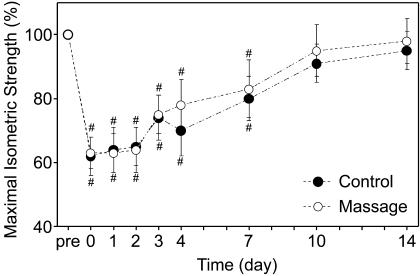
Results: Delayed-onset muscle soreness was significantly less for the massage condition for peak soreness in extending the elbow joint and palpating the brachioradialis muscle (P < .05). Soreness while flexing the elbow joint (P = .07) and palpating the brachialis muscle (P = .06) was also less with massage. Massage treatment had significant effects on plasma creatine kinase activity, with a significantly lower peak value at 4 days postexercise (P < .05), and upper arm circumference, with a significantly smaller increase than the control at 3 and 4 days postexercise (P < .05). However, no significant effects of massage on recovery of muscle strength and ROM were evident.
Conclusions: Massage was effective in alleviating DOMS by approximately 30% and reducing swelling, but it had no effects on muscle function.
Figures

Comment in
-
Appraising clinical studies: a commentary on the Zainuddin et al and Hart et al studies.J Athl Train. 2005 Jul-Sep;40(3):186-90. J Athl Train. 2005. PMID: 16284639 Free PMC article. No abstract available.
References
-
- Armstrong RB. Mechanisms of exercise-induced delayed onset muscular soreness: a brief review. Med Sci Sports Exerc. 1984;16:529–538. - PubMed
-
- Clarkson PM, Nosaka K, Braun B. Muscle function postexercise-induced muscle damage and rapid adaptation. Med Sci Sports Exerc. 1992;24:512–520. - PubMed
-
- Keskula DR. Clinical implications of eccentric exercise in sports medicine. J Sport Rehabil. 1996;5:321–329.
-
- Gulick DT, Kimura IF. Delayed-onset muscle soreness: what is it and how do we treat it? J Sport Rehabil. 1996;5:234–243.
-
- Nosaka K, Newton M, Sacco P. Delayed-onset muscle soreness does not reflect the magnitude of eccentric-exercise–induced muscle damage. Scand J Med Sci Sports. 2002;12:337–346. - PubMed
LinkOut - more resources
Full Text Sources
Medical