Local literature bias in genetic epidemiology: an empirical evaluation of the Chinese literature
- PMID: 16285839
- PMCID: PMC1285066
- DOI: 10.1371/journal.pmed.0020334
Local literature bias in genetic epidemiology: an empirical evaluation of the Chinese literature
Abstract
Background: Postulated epidemiological associations are subject to several biases. We evaluated whether the Chinese literature on human genome epidemiology may offer insights on the operation of selective reporting and language biases.
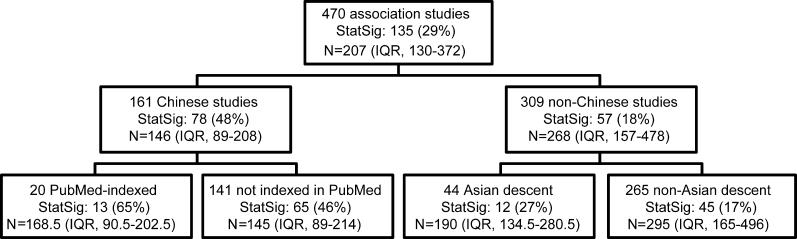
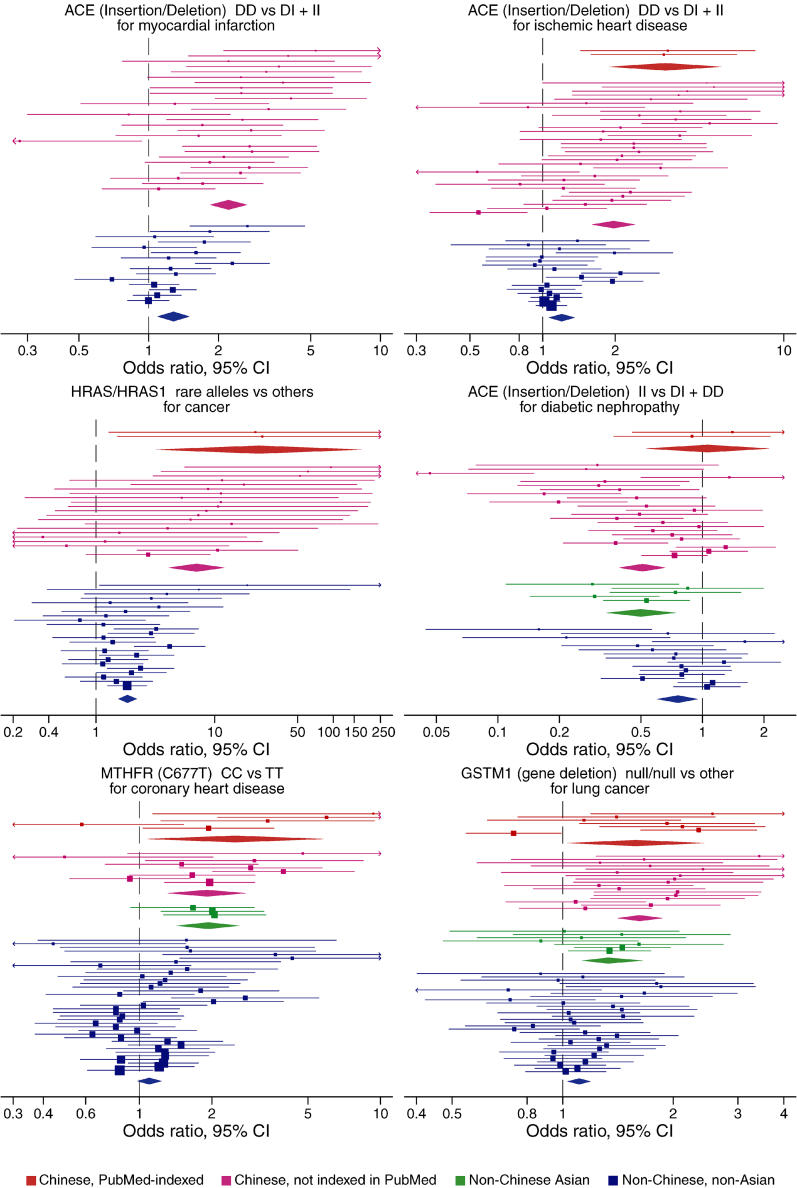
Methods and findings: We targeted 13 gene-disease associations, each already assessed by meta-analyses, including at least 15 non-Chinese studies. We searched the Chinese Journal Full-Text Database for additional Chinese studies on the same topics. We identified 161 Chinese studies on 12 of these gene-disease associations; only 20 were PubMed-indexed (seven English full-text). Many studies (14-35 per topic) were available for six topics, covering diseases common in China. With one exception, the first Chinese study appeared with a time lag (2-21 y) after the first non-Chinese study on the topic. Chinese studies showed significantly more prominent genetic effects than non-Chinese studies, and 48% were statistically significant per se, despite their smaller sample size (median sample size 146 versus 268, p < 0.001). The largest genetic effects were often seen in PubMed-indexed Chinese studies (65% statistically significant per se). Non-Chinese studies of Asian-descent populations (27% significant per se) also tended to show somewhat more prominent genetic effects than studies of non-Asian descent (17% significant per se).
Conclusion: Our data provide evidence for the interplay of selective reporting and language biases in human genome epidemiology. These biases may not be limited to the Chinese literature and point to the need for a global, transparent, comprehensive outlook in molecular population genetics and epidemiologic studies in general.
Conflict of interest statement
Figures
Comment in
-
Selection bias in meta-analyses of gene-disease associations.PLoS Med. 2005 Dec;2(12):e409. doi: 10.1371/journal.pmed.0020409. Epub 2005 Nov 22. PLoS Med. 2005. PMID: 16363911 Free PMC article.
-
Crossing the language limitations.PLoS Med. 2006 Sep;3(9):e410. doi: 10.1371/journal.pmed.0030410. PLoS Med. 2006. PMID: 17002510 Free PMC article. No abstract available.
References
-
- Gregoire G, Derderian F, Le Lorier J. Selecting the language of the publications included in a meta-analysis: is there a Tower of Babel bias? J Clin Epidemiol. 1995;48:159–163. - PubMed
-
- Egger M, Zellweger-Zahner T, Schneider M, Junker C, Lengeler C, et al. Language bias in randomised controlled trials published in English and German. Lancet. 1997;350:326–329. - PubMed
-
- Vickers A, Goyal N, Harland R, Rees R. Do certain countries produce only positive results? A systematic review of controlled trials. Control Clin Trials. 1998;19:159–166. - PubMed
-
- Juni P, Holenstein F, Sterne J, Bartlett C, Egger M. Direction and impact of language bias in meta-analyses of controlled trials: Empirical study. Int J Epidemiol. 2002;31:115–123. - PubMed
-
- Ioannidis JP. Genetic associations: False or true? Trends Mol Med. 2003;9:135–138. - PubMed
Publication types
MeSH terms
LinkOut - more resources
Full Text Sources