. 2005 Nov 21;579(28):6428-32.
doi: 10.1016/j.febslet.2005.10.036. Epub 2005 Nov 2.

Interaction between HIF-1 alpha (ODD) and hARD1 does not induce acetylation and destabilization of HIF-1 alpha

Affiliations

Interaction between HIF-1 alpha (ODD) and hARD1 does not induce acetylation and destabilization of HIF-1 alpha

Thomas Arnesen et al. FEBS Lett. .

Abstract

Hypoxia inducible factor-1 alpha (HIF-1 alpha) is a central component of the cellular responses to hypoxia. Hypoxic conditions result in stabilization of HIF-1 alpha and formation of the transcriptionally active HIF-1 complex. It was suggested that mammalian ARD1 acetylates HIF-1 alpha and thereby enhances HIF-1 alpha ubiquitination and degradation. Furthermore, ARD1 was proposed to be down-regulated in hypoxia thus facilitating the stabilization of HIF-1 alpha. Here we demonstrate that the level of human ARD1 (hARD1) protein is not decreased in hypoxia. Moreover, hARD1 does not acetylate and destabilize HIF-1 alpha. However, we find that hARD1 specifically binds HIF-1 alpha, suggesting a putative, still unclear, connection between these proteins.


Figures
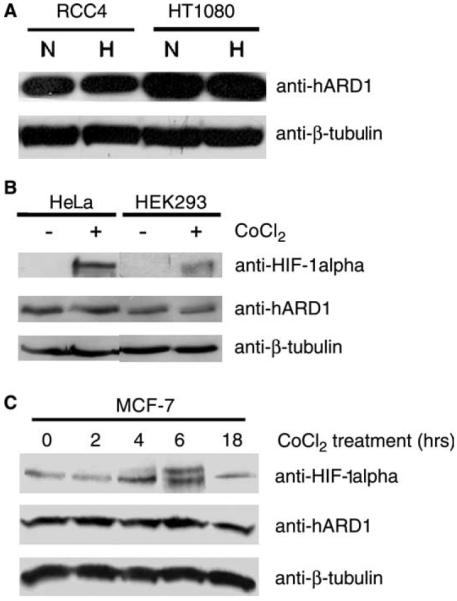
Fig. 1
Fig. 1
The level of hARD1 protein is stable during hypoxia. (A) RCC4 and HT1080 cells were exposed to either normoxia (N) or hypoxia (H) for 18 h and the cell lysates were analyzed by Western blotting with anti-hARD1. (B) As (A) using HeLa and HEK293 cells and CoCl2 treatment for 6 h. (C) As (A) adding CoCl2 for the indicated times to MCF-7 cells.
Fig. 2
Fig. 2
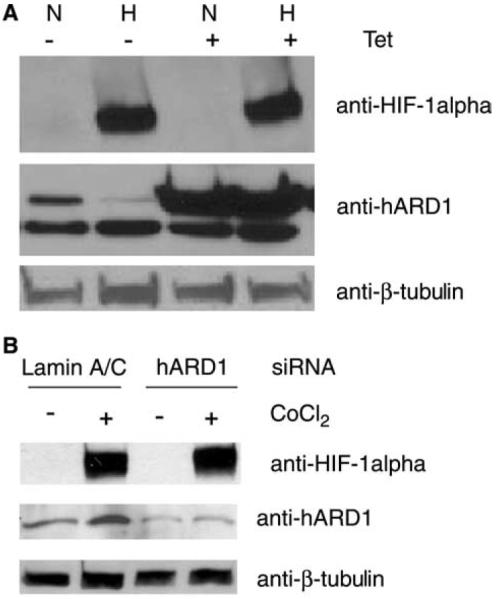
hARD1 does not regulate the stability of HIF-1α. (A) Overexpression of FLAG-hARD1 was induced in a HeLa-Tet inducible cell line under normoxic (N) or hypoxic (H) conditions. Cell lysates were analyzed by Western blotting with anti-HIF-1α. (B) hARD1 was knocked down in HeLa cells by siRNAs in the presence or absence of CoCl2. The level of HIF-1α in the cell lysates was analyzed by Western blotting.
Fig. 3
Fig. 3
hARD1 interacts with HIF-1α. (A) MCF-7 cells were cotransfected by plasmids encoding HA-HIF-1α and Xp-hARD1 (or Xp-lacZ as a negative control). Immunoprecipitates of the cell lysates using anti-Xp were analyzed by Western blotting with anti-HA to detect HA-HIF-1α. (B) GST (negative control) or GST-ODD beads were incubated with NusA-hARD1 or NusA-ABD (negative control). After washing steps, the beads were analyzed by SDS–PAGE and Coomassie staining to determine the level of retained NusA-hARD1/ABD. (C) As (B) using pure hARD1 and analysis by Western blotting and anti-hARD1.
Fig. 4
Fig. 4
hARD1 does not acetylate HIF-1α. (A) Interaction assay as Fig. 3C using GST, GST-ODD WT or GST-ODD K532R beads and acetylation buffer with indicated concentrations of Acetyl Coenzyme A (AcCoA). hARD1 retained on beads after washing was analyzed by SDS–PAGE and Western blotting with anti-hARD1. (B) Acetylation assay with GST-ODD and purified hARD1. Detection of acetylated GST-ODD by Western blotting and anti-acetyl lysine and by incorporation of [14-C] acetyl coenzyme A. Coomassie staining verifies equal loading of GST-ODD. Upper panel: Demonstration of hARD1 activity in ACTH (adrenocorticotropin 1–24) N-α-acetylation assay. (C) As (B), but with immunoprecipitated NATH–hARD1 complexes as enzyme. HeLa cellular lysates were immunoprecipitated (IP) with anti-NATH, anti-hARD1 or rabbit immunoglobulins (Ig) as a negative control.

References

    1. Marti HH. Angiogenesis – a self-adapting principle in hypoxia. EXS. 2005:163–180. - PubMed
    1. Acker T, Plate KH. Role of hypoxia in tumor angiogenesis-molecular and cellular angiogenic crosstalk. Cell Tissue Res. 2003;314:145–155. - PubMed
    1. Vaupel P. The role of hypoxia-induced factors in tumor progression. Oncologist. 2004;(Suppl. 5):10–17. - PubMed
    1. Bacon AL, Harris AL. Hypoxia-inducible factors and hypoxic cell death in tumour physiology. Ann. Med. 2004;36:530–539. - PubMed
    1. Metzen E, Ratcliffe PJ. HIF hydroxylation and cellular oxygen sensing. Biol. Chem. 2004;385:223–230. - PubMed

Publication types

Substances