. 2005 Dec;38(6):469-85.
doi: 10.1016/j.jbi.2005.08.009. Epub 2005 Oct 21.

The anatomy of decision support during inpatient care provider order entry (CPOE): empirical observations from a decade of CPOE experience at Vanderbilt

Affiliations

The anatomy of decision support during inpatient care provider order entry (CPOE): empirical observations from a decade of CPOE experience at Vanderbilt

Randolph A Miller et al. J Biomed Inform. 2005 Dec.

Abstract

The authors describe a pragmatic approach to the introduction of clinical decision support at the point of care, based on a decade of experience in developing and evolving Vanderbilt's inpatient "WizOrder" care provider order entry (CPOE) system. The inpatient care setting provides a unique opportunity to interject CPOE-based decision support features that restructure clinical workflows, deliver focused relevant educational materials, and influence how care is delivered to patients. From their empirical observations, the authors have developed a generic model for decision support within inpatient CPOE systems. They believe that the model's utility extends beyond Vanderbilt, because it is based on characteristics of end-user workflows and on decision support considerations that are common to a variety of inpatient settings and CPOE systems. The specific approach to implementing a given clinical decision support feature within a CPOE system should involve evaluation along three axes: what type of intervention to create (for which the authors describe 4 general categories); when to introduce the intervention into the user's workflow (for which the authors present 7 categories), and how disruptive, during use of the system, the intervention might be to end-users' workflows (for which the authors describe 6 categories). Framing decision support in this manner may help both developers and clinical end-users plan future alterations to their systems when needs for new decision support features arise.


Figures
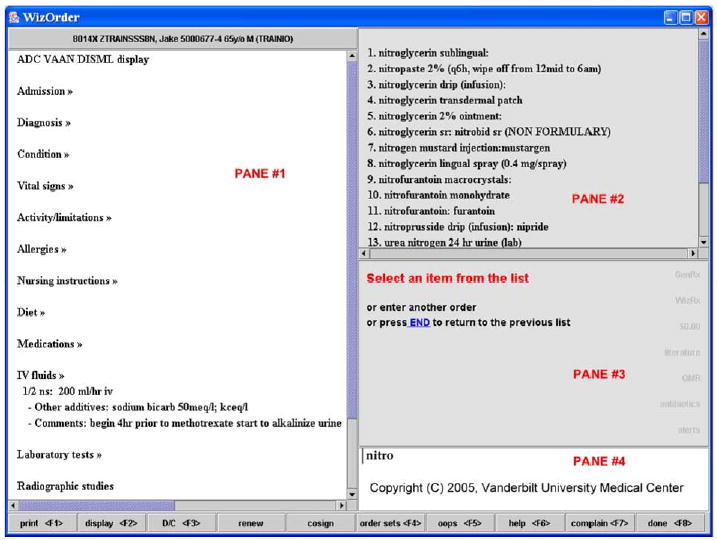
Fig. 1
Fig. 1
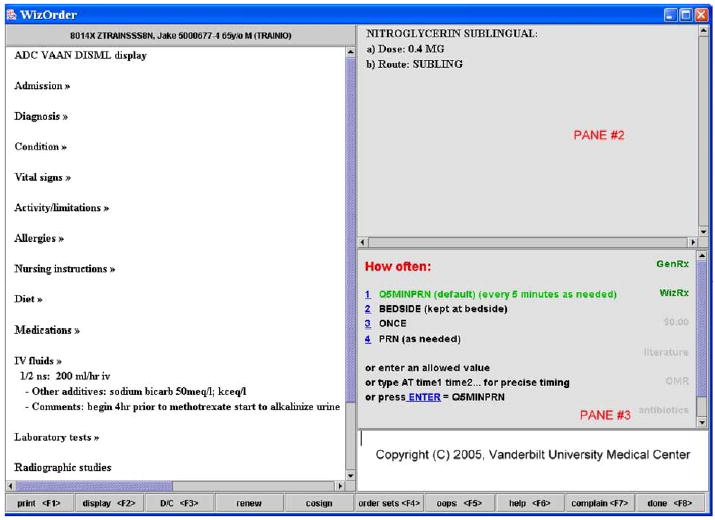
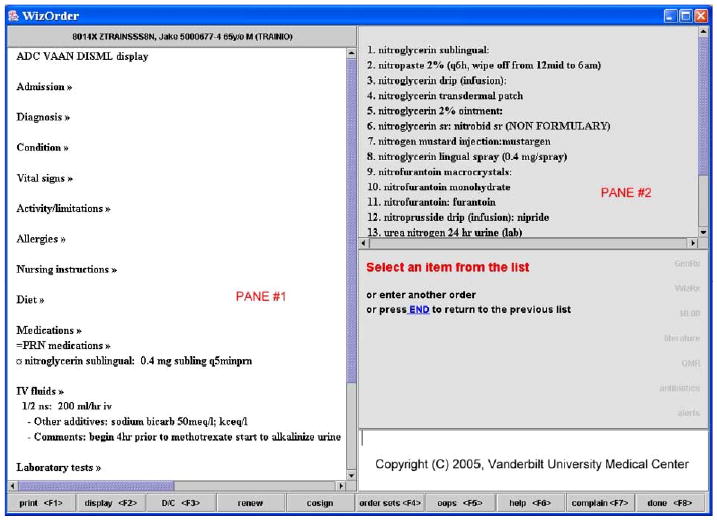
WizOrder primary user interface screen panes: #1, current and recent orders display; #2, selectable “pick list” display; #3, in-context instructions; #4, user input text entry area. User had previously typed “nitro” into completer in pane #4; pane #2 shows results.
Fig. 2
Fig. 2
Frequency prompts (medication-specific) for “nitroglycerin sublingual” orderable, after dose already specified by similar process.
Fig. 3
Fig. 3
Order for “nitroglycerin” moves to left window (pane #1) once fully completed.
Fig. 4
Fig. 4
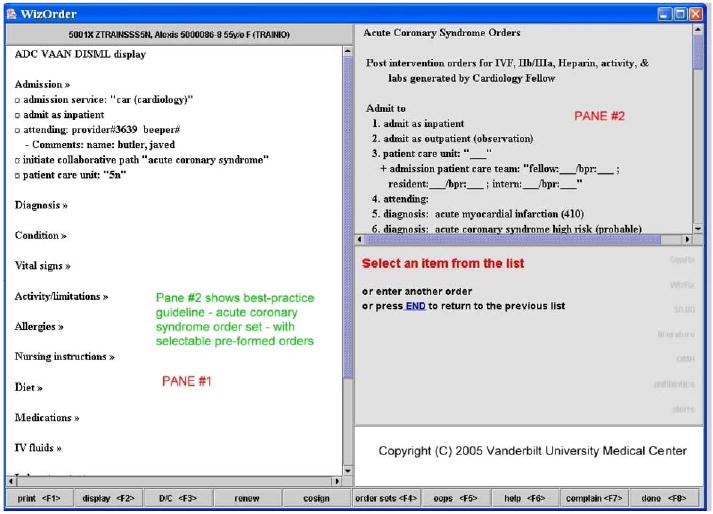
First six orders in the acute coronary syndrome orderset.
Fig. 7
Fig. 7
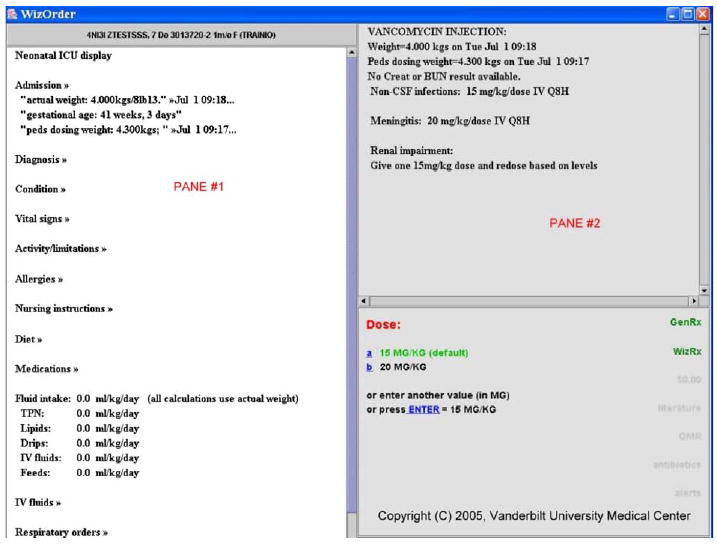
In-line recommendations for dosing vancomycin in neonatal intensive care unit (NICU) include: (A) pane #2, suggested doses for regular use, for meningitis, and for renal impairment; (B) pane #1, passive display of weight, dosing weight, and gestational age; and (C) pane #2, display of renal function test results (not available for training patient in this example).
Fig. 8
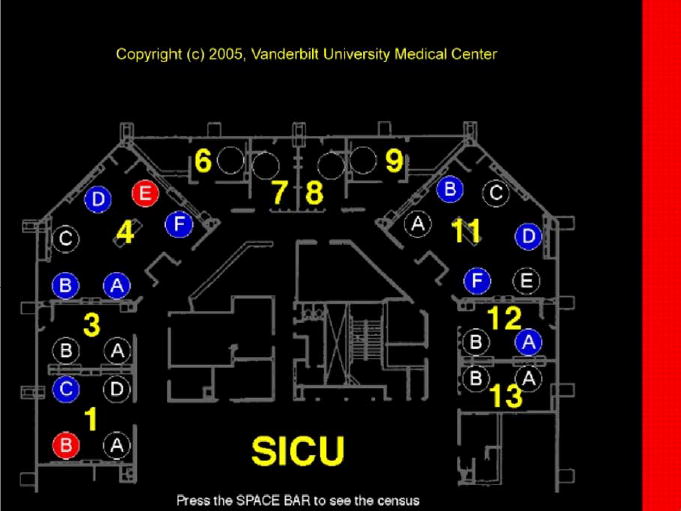
Fig. 8
CPOE “map” view of hospital ward. Map indicates beds (circles) with new, urgent “stat” (red shading in circle) orders and those with new “routine” orders (blue shading in circle); right border shading (red or blue) indicates highest priority of new orders not yet acknowledged (across all beds) by nursing staff. (For interpretation of the references to color in this figure legend, the reader is referred to the web version of this paper.)
Fig. 9
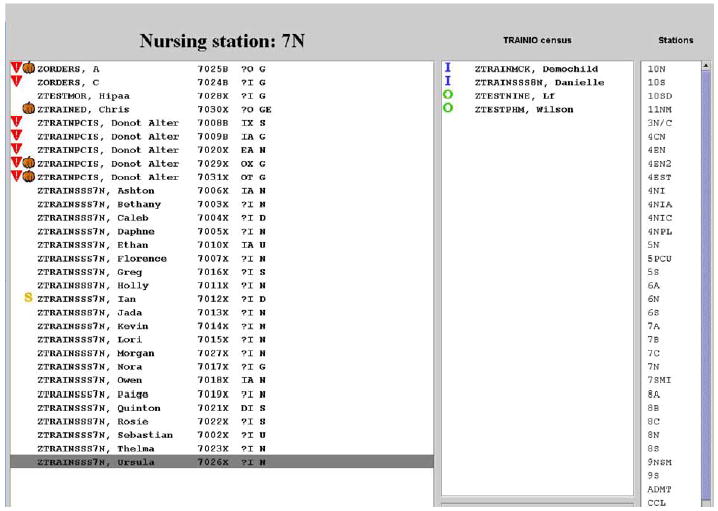
Fig. 9
“Patient list” view of CPOE ward census. Several graphical “icon” alerts (left margin next to patient name) provide useful information regarding ward census at a glance. The inverted triangles provide duplicate last name warnings; “S” indicates patients on whom medical students have entered orders that must be reviewed by a licensed MD to become “activated”; and pumpkins indicate patients who have been bedded as outpatients long enough that conversion to inpatient status (or discharge to home) should be considered.
Fig. 11
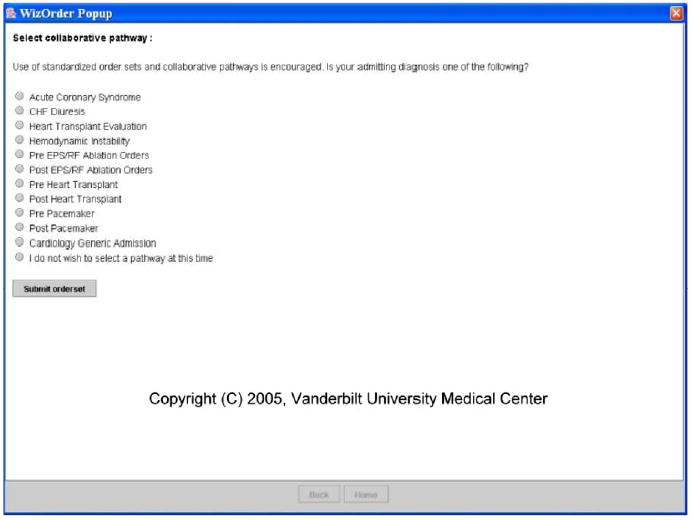
Fig. 11
Admission Wizard prompts user to select evidence-based protocol for patient when relevant to case.
Fig. 12
Fig. 12
Drug–drug interaction warning after entry of new medication name.
Fig. 14
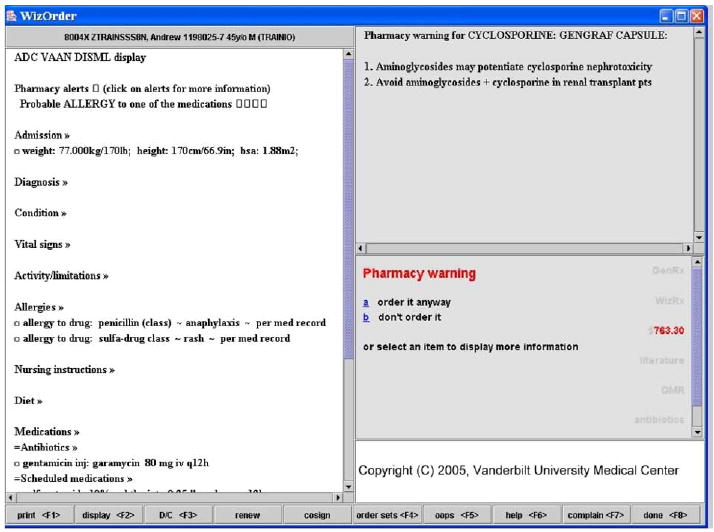
Fig. 14
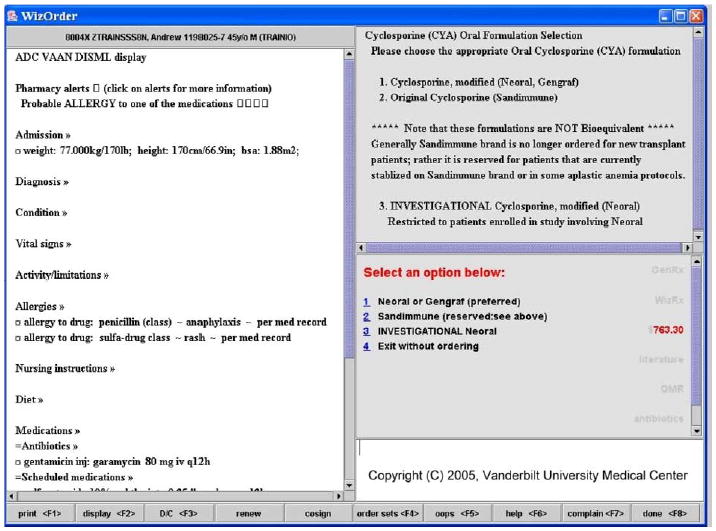
“In-line,” patient-specific, interactive advice for clinician while attempting to prescribe cyclosporine for patient; developed by experts in Pharmacy to guide clinician to best choice.
Fig. 16
Fig. 16
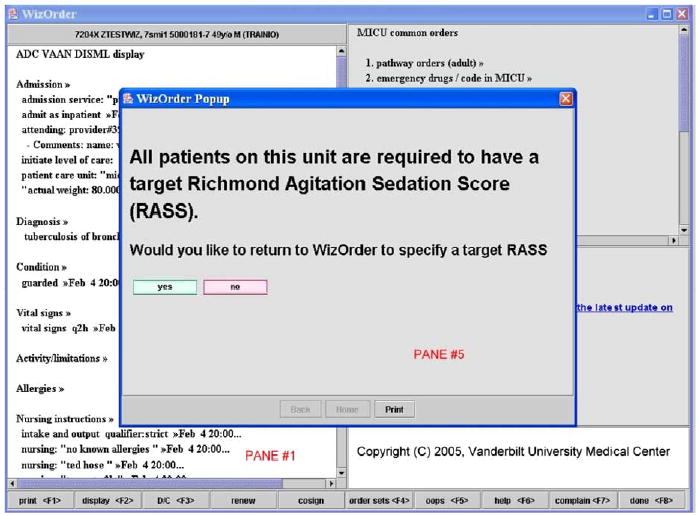
WizOrder “exit check”—on completing admission orders on an ICU patient, if the clinician-user has not specified a target RASS (Richmond Agitation Sedation Scale) score, the system uses a pop-up alert to remind the clinician that it is ICU policy to do so.
Fig. 21
Fig. 21
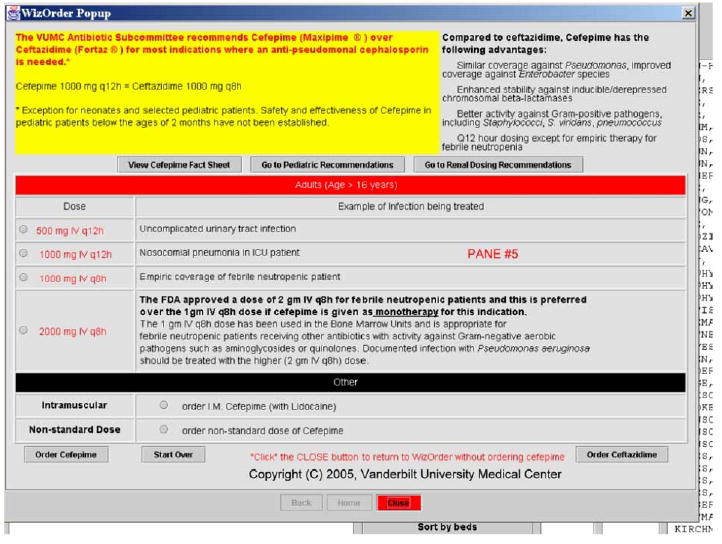
User ordered an antibiotic for which the Pharmaceuticals and Therapeutics (P&T) Committee had recommended a substitution. A variant “pop-up,” this educational advisor guides clinician through ordering alternative antibiotic. Links to “package inserts” (via buttons) detail how to prescribe recommended drug under various circumstances. A physician who knows little about the recommended drug could learn enough to prescribe it appropriately.
Fig. 22
Fig. 22
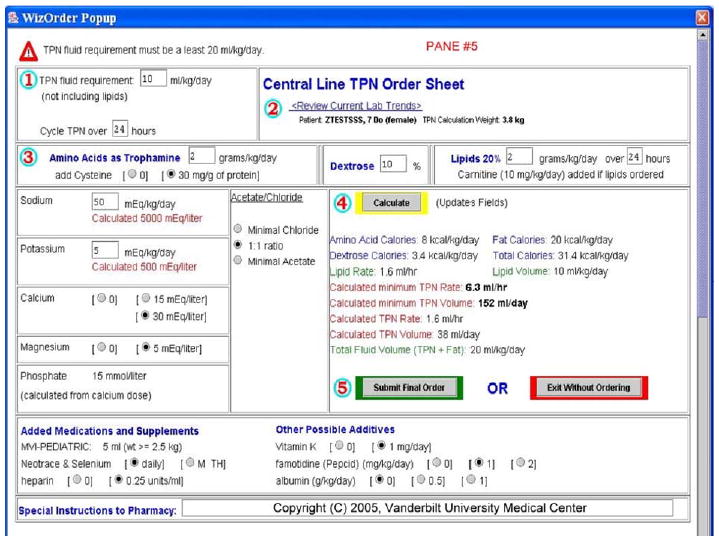
Neonatal Intensive Care Unit (NICU) Total Parenteral Nutrition (TPN) Advisor provides complex interactive advice and performs various calculations.

References

    1. Kassirer JP, Gorry GA. Clinical problem solving: a behavioral analysis. Ann Intern Med. 1978;89(2):245–55. - PubMed
    1. Covell DG, Uman GC, Manning PR. Information needs in office practice: are they being met? Ann Intern Med. 1985;103(4):596–599. - PubMed
    1. Kassirer JP, Kopelman RI. Knowledge and clinical expertise. Hosp Pract (Off Ed) 1988;23(3):46. 53, 57 passim. - PubMed
    1. Jelovsek FR, Rittwage J, Pearse WH, Visscher HC. Information management needs of the obstetrician-gynecologist—a survey. Obstet Gynecol. 1989;73(3 Pt 1):395–9. - PubMed
    1. Williamson JW, German PS, Weiss R, Skinner EA, Bowes third F. Health science information management and continuing education of physicians. A survey of U.S. primary care practitioners and their opinion leaders. Ann Intern Med. 1989;110(2):151–60. - PubMed

Publication types

LinkOut - more resources