. 2005 Dec;187(23):7901-11.
doi: 10.1128/JB.187.23.7901-7911.2005.

Increased excision of the Salmonella prophage ST64B caused by a deficiency in Dam methylase

Affiliations

Increased excision of the Salmonella prophage ST64B caused by a deficiency in Dam methylase

Ana Alonso et al. J Bacteriol. 2005 Dec.

Abstract

Salmonella enterica mutants defective in Dam methylase are strongly attenuated in virulence and release a large amount of proteins to the extracellular medium. The extent to which these two phenotypes are linked is unknown. Using a proteomic approach, we identified Sb6, Sb13, and Sb36 as proteins present in larger amounts in culture supernatants of an S. enterica serovar Typhimurium dam mutant than in those of the wild-type strain. These three proteins are encoded in the Salmonella prophage ST64B. Higher amounts of ST64B phage DNA and tailless viral capsids were also detected in supernatant extracts of the dam mutant, suggesting that Dam methylation negatively regulates the excision of ST64B. Reverse transcription-PCR analysis revealed that the expression of two ST64B genes encoding a putative antirepressor and a phage replication protein increases in the dam mutant. The SOS response also augments the excision of ST64B. Infection assays performed with phage-cured strains demonstrated that ST64B does not carry genes required for virulence in the mouse model. Evidence was also obtained discarding a relationship between the high excision of ST64B and the envelope instability or virulence attenuation phenotype. Taken together, these data indicate that ST64B excises at a high rate in dam mutants due to the loss of repression exerted by Dam on phage genes and induction of the SOS response characteristic of these mutants. The exacerbated excision of ST64B does not however contribute to the incapacity of dam mutants to cause disease.


Figures
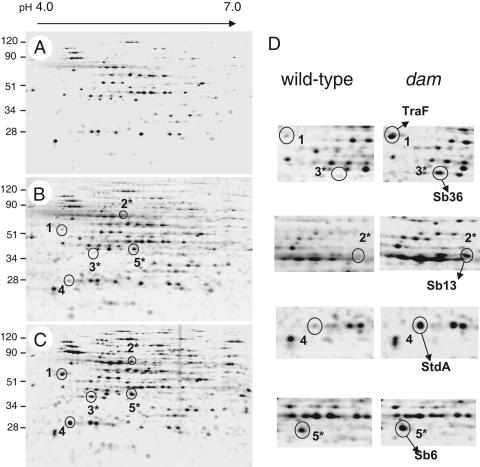
FIG. 1.
FIG. 1.
Extracellular proteins present in culture supernatants of serovar Typhimurium strains SL1344 (wild-type, dam+) and SV1610 (dam). Two-dimensional electrophoresis was applied to resolve extracellular proteins present in supernatants of the following strains and culture volumes: (A) wild-type, 10 ml; (B) wild-type, 20 ml; and (C) dam mutant, 10 ml. Bacteria were grown overnight in LB medium in static conditions at 37°C. Proteins that appeared more prominent in the samples of the dam mutant are highlighted (spots 1 to 5). Spots labeled with an asterisk (2*, 3*, and 5*) correspond to ST64B phage proteins. (D) Enlargement of the gel areas in which differences in the protein pattern were detected. Shown are the five proteins identified by peptide-mass fingerprinting. The size of the molecular weight markers is indicated in kilodaltons.
FIG. 2.
FIG. 2.
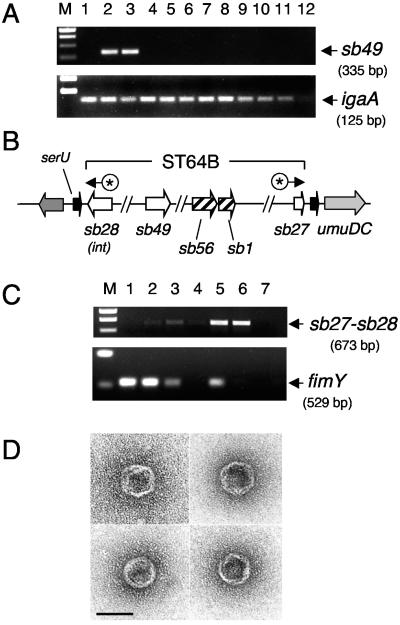
ST64B prophage presents a narrow distribution in the Salmonella genus and is induced at a high rate in dam mutants. (A) PCR-mediated amplification of products specific to the genes sb49 (ST64B phage) and igaA (present in all salmonellae). The assay was performed on DNA collected from colonies of the following Salmonella strains (lane 1) LT2; (lane 2) SL1344; (lane 3) 14028s; (lane 4) 5866; (lane 5) SARC3; (lane 6) SARC5; (lane 7) SARC7; (lane 8) SARC9; (lane 9) SARC11; (lane 10) SARC13; (lane 11) SARC15; and (lane 12) negative control (no DNA). Two of the three subspecies I serovar Typhimurium strains tested, SL1344 and 14028s, carry the ST64B prophage. See Table 1 for complete strain descriptions (B) Schematic representation of the ST64B phage genome integrated in the bacterial chromosome. Indicated with asterisks (*) are the relative positions of primers designed on sb27 and sb28 to amplify the excised form of phage DNA. (C) PCRs performed with sb27-sb28 primers in DNA template isolated from (lane 1) a colony of wild-type strain serovar Typhimurium SL1344; (lane 2) a colony of serovar Typhimurium SV1610 (dam); (lane 3) supernatant of the SL1344 culture; (lane 4) filtered supernatant of the SL1344 culture; (lane 5) supernatant of the SV1610 (dam) culture; (lane 6) filtered supernatant of the SV1610 (dam) culture; (lane 7) negative control with no DNA. As a control for the presence of chromosomal DNA, the same samples were used for PCR amplification with primers specific for the bacterial gene fimY (see Materials and Methods). Lane M, size markers. (D) ST64B phage particles seen in extracts prepared from the culture supernatant of the dam mutant. Bar, 50 nm.
FIG. 3.
FIG. 3.
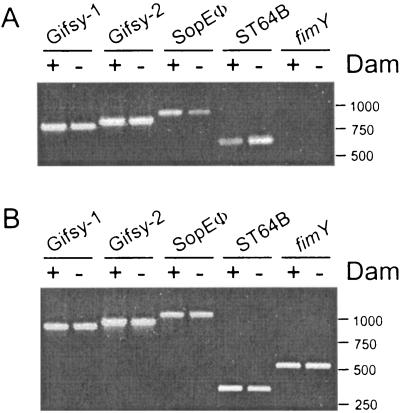
Effect of the dam mutation on the excision rate of different Salmonella prophages. Shown is the PCR-mediated amplification of products specific to genes of the following prophages: Gifsy-1 (xis gene, product size 785 bp); Gifsy-2 (sodC1 gene, product size 856 bp); SopEΦ (panel A, sopE gene, product size 1,042 bp); and ST64B (sb27-sb28 product of size 673 bp; and panel B, sb49 gene product of size 335 bp). As a control, a product specific for a bacterial gene fimY (product size 529 bp), was included for comparison. (A) Samples prepared from culture supernatant; (B) samples prepared from bacteria grown on plates. The strains used were SL1344 (wild-type, dam+) and SV1610 (dam). The assay was repeated two times with identical results.
FIG. 4.
FIG. 4.
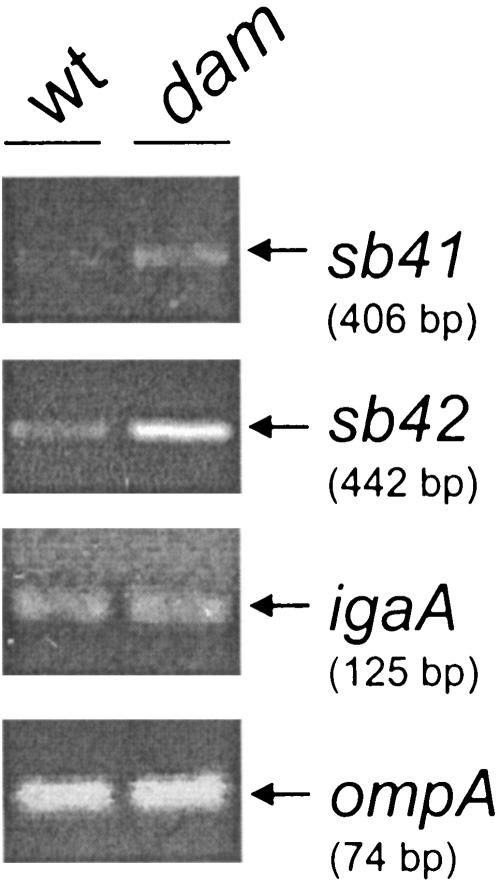
Increased expression of the ST64B genes sb41 and sb42 in dam mutants. Total RNA was extracted from SL1344 (wild type) and SV1610 (dam) bacteria grown to exponential phase in LB medium at 37°C (final OD600 of ∼0.3) and further subjected to an RT-PCR with primers specific to the ST64B genes sb41 and sb42. These two genes encode functions related to phage induction. The expression of two bacterial genes, ompA and igaA, was also monitored for comparison. The size of each amplicon is indicated. The assay was repeated three times with similar results.
FIG. 5.
FIG. 5.
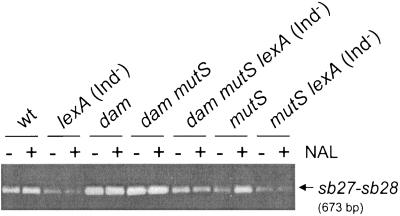
SOS response augments the excision rate of the ST64B prophage. A series of isogenic strains defective for Dam methylase or induction of the SOS response were used to monitor the excision rate of ST64B. Bacteria were collected in logarithmic exponential phase after 4 h of growth in LB medium (final OD600 of ∼0.3). A culture in parallel of each of the strains was also incubated for the same period of time in the presence of 1 μg ml−1 nalidixic acid (NAL). No changes in the final OD600 were registered in untreated versus treated cultures. Shown is the PCR product specific to the excised form of the ST64B genome (sb27-sb28 amplicon) detected in samples of culture supernatants. This series of isogenic strains was constructed in the 14028s genetic background (see Table 1 for details). The assay was repeated three times with similar results.
FIG. 6.
FIG. 6.
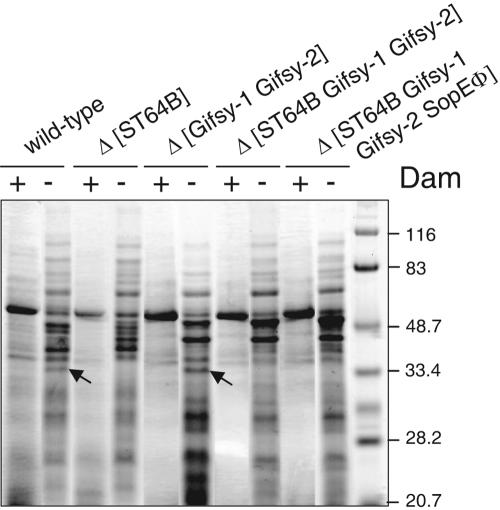
Increased excision of ST64B does not contribute to the phenotype of envelope instability of dam mutants. Protein extracts were prepared from culture supernatants of the following isogenic strains: SL1344, wild type; SV1610, dam; MD1104, Δ[ST64B]; MD1202, Δ[ST64B] dam; MA6247, Δ[Gifsy-1 Gifsy-2]; MD1203, Δ[Gifsy-1 Gifsy-2] dam; MA7551, Δ[ST64B Gifsy-1 Gifsy-2]; MD1201, Δ[ST64B Gifsy-1 Gifsy-2] dam; MA7891, Δ[ST64B Gifsy-1 Gifsy-2 SopEΦ]; and MD0200, Δ[ST64B Gifsy-1 Gifsy-2 SopEΦ] dam. Bacteria were grown overnight in LB medium at 37°C in static conditions. The amount loaded per lane corresponded to the same number of bacteria (2 × 10⁹). The sizes of the prestained molecular weight markers are indicated in kilodaltons. Arrows highlight a prominent protein that is only observed in dam mutants carrying the ST64B prophage. The assay was repeated three times with similar results.

References

    1. Allison, G. E., D. Angeles, N. Tran-Dinh, and N. K. Verma. 2002. Complete genomic sequence of SfV, a serotype-converting temperate bacteriophage of Shigella flexneri. J. Bacteriol. 184:1974-1987. - PMC - PubMed
    1. Arnold, H. P., U. Ziese, and W. Zillig. 2000. SNDV, a novel virus of the extremely thermophilic and acidophilic archaeon Sulfolobus. Virology 272:409-416. - PubMed
    1. Baranyi, U., R. Klein, W. Lubitz, D. H. Kruger, and A. Witte. 2000. The archaeal halophilic virus-encoded Dam-like methyltransferase M. phiCh1-I methylates adenine residues and complements dam mutants in the low salt environment of Escherichia coli. Mol. Microbiol. 35:1168-1179. - PubMed
    1. Beuzon, C. R., and D. W. Holden. 2001. Use of mixed infections with Salmonella strains to study virulence genes and their interactions in vivo. Microbes Infect. 3:1345-1352. - PubMed
    1. Beveridge, T. J. 1999. Structures of gram-negative cell walls and their derived membrane vesicles. J. Bacteriol. 181:4725-4733. - PMC - PubMed

Publication types

MeSH terms

Substances

LinkOut - more resources