


Imputation of missing data when measuring physical activity by accelerometry
- PMID: 16294118
- PMCID: PMC2435061
- DOI: 10.1249/01.mss.0000185651.59486.4e
Imputation of missing data when measuring physical activity by accelerometry
Abstract
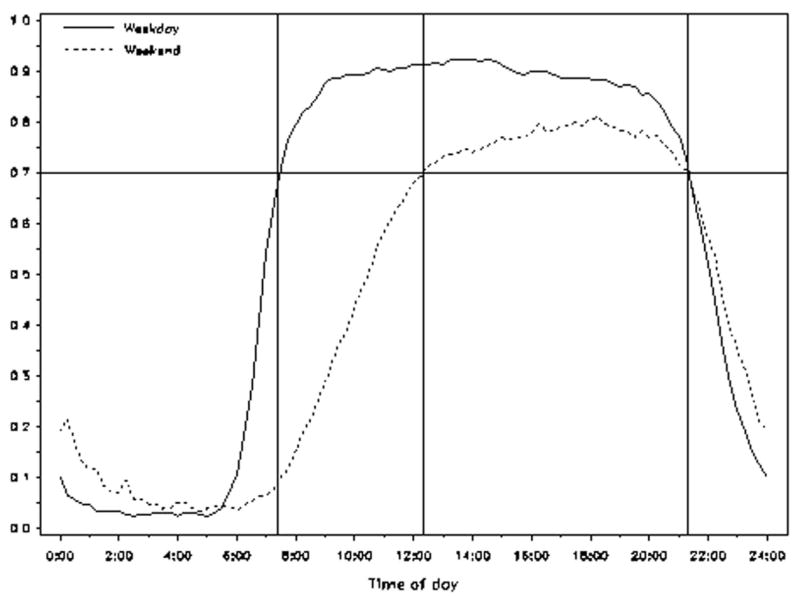
Purpose: We consider the issue of summarizing accelerometer activity count data accumulated over multiple days when the time interval in which the monitor is worn is not uniform for every subject on every day. The fact that counts are not being recorded during periods in which the monitor is not worn means that many common estimators of daily physical activity are biased downward.
Methods: Data from the Trial for Activity in Adolescent Girls (TAAG), a multicenter group-randomized trial to reduce the decline in physical activity among middle-school girls, were used to illustrate the problem of bias in estimation of physical activity due to missing accelerometer data. The effectiveness of two imputation procedures to reduce bias was investigated in a simulation experiment. Count data for an entire day, or a segment of the day were deleted at random or in an informative way with higher probability of missingness at upper levels of body mass index (BMI) and lower levels of physical activity.
Results: When data were deleted at random, estimates of activity computed from the observed data and those based on a data set in which the missing data have been imputed were equally unbiased; however, imputation estimates were more precise. When the data were deleted in a systematic fashion, the bias in estimated activity was lower using imputation procedures. Both imputation techniques, single imputation using the EM algorithm and multiple imputation (MI), performed similarly, with no significant differences in bias or precision.
Conclusions: Researchers are encouraged to take advantage of software to implement missing value imputation, as estimates of activity are more precise and less biased in the presence of intermittent missing accelerometer data than those derived from an observed data analysis approach.
Figures
References
-
- Cooper AR, Page AS, Foster LJ, Qahwaji D. Commuting to school: are children who walkmore physically active? Am J Prev Med. 2003;25:273–276. - PubMed
-
- Dempster AP, Laird NM, Rubin DB. Maximum likelihood from incomplete data via the EM algorithm. J R Stat Soc Series B. 1977;39:1–38.
-
- Donner A. The relative effectiveness of procedures commonly used in multiple regression analysis for dealing with missing values. Am Stat. 1982;36:378–381.
-
- Epstein LH, Paluch RA, Coleman KJ, Vito D, Anderson K. Determinants of physical activity in obese children assessed by accelerometer and self-report. Med Sci Sports Exerc. 1996;28:1157–1164. - PubMed
-
- Gmel G. Imputation of missing values in the case of a multiple item instrument measuring alcohol consumption. Stat Med. 2001;20:2369–2381. - PubMed
Publication types
MeSH terms
Grants and funding
- U01HL66845/HL/NHLBI NIH HHS/United States
- U01HL66855/HL/NHLBI NIH HHS/United States
- U01HL66857/HL/NHLBI NIH HHS/United States
- U01 HL066855/HL/NHLBI NIH HHS/United States
- U01 HL066858/HL/NHLBI NIH HHS/United States
- U01 HL066856/HL/NHLBI NIH HHS/United States
- U01HL66858/HL/NHLBI NIH HHS/United States
- U01 HL066845/HL/NHLBI NIH HHS/United States
- U01HL66852/HL/NHLBI NIH HHS/United States
- U01HL66856/HL/NHLBI NIH HHS/United States
- U01 HL066852/HL/NHLBI NIH HHS/United States
- U01 HL066853/HL/NHLBI NIH HHS/United States
- U01 HL066857/HL/NHLBI NIH HHS/United States
- U01HL66853/HL/NHLBI NIH HHS/United States
