. 2006 Jan 20;281(3):1309-12.
doi: 10.1074/jbc.C500405200. Epub 2005 Nov 18.

Regulation through the RNA polymerase secondary channel. Structural and functional variability of the coiled-coil transcription factors

Affiliations

Regulation through the RNA polymerase secondary channel. Structural and functional variability of the coiled-coil transcription factors

Jindrich Symersky et al. J Biol Chem. .

Abstract

Gre factors enhance the intrinsic endonucleolytic activity of RNA polymerase to rescue arrested transcription complexes and are thought to confer the high fidelity and processivity of RNA synthesis. The Gre factors insert the extended alpha-helical coiled-coil domains into the RNA polymerase secondary channel to position two invariant acidic residues at the coiled-coil tip near the active site to stabilize the catalytic metal ion. Gfh1, a GreA homolog from Thermus thermophilus, inhibits rather than activates RNA cleavage. Here we report the structure of the T. thermophilus Gfh1 at 2.4 A resolution revealing a two-domain architecture closely resembling that of GreA. However, the interdomain orientation is strikingly distinct (approximately 162 degrees rotation) between the two proteins. In contrast to GreA, which has two acidic residues on a well fixed self-stabilized alpha-turn, the tip of the Gfh1 coiled-coil is flexible and contains four acidic residues. This difference is likely the key to the Gre functional diversity, while Gfh1 inhibits exo- and endonucleolytic cleavage, RNA synthesis, and pyrophosphorolysis, GreA enhances only the endonucleolytic cleavage. We propose that Gfh1 acidic residues stabilize the RNA polymerase active center in a catalytically inactive configuration through Mg2+-mediated interactions. The excess of the acidic residues and inherent flexibility of the coiled-coil tip might allow Gfh1 to adjust its activity to structurally distinct substrates, thereby inhibiting diverse catalytic reactions of RNA polymerase.


Figures
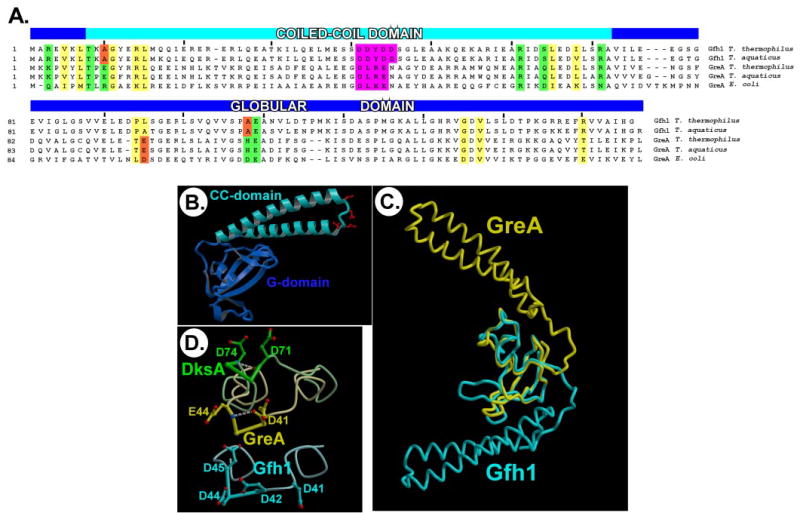
FIGURE 1
FIGURE 1. The Gfh1 structure and comparison with GreA and DksA
A, alignment of the Gfh1 and GreA sequences. The residues with conserved chemical properties among Gfh1 and GreA sequences that might thus form the Gfh1-like (hydrophobic) and GreA-like (”polar“) interface in both protein families are marked with yellow and green boxes, respectively, whereas the unfavorable substitutions in both Gfh1 and GreA are outlined by red boxes. The potentially functionally crucial segments at the tip of the CC-domains are highlighted with magenta. B, the structure of the Gfh1 protein. The acidic side chains at the CC tip are shown in red. C, the Gfh1 and GreA structures superimposed by the G-domains. D, the CC tips of DksA (green), GreA (yellow), and Gfh1 (cyan). DksA and GreA are superimposed by the CC-domains, and the Gfh1 CC tip is shown in a similar orientation. The hydrogen bonds stabilizing the α-turns in GreA, and DksA are shown as white dashed lines.
FIGURE 2
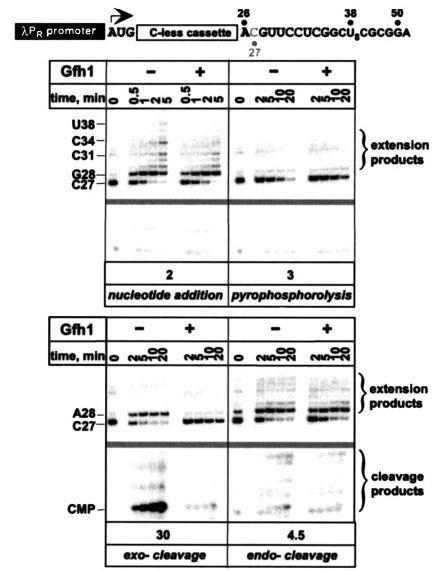
FIGURE 2. Gfh1 inhibits all catalytic activities of T. thermophilus RNAP
Top, transcript generated from the λPR promoter on pIA253; transcriptional start site is indicated by an arrow and is followed by a 26-nucleotide C-less cassette. Bottom, halted unlabeled A26 TECs were purified through G50 columns (Amersham Biosciences) and incubated with [α-32P]CTP to form 3′-end-labeled C27 TECs. C27 complexes were incubated at 37 °C with 200 nm UTP and GTP (nucleotide addition), 10 μm PPi (pyrophosphorolysis), 500 μm ATP, and 8 mm MnCl2 (exo-cleavage) or at 55 °C (endo-cleavage). Gfh1 was added to 500 nm where indicated. Aliquots were withdrawn at times indicated above each panel, quenched with 5 m urea, 10 mm EDTA, and separated on a 13% denaturing urea-acryl-amide (19:1) gel. The portion of the gel lacking radioactive signals (between the C27 and the cleavage products) was deleted to conserve space (gray bar). Gfh1 inhibitory effect (-fold, shown below each panel) on each catalytic reaction was determined by comparing the rate of reaction in the absence to that in the presence of Gfh1. For nucleotide addition, accumulation of C34 RNA species was quantified. PPi cleavage was measured by the disappearance of the labeled C27 RNA (shorter RNA fragments are not labeled). Endo- and exo- digestion was monitored by the accumulation of the corresponding cleavage products (CMP in case of the exo-nucleolytic cleavage). A representative gel is shown; the experiment was repeated at least three times for each reaction.
FIGURE 3
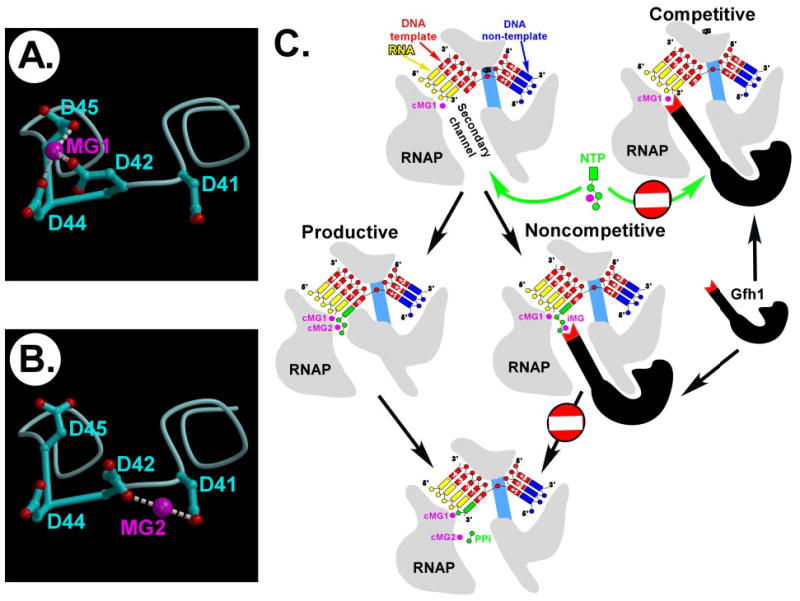
FIGURE 3. Proposed mechanisms of the Gfh1 action
A and B, the flexibility and the number of the acidic residues at the CC tip of Gfh1 allow for the alternative binding (MG1 or MG2) of the Mg2+ ions. C, two hypothetical pathways (competitive and noncompetitive) by which the Gfh1 protein may inhibit nucleotide addition. cMg1 and cMg2 are the two catalytic metals, whereas iMg is a putative inhibitory Mg2+ ion.

References

    1. Rozovskaia T, Chenchik A, Bibilashvili R. Mol Biol (Mosk) 1981;15:636–652. - PubMed
    1. Borukhov S, Sagitov V, Goldfarb A. Cell. 1993;72:459–466. - PubMed
    1. Sosunov V, Sosunova E, Mustaev A, Bass I, Nikiforov V, Goldfarb A. EMBO J. 2003;22:2234–2244. - PMC - PubMed
    1. Steitz TA. Nature. 1998;391:231–232. - PubMed
    1. Adelman K, Yuzenkova J, La Porta A, Zenkin N, Lee J, Lis JT, Borukhov S, Wang MD, Severinov K. Mol Cell. 2004;14:753–762. - PubMed

Publication types

Substances

Associated data

LinkOut - more resources