


Synergistic effect of Nod1 and Nod2 agonists with toll-like receptor agonists on human dendritic cells to generate interleukin-12 and T helper type 1 cells
- PMID: 16299289
- PMCID: PMC1307098
- DOI: 10.1128/IAI.73.12.7967-7976.2005
Synergistic effect of Nod1 and Nod2 agonists with toll-like receptor agonists on human dendritic cells to generate interleukin-12 and T helper type 1 cells
Abstract
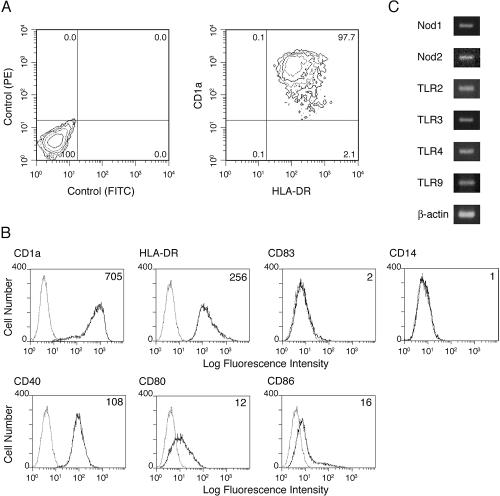
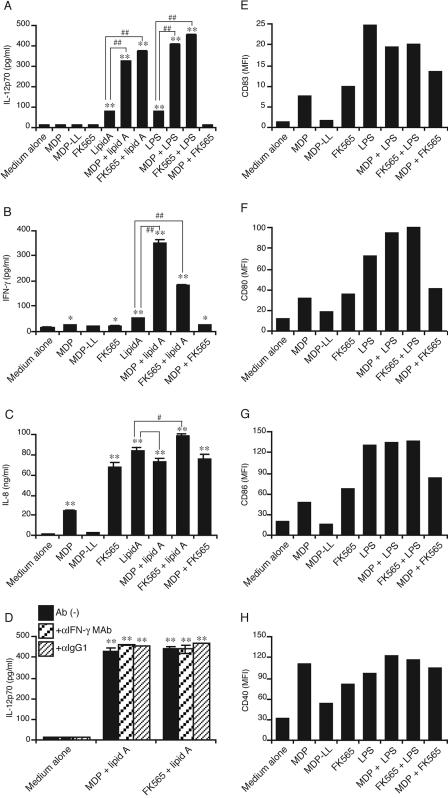
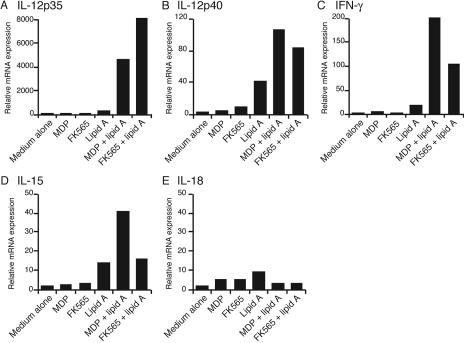
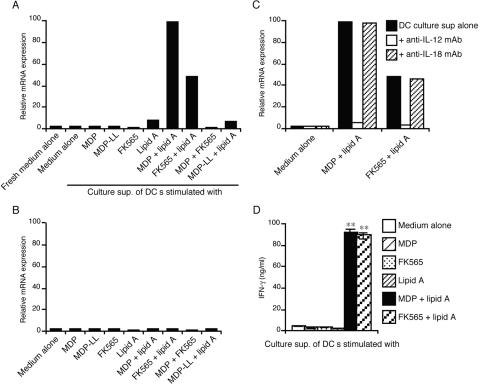
A synthetic Nod2 agonist, muramyldipeptide (MDP), and two Nod1 agonists, FK565 and FK156, mimic the bacterial peptidoglycan moiety and are powerful adjuvants that induce cell-mediated immunity, especially delayed-type hypersensitivity. In this study, we used human dendritic cell (DC) cultures to examine possible T helper type 1 (Th1) responses induced by MDP and FK565/156 in combination with various synthetic Toll-like receptor (TLR) agonists, including synthetic lipid A (TLR4 agonist), the synthetic triacyl lipopeptide Pam3CSSNA (TLR2 agonist), poly(I:C) (TLR3 agonist), and CpG DNA (TLR9 agonist). Immature DCs derived from human monocytes expressed mRNAs for Nod1, Nod2, TLR2, TLR3, TLR4, and TLR9. The stimulation of DCs with MDP and FK565 in combination with lipid A, poly(I:C), and CpG DNA, but not with Pam3CSSNA, synergistically induced interleukin-12 (IL-12) p70 and gamma interferon (IFN-gamma), but not IL-18, in culture supernatants and induced IL-15 on the cell surface. In correlation with the cytokine induction, an upregulation of the mRNA expression of these cytokine genes was observed. Notably, IL-12 p35 mRNA expression increased >1,000-fold upon stimulation with lipid A plus either MDP or FK565 compared with stimulation with each stimulant alone. In contrast, for the expression of CD83 and costimulatory molecules such as CD40, CD80, and CD86, no synergistic effects were observed upon stimulation with Nod plus TLR agonists. The culture supernatants of DCs stimulated with lipid A plus either MDP or FK565 activated human T cells to produce high levels of IFN-gamma, and the activity was attributable to DC-derived IL-12. These findings suggest that Nod1 and Nod2 agonists in combination with TLR3, TLR4, and TLR9 agonists synergistically induce IL-12 and IFN-gamma production in DCs to induce Th1-lineage immune responses.
Figures

References
-
- Adam, A. 1985. Synthetic adjuvants. John Wiley & Sons, New York, N.Y.
-
- Agrawal, S., A. Agrawal, B. Doughty, A. Gerwitz, J. Blenis, T. Van Dyke, and B. Pulendran. 2003. Different Toll-like receptor agonists instruct dendritic cells to induce distinct Th responses via differential modulation of extracellular signal-regulated kinase-mitogen-activated protein kinase and c-Fos. J. Immunol. 171:4984-4989. - PubMed
-
- Askew, D., R. S. Chu, A. M. Krieg, and C. V. Harding. 2000. CpG DNA induces maturation of dendritic cells with distinct effects on nascent and recycling MHC-II antigen-processing mechanisms. J. Immunol. 165:6889-6895. - PubMed
-
- Banchereau, J., and R. M. Steinman. 1998. Dendritic cells and the control of immunity. Nature 392:245-252. - PubMed
-
- Bessler, W. G., R. B. Johnson, K. Wiesmüller, and G. Jung. 1982. B-lymphocyte mitogenicity in vitro of a synthetic lipopeptide fragment derived from bacterial lipoprotein. Hoppe-Seyler's Z. Physiol. Chem. 363:767-770. - PubMed
Publication types
MeSH terms
Substances
LinkOut - more resources
Full Text Sources
Other Literature Sources
Research Materials
Miscellaneous
