


Whole-genome analyses of speciation events in pathogenic Brucellae
- PMID: 16299333
- PMCID: PMC1307078
- DOI: 10.1128/IAI.73.12.8353-8361.2005
Whole-genome analyses of speciation events in pathogenic Brucellae
Abstract
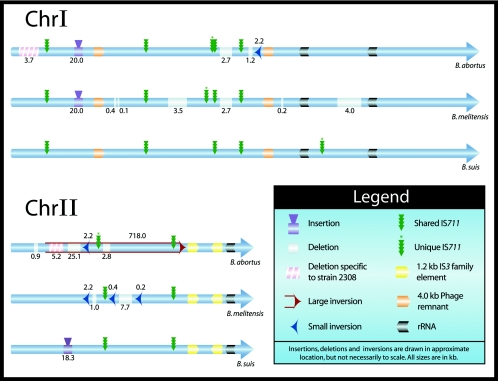
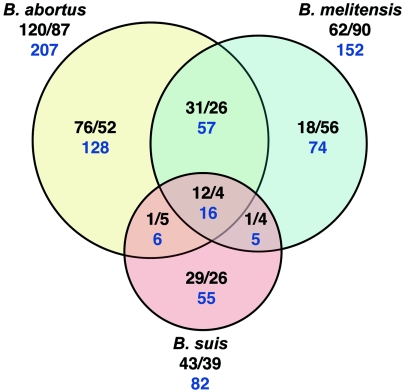
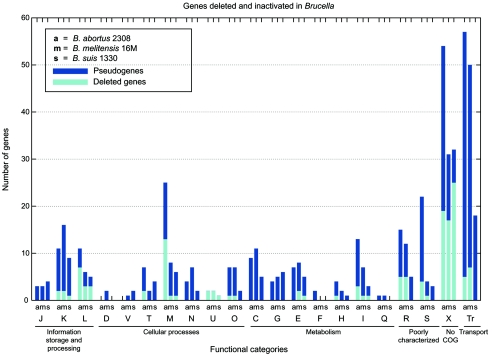
Despite their high DNA identity and a proposal to group classical Brucella species as biovars of Brucella melitensis, the commonly recognized Brucella species can be distinguished by distinct biochemical and fatty acid characters, as well as by a marked host range (e.g., Brucella suis for swine, B. melitensis for sheep and goats, and Brucella abortus for cattle). Here we present the genome of B. abortus 2308, the virulent prototype biovar 1 strain, and its comparison to the two other human pathogenic Brucella species and to B. abortus field isolate 9-941. The global distribution of pseudogenes, deletions, and insertions supports previous indications that B. abortus and B. melitensis share a common ancestor that diverged from B. suis. With the exception of a dozen genes, the genetic complements of both B. abortus strains are identical, whereas the three species differ in gene content and pseudogenes. The pattern of species-specific gene inactivations affecting transcriptional regulators and outer membrane proteins suggests that these inactivations may play an important role in the establishment of host specificity and may have been a primary driver of speciation in the genus Brucella. Despite being nonmotile, the brucellae contain flagellum gene clusters and display species-specific flagellar gene inactivations, which lead to the putative generation of different versions of flagellum-derived structures and may contribute to differences in host specificity and virulence. Metabolic changes such as the lack of complete metabolic pathways for the synthesis of numerous compounds (e.g., glycogen, biotin, NAD, and choline) are consistent with adaptation of brucellae to an intracellular life-style.
Figures
References
-
- Arellano-Reynoso, B., N. Lapaque, S. Salcedo, G. Briones, A. E. Ciocchini, R. Ugalde, E. Moreno, I. Moriyon, and J. P. Gorvel. 2005. Cyclic β-1,2-glucan is a brucella virulence factor required for intracellular survival. Nat. Immunol. 6:618-625. - PubMed
-
- Bachman, M. A., and M. S. Swanson. 2001. RpoS co-operates with other factors to induce Legionella pneumophila virulence in the stationary phase. Mol. Microbiol. 40:1201-1214. - PubMed
-
- Berg, H. C. 2003. The rotary motor of bacterial flagella. Annu. Rev. Biochem. 72:19-54. - PubMed
-
- Boschiroli, M. L., S. Ouahrani-Bettache, V. Foulongne, S. Michaux-Charachon, G. Bourg, A. Allardet-Servent, C. Cazevieille, J. P. Lavigne, J. P. Liautard, M. Ramuz, and D. O'Callaghan. 2002. Type IV secretion and Brucella virulence. Vet. Microbiol. 90:341-348. - PubMed
Publication types
MeSH terms
Substances
Associated data
- Actions
- Actions
LinkOut - more resources
Full Text Sources
Other Literature Sources
Molecular Biology Databases
