Measuring the severity of depression and remission in primary care: validation of the HAMD-7 scale
- PMID: 16301700
- PMCID: PMC1283499
- DOI: 10.1503/cmaj.050786
Measuring the severity of depression and remission in primary care: validation of the HAMD-7 scale
Erratum in
- CMAJ. 2006 Jan 17;174(2):207
Abstract
Background: Symptomatic remission is the optimal outcome in depression. A brief, validated tool for symptom measurement that can indicate when remission has occurred in mental health and primary care settings is unavailable. We evaluated a 7-item abbreviated version (HAMD-7) of the 17-item Hamilton Depression Rating Scale (HAMD-17) in a randomized controlled clinical trial of patients with major depressive disorder being cared for in primary care settings.
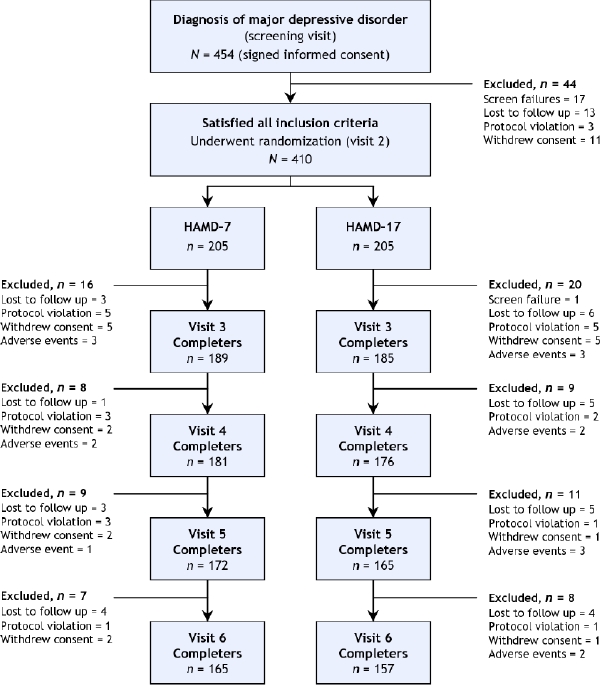
Methods: We enrolled 454 patients across 47 primary care settings who met DSM-IV-TR criteria for a major depressive disorder. Of these, 410 patients requiring antidepressant medication were randomized to have their symptoms rated with either HAMD-7 (n = 205) or HAMD-17 (n = 205) as the primary measurement tool. The primary outcome was the proportion of patients who achieved a-priori defined responses to 8 weeks of therapy using each instrument.
Results: Of the 205 participants per group, 67% of those evaluated with HAMD-7 were classified as having responded to therapy (defined as a > or = 50% reduction from the pretreatment score), compared with 74% of those evaluated with HAMD-17 (p = 0.43). The difference between the groups' changes in scores from baseline (pretreatment) to endpoint was significant (p < 0.001), without a main effect of group (p = 0.84) or group-by-time (p = 0.83) interaction. The HAMD-7 test was brief to administer (e.g., 3-4 min for 85% of the primary care physicians evaluated), which facilitated the efficient and structured evaluation of salient depressive symptoms.
Interpretation: The abbreviated HAMD-7 depression scale is equivalent to the HAMD-17 in assessing remission in patients with a major depressive disorder undergoing drug therapy.
Figures
Comment in
-
One size fits all?CMAJ. 2006 Apr 11;174(8):1132-3; author reply 1133-4. doi: 10.1503/cmaj.1060005. CMAJ. 2006. PMID: 16606963 Free PMC article. No abstract available.
References
-
- Thase ME, Sloan DM, Kornstein SG. Remission as the critical outcome of depression treatment. Psychopharmacol Bull 2002;36(4 Suppl 3):12-25. - PubMed
-
- Keller MB. Past, present, and future directions for defining optimal treatment outcome in depression: remission and beyond. JAMA 2003;289(23):3152-60. - PubMed
-
- Von Korff M, Katon W, Unutzer J, Wells K, Wagner EH. Improving depression care: barriers, solutions, and research needs. J Fam Pract 2001;50(6):E1. - PubMed
-
- Glassman AH, Shapiro PA. Depression and the course of coronary artery disease. Am J Psychiatry 1998;155(1):4-11. - PubMed
-
- Wells KB, Stewart A, Hays RD, Burnam MA, Rogers W, Daniels M, Berry S, Greenfield S, Ware J. The functioning and well-being of depressed patients: results from the Medical Outcomes Study. JAMA 1989;262(7):914-9. - PubMed
Publication types
MeSH terms
LinkOut - more resources
Full Text Sources
Miscellaneous