Treatment of Candida glabrata infection in immunosuppressed mice by using a combination of liposomal amphotericin B with caspofungin or micafungin
- PMID: 16304150
- PMCID: PMC1315958
- DOI: 10.1128/AAC.49.12.4895-4902.2005
Treatment of Candida glabrata infection in immunosuppressed mice by using a combination of liposomal amphotericin B with caspofungin or micafungin
Abstract
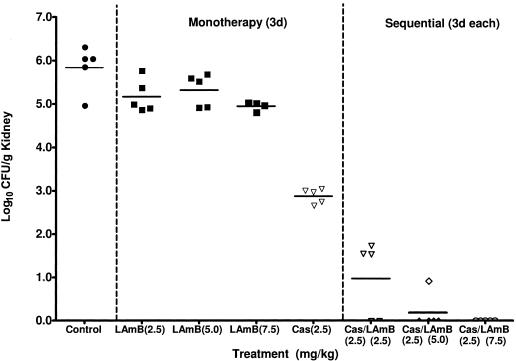
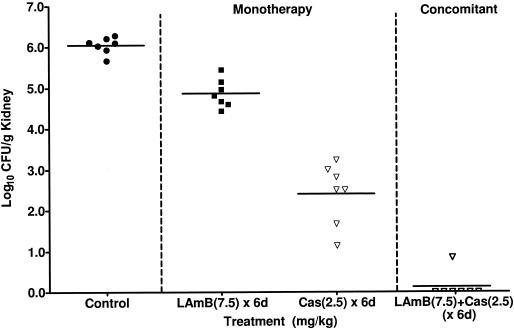
While Candida albicans remains the most common Candida isolate, Candida glabrata accounts for approximately 15 to 20% of all Candida infections in the United States. In this study we used immunosuppressed mice infected with C. glabrata to investigate the efficacy of liposomal amphotericin B alone or in combination with the echinocandin caspofungin or micafungin. For monotherapy, mice were given six daily doses of liposomal amphotericin B (3 to 20 mg/kg of body weight), caspofungin (1 to 5 mg/kg), or micafungin (2.5 to 10 mg/kg). With concomitant therapy, mice received liposomal amphotericin B (7.5 mg/kg) in addition to caspofungin (2.5 mg/kg) or micafungin (2.5 mg/kg) for 6 days. For sequential therapy, liposomal amphotericin B was administered on days 1 to 3 and caspofungin or micafungin was given on days 4 to 6; conversely, caspofungin or micafungin was administered on days 1 to 3 and liposomal amphotericin B was given on days 4 to 6. Efficacy was based on the number of CFU per gram of kidney 21 days postchallenge. Monotherapy with liposomal amphotericin B (7.5 to 20 mg/kg) was significantly more effective than no drug treatment (control group) (P < 0.05) and demonstrated a dose-dependent response, with 20 mg/kg lowering the CFU/g from 6.3 to 4.2 (significantly different from the value for the control group [P < 0.001]). Monotherapy with all echinocandin doses lowered the CFU/g from 6.0 to 6.4 to 2.7 to 3.3 (significantly different from the value for the control group [P < 0.001]) with no dose-dependent response. Complete clearance of infection could be achieved only when liposomal amphotericin B was given either concomitantly with caspofungin or micafungin or if liposomal amphotericin B was given sequentially with caspofungin. In conclusion, the combination of liposomal amphotericin B with an echinocandin markedly improved the therapeutic outcome in murine C. glabrata systemic infection.
Figures





References
-
- Abi-Said, D., E. Anaissie, O. Uzun, I. Raad, H. Pinzcowski, and S. Vartivarian. 1997. The epidemiology of hematogenous candidiasis caused by different Candida species. Clin. Infect. Dis. 24:1122-1128. - PubMed
-
- Abruzzo, G. K., A. M. Flattery, C. J. Gill, L. Kong, J. G. Smith, V. B. Pikounis, J. M. Balkovec, A. F. Bouffard, J. F. Dropinski, H. Rosen, H. Kropp, and K. Bartizal. 1997. Evaluation of the echinocandin antifungal MK-0991 (L-743,872): efficacies in mouse models of disseminated aspergillosis, candidiasis, and cryptococcosis. Antimicrob. Agents Chemother. 41:2333-2338. - PMC - PubMed
-
- Adler-Moore, J. P., J. A. Olson, and R. T. Proffitt. 2004. Alternative dosing regimens of liposomal amphotericin B (AmBisome) effective in treating murine systemic candidiasis. J. Antimicrob. Chemother. 54:1096-1102. - PubMed
-
- Anaissie, E. J., R. O. Darouiche, D. Abi-Said, O. Uzun, J. Mera, L. O. Gentry, T. Williams, D. P. Kontoyiannis, C. L. Karl, and G. P. Bodey. 1996. Management of invasive candidal infections: results of a prospective, randomized, multicenter study of fluconazole versus amphotericin B and review of the literature. Clin. Infect. Dis. 23:964-972. - PubMed
Publication types
MeSH terms
Substances
LinkOut - more resources
Full Text Sources
Medical