


Simple model for tuberculosis in cattle and badgers
- PMID: 16306260
- PMCID: PMC1292989
- DOI: 10.1073/pnas.0509003102
Simple model for tuberculosis in cattle and badgers
Abstract
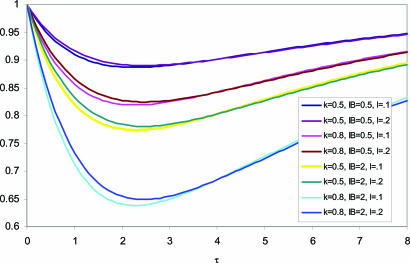
As an aid to the study of bovine tuberculosis (TB), a simple model has been developed of an epidemic involving two species, cattle and badgers. Each species may infect the other. The proportion of animals affected is assumed relatively small so that the usual nonlinear aspects of epidemic theory are avoided. The model is used to study the long-run and transient effect on cattle of culling badgers and the effect of a period without routine testing for TB, such as occurred during the 2001 epidemic of foot-and-mouth disease in Great Britain. Finally, by examining the changes in cattle TB over the last 15 years, and with some other working assumptions, it is estimated that the net reproduction number of the epidemic is approximately 1.1. The implications for controlling the disease are discussed.
Figures


References
-
- Anderson, R. M. & May, R. M. (1992) Infectious Diseases in Man (Oxford Univ. Press, Oxford).
-
- Department for Environment, Food and Rural Affairs (2005) The Incidence of TB in Cattle–Great Britain. Available at http://statistics.defra.gov.uk/esg/statnot/tbpn.pdf. Accessed September 21, 2005.
-
- Krebs, J. R., Anderson, R. M., Clutton-Brock, T., Morrison, W. I., Young, D. & Donnelly, C. A. (1997) Bovine Tuberculosis in Cattle and Badgers (MAFF, London) No. PB3423.
-
- Krebs, J. R., Anderson, R. M., Clutton-Brock, T., Donnelly, C. A., Frost, S., Morrison, W. I., Woodroffe, R. & Young, D. (1998) Science 279, 817–818. - PubMed
-
- Dunnet, G. M., Jones, D. M. & McInerney, J. P. (1986) Badgers and Bovine Tuberculosis (HMSO, London).
MeSH terms
LinkOut - more resources
Full Text Sources
Medical
Research Materials
