


Phylogenetic analysis of the main neutralization and hemagglutination determinants of all human adenovirus prototypes as a basis for molecular classification and taxonomy
- PMID: 16306598
- PMCID: PMC1316018
- DOI: 10.1128/JVI.79.24.15265-15276.2005
Phylogenetic analysis of the main neutralization and hemagglutination determinants of all human adenovirus prototypes as a basis for molecular classification and taxonomy
Abstract
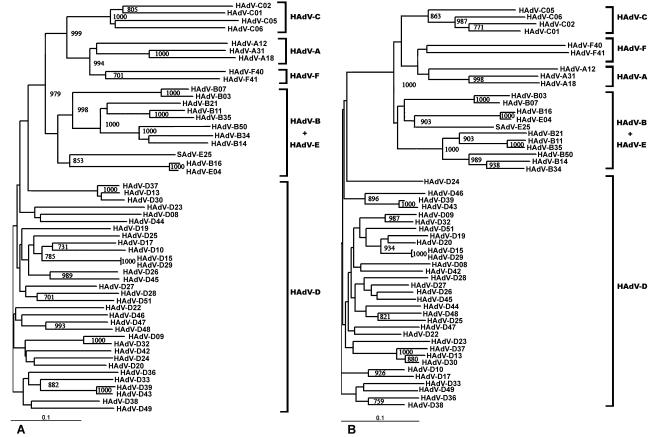
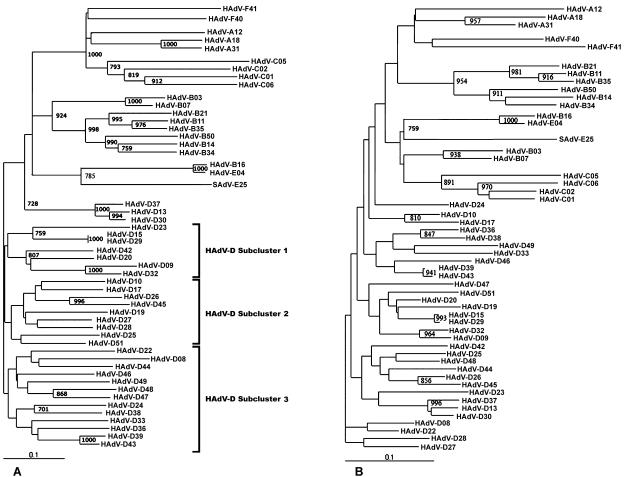
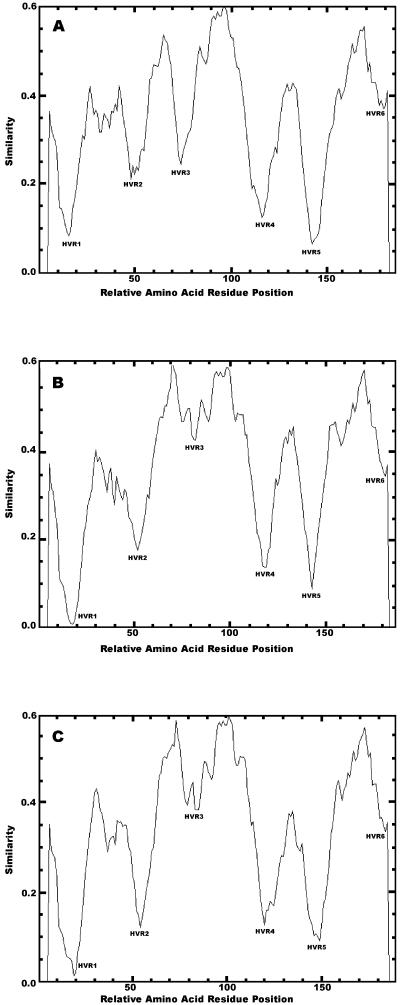
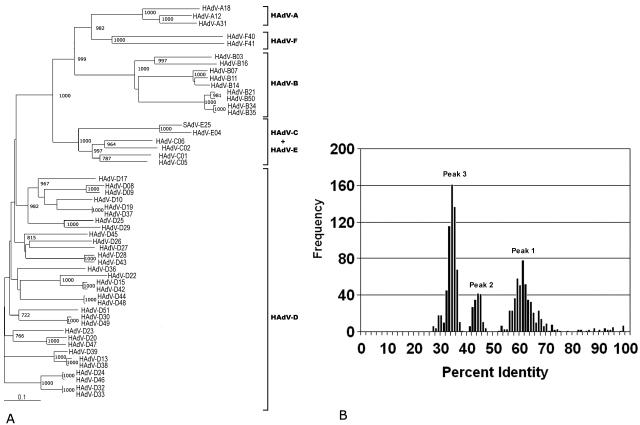
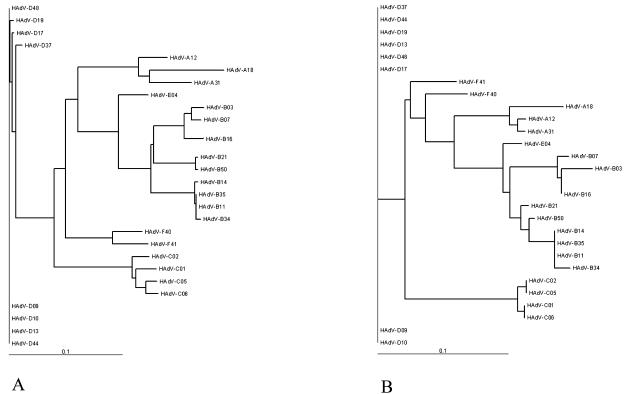
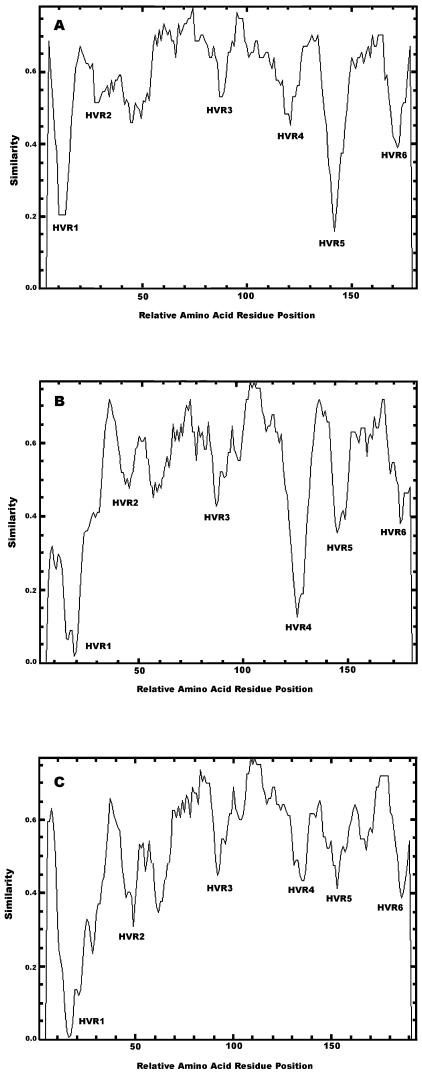
Human adenoviruses (HAdV) are responsible for a wide spectrum of diseases. The neutralization epsilon determinant (loops 1 and 2) and the hemagglutination gamma determinant are relevant for the taxonomy of HAdV. Precise type identification of HAdV prototypes is crucial for detection of infection chains and epidemiology. epsilon and gamma determinant sequences of all 51 HAdV were generated to propose molecular classification criteria. Phylogenetic analysis of epsilon determinant sequences demonstrated sufficient genetic divergence for molecular classification, with the exception of HAdV-15 and HAdV-29, which also cannot be differentiated by classical cross-neutralization. Precise sequence divergence criteria for typing (<2.5% from loop 2 prototype sequence and <2.4% from loop 1 sequence) were deduced from phylogenetic analysis. These criteria may also facilitate identification of new HAdV prototypes. Fiber knob (gamma determinant) phylogeny indicated a two-step model of species evolution and multiple intraspecies recombination events in the origin of HAdV prototypes. HAdV-29 was identified as a recombination variant of HAdV-15 (epsilon determinant) and a speculative, not-yet-isolated HAdV prototype (gamma determinant). Subanalysis of molecular evolution in hypervariable regions 1 to 6 of the epsilon determinant indicated different selective pressures in subclusters of species HAdV-D. Additionally, gamma determinant phylogenetic analysis demonstrated that HAdV-8 did not cluster with -19 and -37 in spite of their having the same tissue tropism. The phylogeny of HAdV-E4 suggested origination by interspecies recombination between HAdV-B (hexon) and HAdV-C (fiber), as in simian adenovirus 25, indicating additional zoonotic transfer. In conclusion, molecular classification by systematic sequence analysis of immunogenic determinants yields new insights into HAdV phylogeny and evolution.
Figures
Similar articles
-
Phylogenetic analysis and structural predictions of human adenovirus penton proteins as a basis for tissue-specific adenovirus vector design.J Virol. 2007 Aug;81(15):8270-81. doi: 10.1128/JVI.00048-07. Epub 2007 May 23. J Virol. 2007. PMID: 17522221 Free PMC article.
-
Molecular evolution of human adenovirus type 16 through multiple recombination events.Virus Genes. 2019 Dec;55(6):769-778. doi: 10.1007/s11262-019-01698-4. Epub 2019 Aug 5. Virus Genes. 2019. PMID: 31385187
-
Detection and sequence-based typing of human adenoviruses using sensitive universal primer sets for the hexon gene.Arch Virol. 2007 Jan;152(1):1-9. doi: 10.1007/s00705-006-0842-8. Epub 2006 Sep 8. Arch Virol. 2007. PMID: 16957827
-
Human adenovirus type 8: the major agent of epidemic keratoconjunctivitis (EKC).J Clin Virol. 2014 Dec;61(4):477-86. doi: 10.1016/j.jcv.2014.10.015. Epub 2014 Nov 4. J Clin Virol. 2014. PMID: 25464969 Review.
-
Human adenovirus type 8 genome typing.J Med Microbiol. 2012 Nov;61(Pt 11):1491-1503. doi: 10.1099/jmm.0.044172-0. Epub 2012 Sep 6. J Med Microbiol. 2012. PMID: 22956755 Review.
Cited by
-
Phylogenetic and Recombination Analysis of Clinical Vitreous Humor-Derived Adenovirus Isolates Reveals Discordance Between Serotype and Phylogeny.Invest Ophthalmol Vis Sci. 2024 Feb 1;65(2):12. doi: 10.1167/iovs.65.2.12. Invest Ophthalmol Vis Sci. 2024. PMID: 38319669 Free PMC article.
-
Human adenovirus type 7 infection causes a more severe disease than type 3.BMC Infect Dis. 2019 Jan 9;19(1):36. doi: 10.1186/s12879-018-3651-2. BMC Infect Dis. 2019. PMID: 30626350 Free PMC article.
-
Phylogenetic analysis and structural predictions of human adenovirus penton proteins as a basis for tissue-specific adenovirus vector design.J Virol. 2007 Aug;81(15):8270-81. doi: 10.1128/JVI.00048-07. Epub 2007 May 23. J Virol. 2007. PMID: 17522221 Free PMC article.
-
A Zoonotic Adenoviral Human Pathogen Emerged through Genomic Recombination among Human and Nonhuman Simian Hosts.J Virol. 2019 Aug 28;93(18):e00564-19. doi: 10.1128/JVI.00564-19. Print 2019 Sep 15. J Virol. 2019. PMID: 31243128 Free PMC article.
-
Extent of circulation of incorrectly labeled adenovirus 50 and 51 prototype preparations.J Clin Microbiol. 2007 Jun;45(6):2092; discussion 2092. doi: 10.1128/JCM.00251-07. J Clin Microbiol. 2007. PMID: 17548457 Free PMC article. No abstract available.
References
-
- Adrian, T., B. Bastian, W. Benoist, J. C. Hierholzer, and R. Wigand. 1985. Characterization of adenovirus 15/H9 intermediate strains. Intervirology 23:15-22. - PubMed
-
- Adrian, T., G. Wadell, J. C. Hierholzer, and R. Wiegand. 1986. DNA restriction analysis of adenovirus prototype 1 to 41. Arch. Virol. 91:277-290. - PubMed
-
- Akiyama, H., T. Kurosu, C. Sakashita, T. Inoue, S. Mori, K. Ohashi, S. Tanikawa, H. Sakamaki, Y. Onozawa, Q. Chen, H. Zheng, and T. Kitamura. 2001. Adenovirus is a key pathogen in hemorrhagic cystitis associated with bone marrow transplantation. Clin. Infect. Dis. 32:1325-1330. - PubMed
MeSH terms
Substances
LinkOut - more resources
Full Text Sources
Other Literature Sources
