


Abnormal expression of bcl-2 and bax in rat tongue mucosa during the development of squamous cell carcinoma induced by 4-nitroquinoline 1-oxide
- PMID: 16309543
- PMCID: PMC2517447
- DOI: 10.1111/j.0959-9673.2005.00444.x
Abnormal expression of bcl-2 and bax in rat tongue mucosa during the development of squamous cell carcinoma induced by 4-nitroquinoline 1-oxide
Abstract
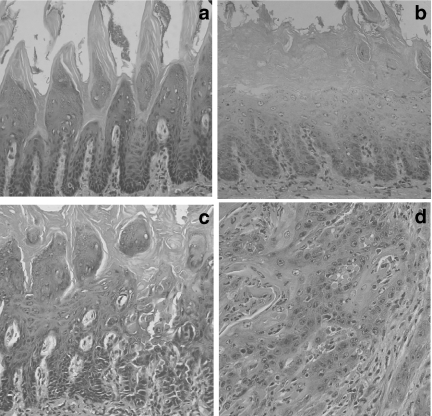
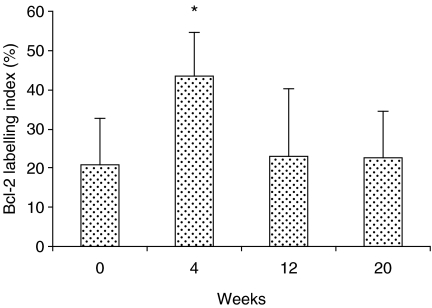
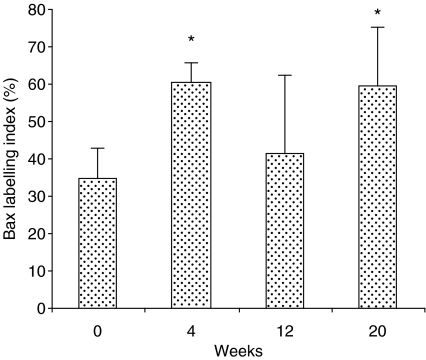
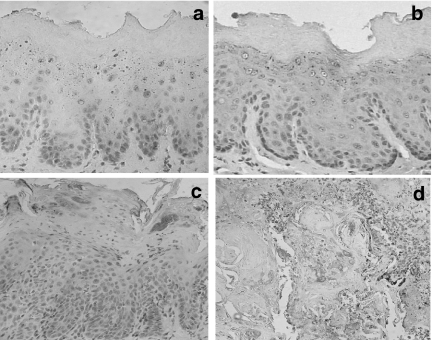
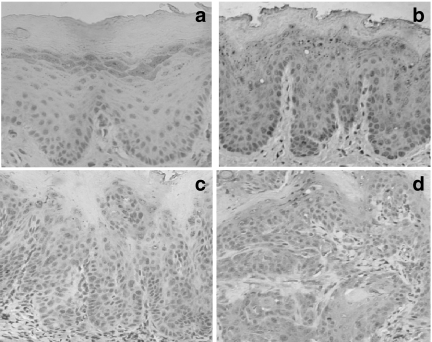
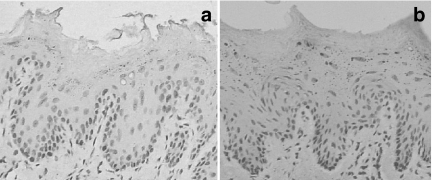
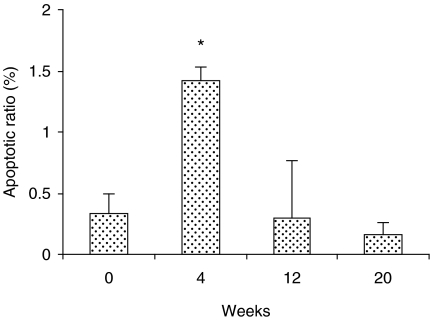
4-Nitroquinoline 1-oxide (4NQO)-induced rat tongue carcinogenesis is a useful model for studying oral squamous cell carcinoma. The aim of this study was to investigate the expression of bcl-2 and bax during tongue carcinogenesis induced by 4NQO. Male Wistar rats were distributed into three groups of 10 animals each and treated with 50 ppm 4NQO solution through their drinking water for 4, 12 or 20 weeks. Ten animals were used as negative control. Although no histological changes were induced in the epithelium after 4 weeks of carcinogen exposure, bcl-2 and bax were over-expressed (P < 0.01) in all layers of the 'normal' epithelium. The expression levels were the same in all layers of epithelium for both the antibodies used (bcl-2 or bax). In dysplastic lesions at 12 weeks following carcinogen administration, the levels of bcl-2 and bax expression did not increase when compared to negative control with the immunoreactivity for bcl-2 being restricted to the superficial layer of epithelium. In well-differentiated squamous cell carcinoma induced after 20 weeks of treatment with 4NQO, bcl-2 was expressed in some cells of tumour islands. On the other hand, immunostaining for bax was widely observed at the tumour nests. The labelling index for bcl-2 and bax showed an increase (P < 0.05) after only 4 weeks of 4NQO administration. In conclusion, our results suggest that abnormalities in the apoptosis pathways are associated with the development of persistent clones of mutated-epithelial cells in the oral mucosa. Bcl-2 and bax expression appears to be associated with a risk factor in the progression of oral cancer.
Figures
References
-
- Akao Y, Otsuki Y, Kataoka S, Ito Y, Tsujimoto Y. Multiple subcellular localization of bcl-2: detection in nuclear outer membrane, endoplasmic reticulum membrane, and mitochondrial membranes. Cancer Res. 1994;54:2468–2471. - PubMed
-
- Arends MJ, Wyllie AH. Apoptosis: mechanisms and roles in pathology. Int. Rev. ExpPathol. 1991;32:223–254. - PubMed
-
- Chen Y, Kayano T, Takagi M. Dysregulated expression of bcl-2 and bax in oral carcinomas: evidence of post-transcriptional control. J. Oral Pathol. Med. 2000;29:63–69. - PubMed
-
- Gastman BR. Apoptosis and predisposition to oral cancer. Head Neck. 2001;23:409–425. - PubMed
-
- Gazzaniga P, Gallucci M, Gradilone A, et al. Detection of BCL-2 RNA in low grade tumours of the urinary bladder. EurJCancer. 1995;31A:2119–2120. - PubMed
Publication types
MeSH terms
Substances
LinkOut - more resources
Full Text Sources
Research Materials
