Gender differences in the slow delayed (IKs) but not in inward (IK1) rectifier K+ currents of canine Purkinje fibre cardiac action potential: key roles for IKs, beta-adrenoceptor stimulation, pacing rate and gender
- PMID: 16314855
- PMCID: PMC1751338
- DOI: 10.1038/sj.bjp.0706491
Gender differences in the slow delayed (IKs) but not in inward (IK1) rectifier K+ currents of canine Purkinje fibre cardiac action potential: key roles for IKs, beta-adrenoceptor stimulation, pacing rate and gender
Abstract
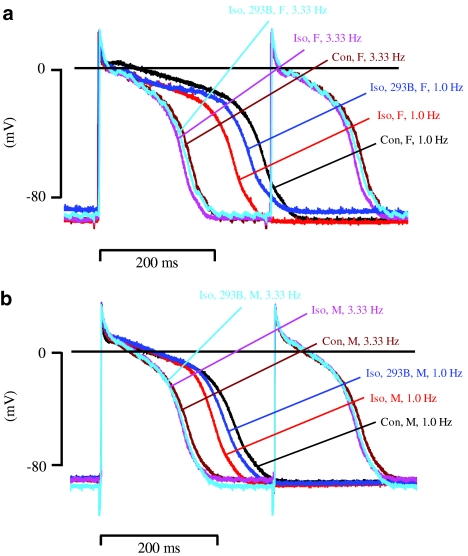
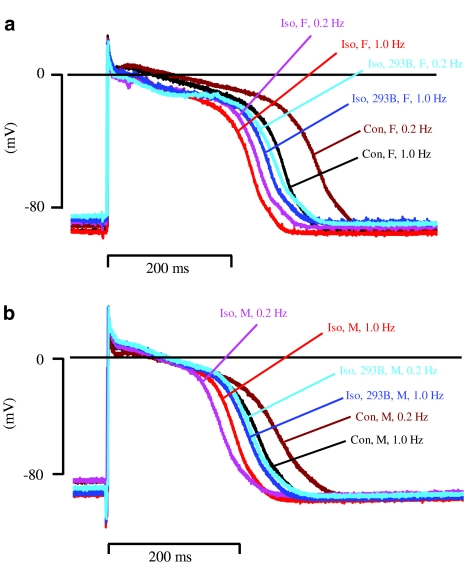
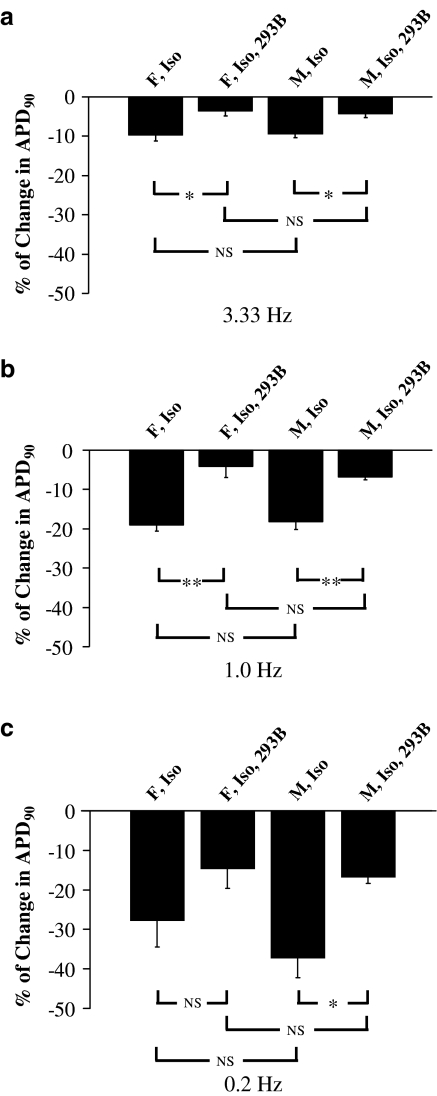
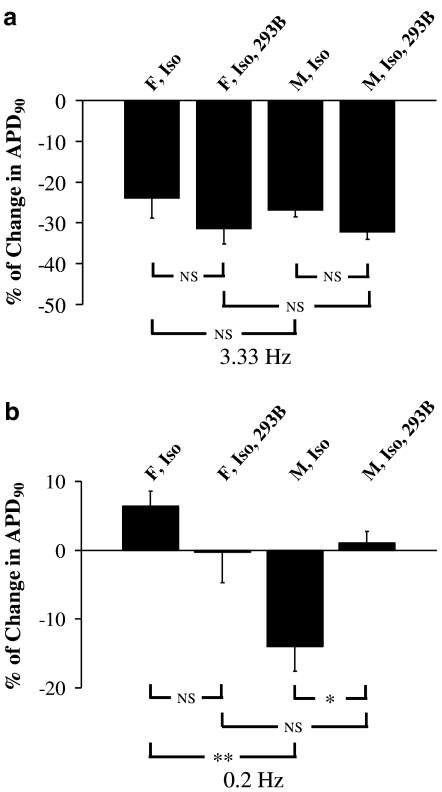
As the beagle dog is a commonly used preclinical species to test the effects of new drugs on cardiac repolarisation and Purkinje fibres have become an established in vitro preparation to assess the effects of these new drugs on action potential duration (APD), the main aim of this study was therefore to evaluate the relative contribution of the inward (I(K1)) and slow delayed (I(Ks)) rectifier cardiac K(+) currents to action potential repolarisation in beagle Purkinje fibres under three different experimental conditions: (i) selective block of I(K1) with BaCl(2), (ii) selective block of I(Ks) with (-) chromanol 293B under basal conditions and (iii) selective block of I(Ks) during beta-adrenoceptor stimulation. Furthermore, the dependence of this contribution on gender and pacing rate was investigated. Microelectrode techniques were employed to measure APD in Purkinje fibres from adult female and male dogs. At stimulation rates of 3.33, 1.0 and 0.2 Hz, the degree of prolongation of APD evoked by BaCl(2) (10 microM) was comparable in fibres from female and male dogs. At the same stimulation rates, 10 microM (-) chromanol 293B did not change the APD in fibres from female and male dogs. During beta-adrenoceptor stimulation with 0.1 microM isoproterenol, an APD prolonging effect of (-) chromanol 293B was detected. In the presence of isoproterenol, action potentials in fibres from male dogs get shorter when changing the stimulation rate from 1.0 to 0.2 Hz, while the opposite is seen in fibres from female dogs. This alteration was completely reversed by (-) chromanol 293B. In conclusion, our findings confirm that beta-adrenoceptor stimulation is one condition where there may be an increased role of I(Ks) in action potential repolarisation. Gender differences in the autonomic modulation of I(Ks) could be a contributing factor to the reported increased susceptibility of female hearts to arrhythmias.
Figures
References
-
- ABI-GERGES N., PHILP K., POLLARD C., WAKEFIELD I., HAMMOND T.G., VALENTIN J.P. Sex differences in ventricular repolarization: from cardiac electrophysiology to Torsades de Pointes. Fundam. Clin. Pharmacol. 2004a;18:139–151. - PubMed
-
- ANON Committee for Proprietary Medical Products (CPMP). Points to consider: The assessment of the potential of QT interval prolongation by non-cardiovascular medicinal products. The European Agency for the evaluation of medicinal products 1997. London, 17 December. Reference CPMP/ICH/986/96
-
- ANON ICH E14 Note for guidance on the clinical evaluation of QT/QTc interval prolongation and proarrhythmic potential for non-antiarrhythmic drugs 2005a. London, 25 May. Reference CHMP/ICH/2/04
-
- ANON ICH S7B Note for guidance on the nonclinical evaluation of the potential for delayed ventricular repolarization (QT interval prolongation) by human pharmaceuticals 2005b. London, 25 May. Reference CHMP/ICH/423/02 - PubMed
Publication types
MeSH terms
Substances
LinkOut - more resources
Full Text Sources
Research Materials