. 2005 Nov 30;25(48):11210-7.
doi: 10.1523/JNEUROSCI.2596-05.2005.

Functional organization of a Schwann cell enhancer

Affiliations

Functional organization of a Schwann cell enhancer

Eric Denarier et al. J Neurosci. .

Abstract

Myelin basic protein (MBP) gene expression is conferred in oligodendrocytes and Schwann cells by different upstream enhancers. In Schwann cells, expression is controlled by a 422 bp enhancer lying -9 kb from the gene. We show here that it contains 22 mammalian conserved motifs > or =6 bp. To investigate their functional significance, different combinations of wild-type or mutated motifs were introduced into reporter constructs that were inserted in single copy at a common hypoxanthine phosphoribosyltransferase docking site in embryonic stem cells. Lines of transgenic mice were derived, and the subsequent qualitative and quantitative expression phenotypes were compared at different stages of maturation. In the enhancer core, seven contiguous motifs cooperate to confer Schwann cell specificity while different combinations of flanking motifs engage, at different stages of Schwann cell maturation, to modulate expression level. Mutation of a Krox-20 binding site reduces the level of reporter expression, whereas mutation of a potential Sox element silences reporter expression. This potential Sox motif was also found conserved in other Schwann cell enhancers, suggesting that it contributes widely to regulatory function. These results demonstrate a close relationship between phylogenetic footprints and regulatory function and suggest a general model of enhancer organization. Finally, this investigation demonstrates that in vivo functional analysis, supported by controlled transgenesis, can be a robust complement to molecular and bioinformatics approaches to regulatory mechanisms.


Figures
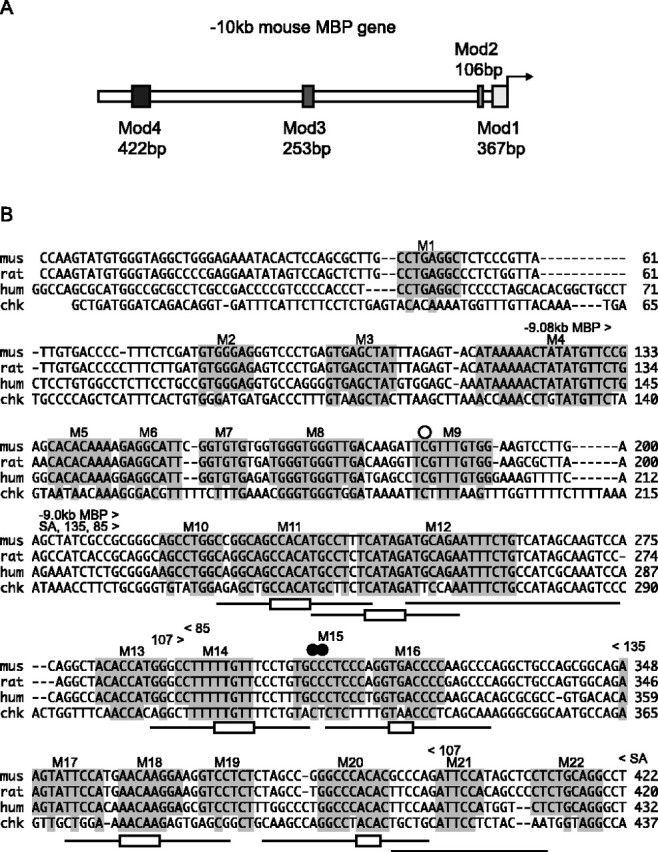
Figure 1.
Figure 1.
A, Schematic representation of the mouse MBP gene 5′ flanking region showing the four conserved noncoding modules. B, Sequence alignments of Mod4 from four different species. Twenty-two motifs of at least 6 bp are conserved in mammals. Motifs are highlighted and designated M1-M22. In vivo footprint analysis revealed a protected guanine (open circle over the sequence) and hypersensitive sites (filled circles). The Mod4 sequences evaluated for enhancer activity in reporter constructs are delineated by arrowheads over the sequence. Oligonucleotides used in EMSA (M11-M21) are indicated by lines under the sequence, and the nucleotides substituted in motif mutations are delineated by rectangles. mus, Mouse; hum, human; chk, chicken.
Figure 2.
Figure 2.
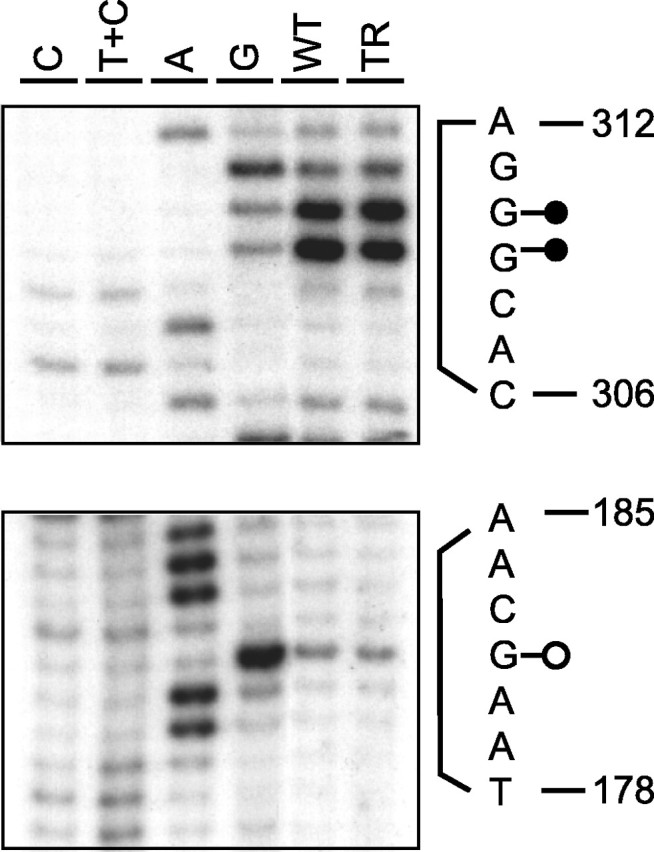
Protein-DNA interactions are revealed in Mod4 by an in vivo footprinting assay. P10 normal mice (WT) and adult trembler mice (TR) were pretreated with dimethylsulfate. DNA prepared from their sciatic nerves was compared with similarly treated purified DNA (sequencing reaction lane C, T+C, A, and G). Protection is detected on base 182, whereas bases 309 and 310 are hypersensitive.
Figure 3.
Figure 3.
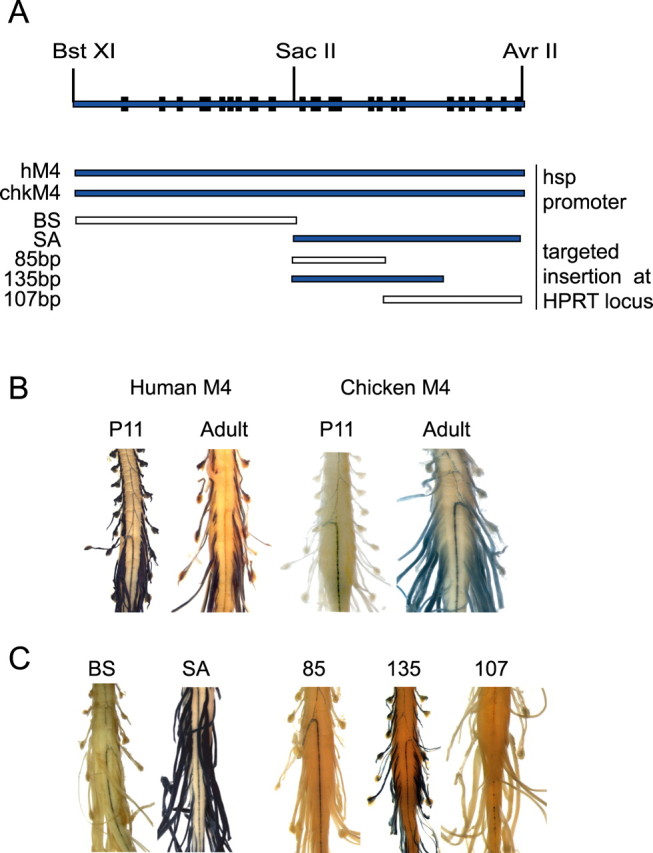
A, Distribution of conserved Mod4 motifs in sequences analyzed for in vivo function. Sequences driving Schwann cell expression are indicated in blue. B, β-Galactosidase histochemistry was performed on whole-mount preparations of spinal cords (CNS) with attached spinal roots (PNS) to reveal Schwann cell-specific targeting. The human Mod4 construct expresses in spinal roots at P11 and in the adult, whereas the chicken Mod4 construct expresses in the spinal roots only in adults. C, The SA and 135 bp constructs are expressed in spinal roots but not in spinal cord oligodendrocytes. Note that the ventral spinal cord shown here demonstrates obvious labeling of the central artery; however, because this is typical of diverse reporter constructs docked at HPRT, it does not represent Mod4-specific enhancer activity.
Figure 4.
Figure 4.
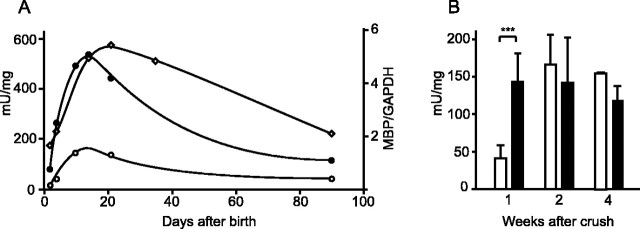
Reporter constructs are responsive to axon signals. A, β-Galactosidase activity in sciatic nerves of mice bearing the SA (black circles) or 135 bp construct (white circles) peak during primary myelin formation in postnatal development and follow the MBP RNA accumulation (white diamonds). B, After nerve crush, β-galactosidase activity in the distal nerve segment (white) of mice bearing SA construct was compared with that in the uninjured contralateral nerve (black) at 1, 2, and 4 weeks after crush. Means ± SD. Asterisks indicate t test result of ***p < 0.001. n = 7, 6, and 2 at 1, 2, and 4 weeks after crush, respectively.
Figure 5.
Figure 5.
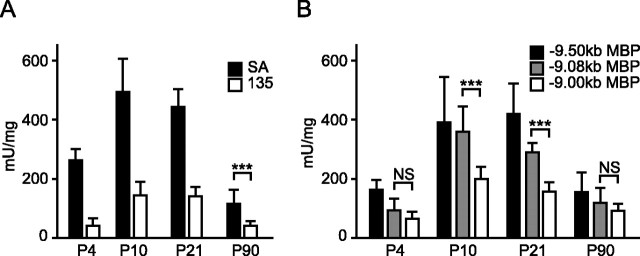
Developmental expression programs realized from constructs containing progressive deletions of Mod4 motifs. A, SA and 135 bp sequences ligated to the minimal hsp promoter. B, Constructs with contiguous MBP 5′ flanking sequences. The sequence terminating at -9.0 kb at the SacII shares the 5′ terminus of SA. Extension to -9.08 kb adds motifs M9 to M5 and further extension to -9.5 includes all 22 Mod4 motifs. Means ± SD. Asterisks indicate the t test result of ***p < 0.001. NS, Not significant. n ≥ 5, except -9.08 kb P21, where n = 3.
Figure 6.
Figure 6.
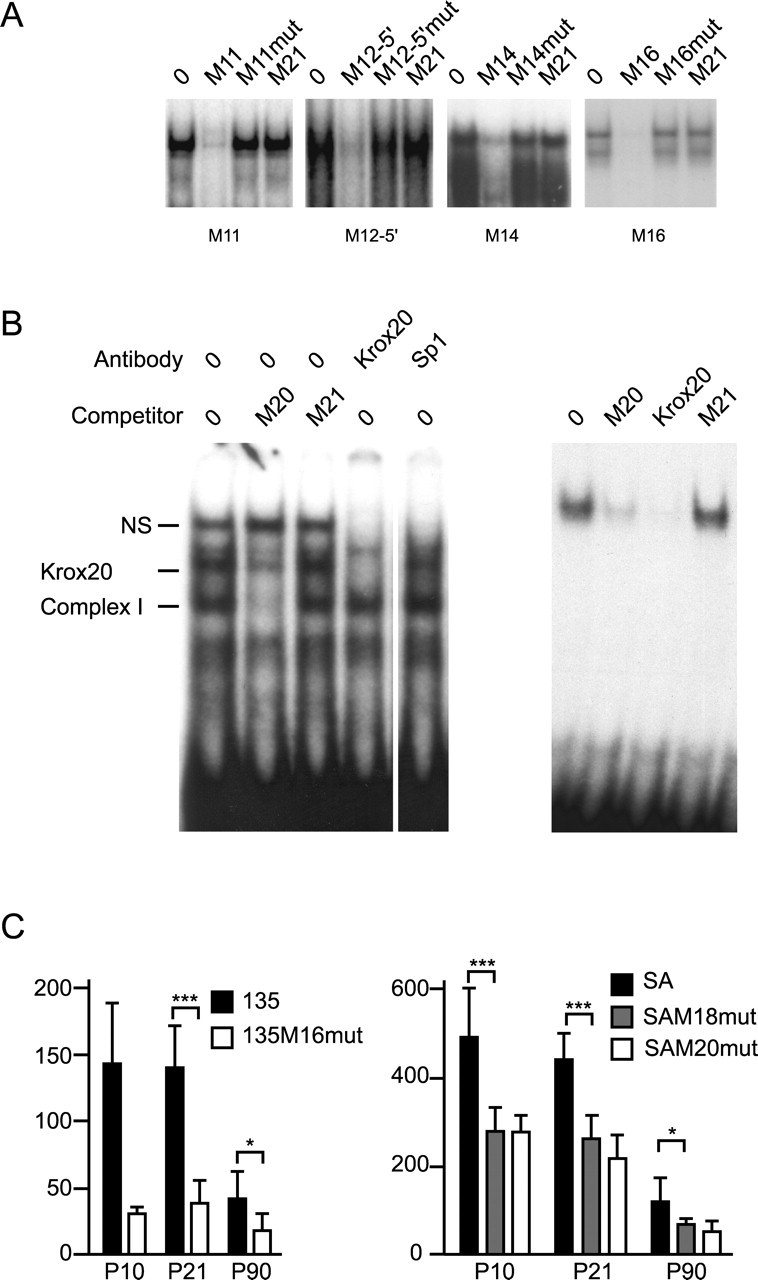
A, Interaction of motifs M11, M12-5′, M14, and M16 detected by EMSA. Labeled oligonucleotides were incubated with sciatic nerve extracts from P10 mice. Competition was performed with the oligonucleotides indicated (top of each lane). Note that two specific complexes are formed with oligonucleotide M16. B, M20 binds Krox-20 from sciatic nerve extracts (left) or bacterially expressed Krox-20 (right). Competition was achieved with the indicated oligos. Characterization of Krox-20 in sciatic nerve extracts was done by supershift with Krox-20 antibody and Sp1 antibody as a control. C, β-Galactosidase activity in sciatic nerve samples from mice bearing control constructs (135 and SA) or mutated constructs (135M16mut, SAM18mut, and SAM20mut). The 135M14mut has no activity and is not represented. Means ± SD. t test results are indicated as *p < 0.05 and ***p < 0.001; n ≥ 5.
Figure 7.
Figure 7.
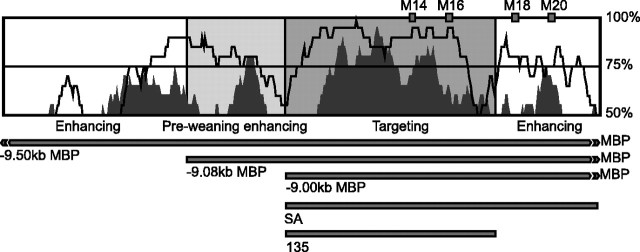
VISTA plot of Mod4 sequence comparisons using a 20 bp window. Mouse and human (open) and mouse and chicken (filled) identities are displayed. The sequences with different attributed functions are shaded in gray. The related Mod4 sequences introduced into constructs are indicated below the VISTA plot.

References

    1. Berman BP, Nibu Y, Pfeiffer BD, Tomancak P, Celniker SE, Levine M, Rubin GM, Eisen MB (2002) Exploiting transcription factor binding site clustering to identify cis-regulatory modules involved in pattern formation in the Drosophila genome. Proc Natl Acad Sci USA 99: 757-762. - PMC - PubMed
    1. Bermingham Jr JR, Scherer SS, O'Connell S, Arroyo E, Kalla KA, Powell FL, Rosenfeld MG (1996) Tst-1/Oct-6/SCIP regulates a unique step in peripheral myelination and is required for normal respiration. Genes Dev 10: 1751-1762. - PubMed
    1. Bondurand N, Girard M, Pingault V, Lemort N, Dubourg O, Goossens M (2001) Human Connexin 32, a gap junction protein altered in the X-linked form of Charcot-Marie-Tooth disease, is directly regulated by the transcription factor SOX10. Hum Mol Genet 10: 2783-2795. - PubMed
    1. Britsch S, Goerich DE, Riethmacher D, Peirano RI, Rossner M, Nave KA, Birchmeier C, Wegner M (2001) The transcription factor Sox10 is a key regulator of peripheral glial development. Genes Dev 15: 66-78. - PMC - PubMed
    1. Bronson SK, Plaehn EG, Kluckman KD, Hagaman JR, Maeda N, Smithies O (1996) Single-copy transgenic mice with chosen-site integration. Proc Natl Acad Sci USA 93: 9067-9072. - PMC - PubMed

Publication types

Substances