Glucose transporter 4: cycling, compartments and controversies
- PMID: 16319959
- PMCID: PMC1369215
- DOI: 10.1038/sj.embor.7400584
Glucose transporter 4: cycling, compartments and controversies
Abstract
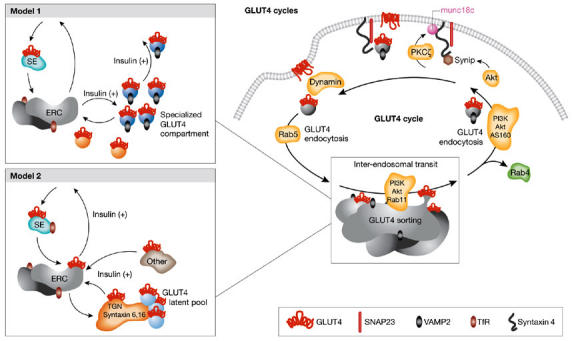
Insulin promotes glucose uptake into muscle and adipose tissues through glucose transporter 4 (GLUT4). In unstimulated cells, rapid endocytosis, slow exocytosis and dynamic or static retention cause GLUT4 to concentrate in early recycling endosomes, the trans-Golgi network and vesicle-associated protein 2-containing vesicles. The coordinated action of phosphatidylinositol 3-kinase effectors, protein kinase Akt, atypical protein kinase C (aPKC) and Akt substrate of 160-kDa (AS160), regulates the GLUT4 cycle by affecting its translocation, fusion with the plasma membrane, internalization and sorting. We review the evidence that supports such cycling, evaluate current models proposing static or dynamic retention, and highlight how distinct steps of GLUT4 transport are regulated by insulin signals. In particular, fusion seems to be regulated by aPKC (via munc18) and Akt (via syntaxin4-interacting protein (synip)). AS160 participates in GLUT4 intracellular retention, and possibly fusion, through candidate ras-related GTP-binding protein (Rab)2, Rab8, Rab10 and/or Rab14. The localization of the insulin-sensitive GLUT4 compartment and the precise target of insulin-derived signals remain open for future investigation.
Figures


References
-
- Al-Hasani H, Hinck CS, Cushman SW (1998) Endocytosis of the glucose transporter GLUT4 is mediated by the GTPase dynamin. J Biol Chem 273: 17504–17510 - PubMed
-
- Antonescu CN, Thong FSL, Niu W, Karneli E, Klip A (2005) To be or not to be: regulation of the intrinsic activity of GLUT4. Curr Med Chem Immunol Endo Metab Agents 5: 175–187
-
- Berwick DC, Dell GC, Welsh GI, Heesom KJ, Hers I, Fletcher LM, Cooke FT, Tavare JM (2004) Protein kinase B phosphorylation of PIKfyve regulates the trafficking of GLUT4 vesicles. J Cell Sci 117: 5985–5993 - PubMed
-
- Björnholm M, Zierath JR (2005) Insulin signal transduction in human skeletal muscle: identifying the defects in Type II diabetes. Biochem Soc Trans 33: 354–357 - PubMed
Publication types
MeSH terms
Substances
LinkOut - more resources
Full Text Sources
Other Literature Sources