


Frequency-dependent success of aggressive mimics in a cleaning symbiosis
- PMID: 16321786
- PMCID: PMC1559983
- DOI: 10.1098/rspb.2005.3256
Frequency-dependent success of aggressive mimics in a cleaning symbiosis
Abstract
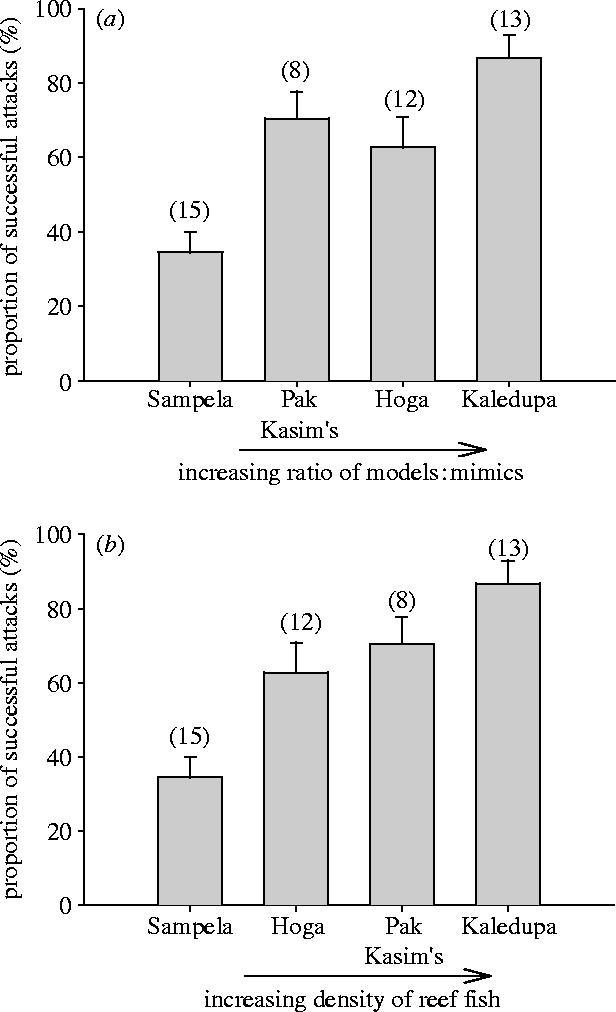
Batesian mimics--palatable organisms that resemble unpalatable ones--are usually maintained in populations by frequency-dependent selection. We tested whether this mechanism was also responsible for the maintenance of aggressive mimicry in natural populations of coral reef fishes. The attack success of bluestriped fangblennies (Plagiotremus rhinorhynchos), which mimic juvenile bluestreaked cleaner wrasses (Labroides dimidiatus) in colour but tear flesh and scales from fishes instead of removing ectoparasites, was frequency-dependent, increasing as mimics became rarer relative to their model. However, cleaner mimics were also more successful on reefs with higher densities of potential victims, perhaps because a dilution-like effect creates few opportunities for potential victims to learn to avoid mimics. Further studies should reveal whether this second mechanism is specific to aggressive mimicry.
Figures


References
-
- Arnal C, Côté I.M, Morand S. Why clean and be cleaned? The importance of client ectoparasites and mucus in a marine cleaning symbiosis. Behav. Ecol. Sociobiol. 2001;51:1–7. 10.1007/s002650100407 - DOI
-
- Bates H.W. Contributions to an insect fauna of the Amazon Valley. Lepidoptera: Heliconidae. Trans. Linn. Soc. 1862;23:495–566.
-
- Cheney K.L, Côté I.M. Mutualism or parasitism? The variable outcome of cleaning. Biol. Lett. 2005;1:162–165. 10.1098/rsbl.2004.0288 - DOI - PMC - PubMed
-
- Côté I.M, Cheney K.L. Distance-dependent costs and benefits of aggressive mimicry in a cleaning symbiosis. Proc. R. Soc. B. 2004;271:2627–2630. 10.1098/rspb.2004.2904 - DOI - PMC - PubMed
Publication types
MeSH terms
LinkOut - more resources
Full Text Sources
