


Trends in disease modifying antirheumatic drug prescription in early rheumatoid arthritis are influenced more by hospital setting than patient or disease characteristics
- PMID: 16322085
- PMCID: PMC1798265
- DOI: 10.1136/ard.2004.027656
Trends in disease modifying antirheumatic drug prescription in early rheumatoid arthritis are influenced more by hospital setting than patient or disease characteristics
Abstract
Objective: To characterise temporal trends and factors associated with the prescription of disease modifying antirheumatic drugs (DMARDs) at the initial consultation in early rheumatoid arthritis (RA).
Methods: Data from 2584 patients with early RA at 19 hospitals were extracted from the Swedish Rheumatoid Arthritis Register for the period 1997-2001. Disease characteristics and DMARD prescription at first consultation with the rheumatologist were investigated using cross tabulation and logistic regression.
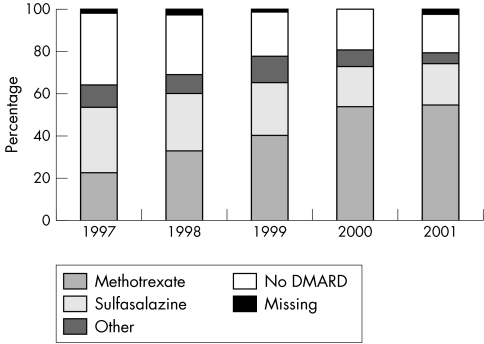
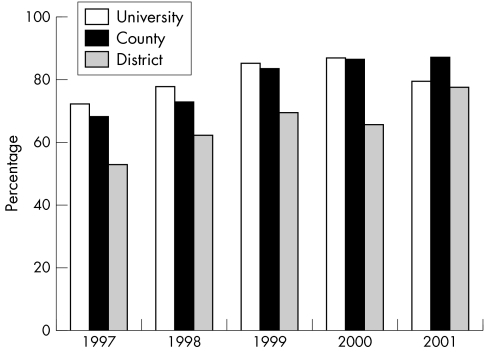
Results: DMARD prescriptions, particularly for methotrexate, increased from 1997 to 2001 independently of patient characteristics. Stratification by hospital type showed that patients in district hospitals were less likely to be prescribed DMARDs than those in university hospitals (adjusted odds ratio (OR) = 0.53 (95% confidence interval (CI) 0.40 to 0.69), p<0.001), independently of confounding factors. Association of the DAS28 with the likelihood of DMARD prescription was greater among patients attending district hospitals (OR = 1.65 (1.34 to 2.02), p<0.001) than those at university hospitals (OR = 1.23 (1.07 to 1.41), p = 0.003) and county hospitals (OR = 1.34 (1.01 to 1.63), p = 0.003). Interaction testing indicated that the difference was significant (p = 0.007).
Conclusions: Temporal trends in DMARD prescription indicate an increasingly aggressive approach to disease management among Swedish rheumatologists. However, the association of hospital type with DMARD prescription suggests that the adoption of research findings in clinical care varies considerably.
Conflict of interest statement
References
-
- Stenger A A, Van Leeuwen M A, Houtman P M, Bruyn G A, Speerstra F, Barendsen B C.et al Early effective suppression of inflammation in rheumatoid arthritis reduces radiographic progression. Br J Rheumatol 1998371157–1163. - PubMed
-
- Egsmose C, Lund B, Borg G, Petterson H, Berg E, Brodin U.et al Patients with rheumatoid arthritis benefit from early 2nd line therapy: 5 year follow‐up of a prospective double blind placebo controlled study. J Rheumatol 1995122208–2213. - PubMed
-
- van der Heijde D M, Jacobs J W, Bijlsma J W, Heurkens A H, van Booma‐Frankfort, van der Veen M J.et al The effectiveness of early treatment with “second‐line” antirheumatic drugs: a randomised controlled trial. Ann Intern Med 1996124699–707. - PubMed
-
- Mottonen T, Hannonen P, Korpela M, Nissila M, Kautiainen H, Ilonen J.et al Delay to institution of therapy and induction of remission using single‐drug or combination‐disease‐modifying antirheumatic drug therapy in early rheumatoid arthritis. Arthritis Rheum 200246894–898. - PubMed
-
- Criswell L A, Henke C J. What explains the variation among rheumatologists in their use of prednisolone and second line agents for the treatment of rheumatoid arthritis? J Rheumatol 199522829–835. - PubMed
Publication types
MeSH terms
Substances
LinkOut - more resources
Full Text Sources
Medical
