


Review
doi: 10.1172/JCI27196.
Platelets in inflammation and atherogenesis
Affiliations
- PMID: 16322783
- PMCID: PMC1297269
- DOI: 10.1172/JCI27196
Item in Clipboard
Review
Platelets in inflammation and atherogenesis
J Clin Invest.
2005 Dec.
Abstract
Platelets represent an important linkage between inflammation, thrombosis, and atherogenesis. Inflammation is characterized by interactions among platelets, leukocytes, and ECs. These interactions trigger autocrine and paracrine activation processes that lead to leukocyte recruitment into the vascular wall. Platelet-induced chronic inflammatory processes at the vascular wall result in development of atherosclerotic lesions and atherothrombosis. This Review highlights the molecular machinery and inflammatory pathways used by platelets to initiate and accelerate atherothrombosis.
Figures

Platelet-endothelium adhesion. Activated endothelium surface expresses P-selectin. Platelet surface receptors GPIbα and PSGL-1 interact with endothelial P-selectin and mediate platelet rolling. Subsequent firm adhesion is mediated through β3 integrins.
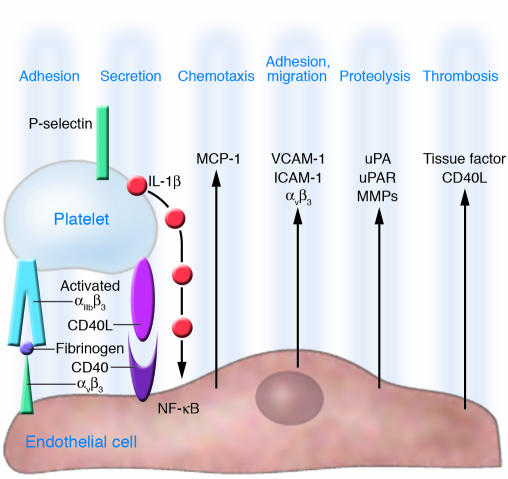
Adherent platelets inflame ECs. Firm platelet adhesion involving αIIbβ3 induces platelet surface exposure of P-selectin (CD62P) and release of CD40L and IL-1β, which stimulate ECs to provide an inflammatory milieu that supports proatherogenic alterations of endothelium.
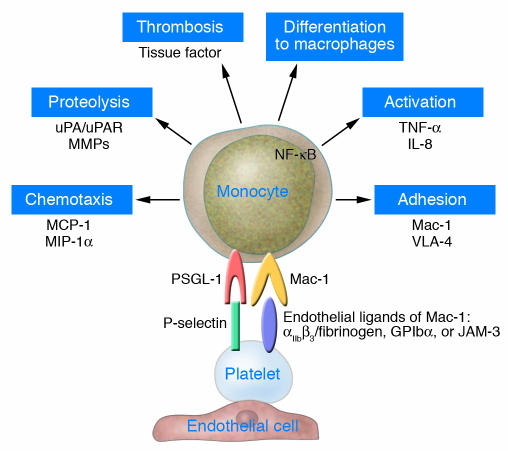
Adherent platelets recruit and inflame monocytes. Adherent and/or activated platelets mainly interact with monocytic PSGL-1 via P-selectin and with monocytic Mac-1 (αMβ2) via αIIbβ3 (and fibrinogen bridging) or GPIbα. Thereby, platelets initiate monocyte secretion of chemokines, cytokines, and procoagulatory tissue factor, upregulate and activate adhesion receptors and proteases, and induce monocyte differentiation into macrophages. Thus, platelet-monocyte interaction provides an atherogenic milieu at the vascular wall that supports plaque formation.
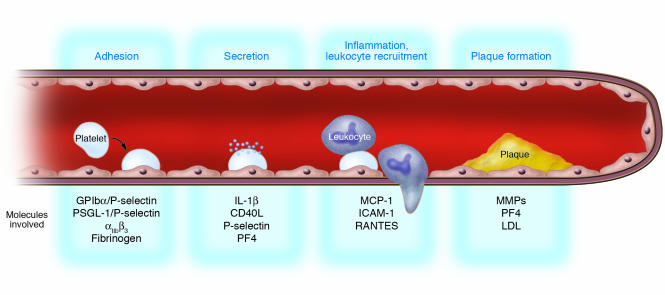
Hypothetical model of atherogenesis triggered by platelets. Activated platelets roll along the endothelial monolayer via GPIbα/P-selectin or PSGL-1/P-selectin. Thereafter, platelets firmly adhere to vascular endothelium via β3 integrins, release proinflammatory compounds (IL-1β, CD40L), and induce a proatherogenic phenotype of ECs (chemotaxis, MCP-1; adhesion, ICAM-1). Subsequently, adherent platelets recruit circulating leukocytes, bind them, and inflame them by receptor interactions and paracrine pathways, thereby initiating leukocyte transmigration and foam cell formation. Thus, platelets provide the inflammatory basis for plaque formation before physically occluding the vessel by thrombosis upon plaque rupture.
References
-
- Ruggeri ZM. Platelets in atherothrombosis. Nat. Med. 2002;8:1227–1234. - PubMed
-
- Nieswandt B, Watson SP. Platelet-collagen interaction: is GPVI the central receptor? Blood. 2003;102:449–461. - PubMed
-
- Arya M, et al. Glycoprotein Ib-IX-mediated activation of integrin alpha(IIb)beta(3): effects of receptor clustering and von Willebrand factor adhesion. J. Thromb. Haemost. 2003;1:1150–1157. - PubMed
Publication types
MeSH terms
Substances
LinkOut - more resources
Full Text Sources
Other Literature Sources
Medical
