


Risk factors for persisting neurological and cognitive impairments following cerebral malaria
- PMID: 16326798
- PMCID: PMC2082712
- DOI: 10.1136/adc.2005.077784
Risk factors for persisting neurological and cognitive impairments following cerebral malaria
Abstract
Background: Persisting neurological and cognitive impairments are common after cerebral malaria. Although risk factors for gross deficits on discharge have been described, few studies have examined those associated with persistent impairments.
Methods: The risk factors for impairments following cerebral malaria were determined by examining hospital records of 143 children aged 6-9 years, previously admitted with cerebral malaria, who were assessed at least 20 months after discharge to detect motor, speech and language, and other cognitive (memory, attention, and non-verbal functioning) impairments.
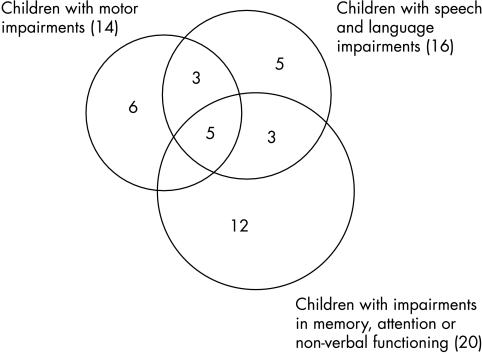
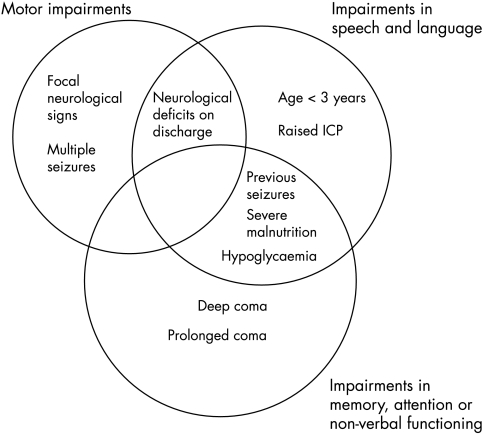
Results: The median age on admission was 30 months (IQR 19-42) and the median time from discharge to assessment was 64 months (IQR 40-78). Thirty four children (23.8%) were defined as having impairments: 14 (9.8%) in motor, 16 (11.2%) in speech and language, and 20 (14.0%) in other cognitive functions. Previous seizures (OR 5.6, 95% CI 2.0 to 16.0), deep coma on admission (OR 28.8, 95% CI 3.0 to 280), focal neurological signs observed during admission (OR 4.6, 95% CI 1.1 to 19.6), and neurological deficits on discharge (OR 4.5, 95% CI 1.4 to 13.8) were independently associated with persisting impairments. In addition, multiple seizures were associated with motor impairment, age <3 years, severe malnutrition, features of intracranial hypertension, and hypoglycaemia with language impairments, while prolonged coma, severe malnutrition, and hypoglycaemia were associated with impairments in other cognitive functions.
Conclusions: Risk factors for persisting neurological and cognitive impairments following cerebral malaria include multiple seizures, deep/prolonged coma, hypoglycaemia, and clinical features of intracranial hypertension. Although there are overlaps in impaired functions and risk factors, the differences in risk factors for specific functions may suggest separate mechanisms for neuronal damage. These factors could form the basis of future preventive strategies for persisting impairments.
Conflict of interest statement
Competing interests: none
References
-
- Newton C R, Krishna S. Severe falciparum malaria in children: current understanding of pathophysiology and supportive treatment. Pharmacol Ther 1998791–53. - PubMed
-
- Dugbartey A T, Spellacy F J, Dugbartey M T. Somatosensory discrimination deficits following pediatric cerebral malaria. Am J Trop Med Hyg 199859393–396. - PubMed
-
- Mung'Ala‐Odera V, Snow R W, Newton C R. The burden of the neurocognitive impairment associated with Plasmodium falciparum malaria in sub‐Saharan Africa. Am J Trop Med Hyg 200471(2 suppl)64–70. - PubMed
Publication types
MeSH terms
Grants and funding
LinkOut - more resources
Full Text Sources
