


MicroRNAs 221 and 222 inhibit normal erythropoiesis and erythroleukemic cell growth via kit receptor down-modulation
- PMID: 16330772
- PMCID: PMC1312381
- DOI: 10.1073/pnas.0506216102
MicroRNAs 221 and 222 inhibit normal erythropoiesis and erythroleukemic cell growth via kit receptor down-modulation
Abstract
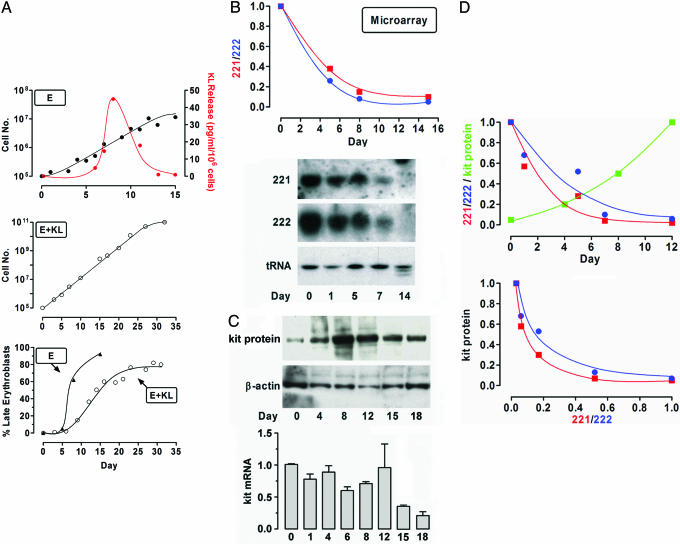
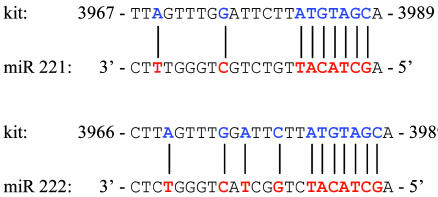
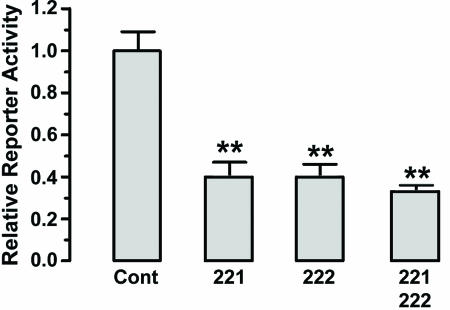
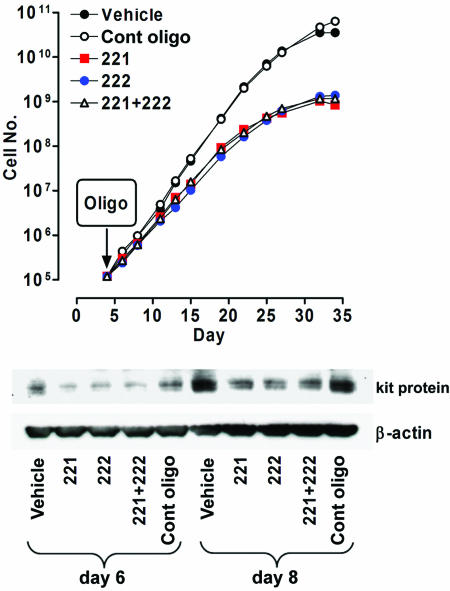
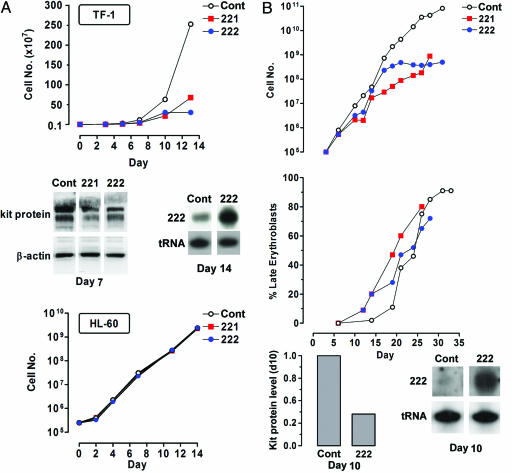
MicroRNAs (miRs) are small noncoding RNAs that regulate gene expression primarily through translational repression. In erythropoietic (E) culture of cord blood CD34+ progenitor cells, the level of miR 221 and 222 is gradually and sharply down-modulated. Hypothetically, this decline could promote erythropoiesis by unblocking expression of key functional proteins. Indeed, (i) bioinformatic analysis suggested that miR 221 and 222 target the 3' UTR of kit mRNA; (ii) the luciferase assay confirmed that both miRs directly interact with the kit mRNA target site; and (iii) in E culture undergoing exponential cell growth, miR down-modulation is inversely related to increasing kit protein expression, whereas the kit mRNA level is relatively stable. Functional studies show that treatment of CD34+ progenitors with miR 221 and 222, via oligonucleotide transfection or lentiviral vector infection, causes impaired proliferation and accelerated differentiation of E cells, coupled with down-modulation of kit protein: this phenomenon, observed in E culture releasing endogenous kit ligand, is magnified in E culture supplemented with kit ligand. Furthermore, transplantation experiments in NOD-SCID mice reveal that miR 221 and 222 treatment of CD34+ cells impairs their engraftment capacity and stem cell activity. Finally, miR 221 and 222 gene transfer impairs proliferation of the kit+ TF-1 erythroleukemic cell line. Altogether, our studies indicate that the decline of miR 221 and 222 during exponential E growth unblocks kit protein production at mRNA level, thus leading to expansion of early erythroblasts. Furthermore, the results on kit+ erythroleukemic cells suggest a potential role of these miRs in cancer therapy.
Figures
References
-
- Bartel, D. P. (2004) Cell 116, 281-297. - PubMed
-
- Lee, Y., Ahn, C., Han, J., Choi, H., Kim, J., Yim, J., Lee, J., Provost, P., Radmark, O., Kim, S., et al. (2003) Nature 425, 415-419. - PubMed
-
- Ambros, V. (2004) Nature 431, 350-355. - PubMed
-
- Yekta, S., Shih, I. H. & Bartel, D. P. (2004) Science 304, 594-596. - PubMed
Publication types
MeSH terms
Substances
Grants and funding
LinkOut - more resources
Full Text Sources
Other Literature Sources
Medical
Molecular Biology Databases
Miscellaneous
