


Independent association of insulin resistance with larger amounts of intermuscular adipose tissue and a greater acute insulin response to glucose in African American than in white nondiabetic women
- PMID: 16332653
- PMCID: PMC2670467
- DOI: 10.1093/ajcn/82.6.1210
Independent association of insulin resistance with larger amounts of intermuscular adipose tissue and a greater acute insulin response to glucose in African American than in white nondiabetic women
Abstract
Background: African Americans (AAs) have a higher prevalence of obesity and type 2 diabetes than do whites. Higher insulin resistance and hyperinsulinemia have been reported in adult AAs than in whites. Differences in adipose tissue and its distribution may account for these findings.
Objective: The objective was to ascertain whether differences between AA and white women in adipose tissue (AT) and skeletal muscle (SM) volumes account for ethnic differences in insulin resistance.
Design: We used whole-body magnetic resonance imaging to measure AT and SM volumes and used the intravenous-glucose-tolerance test to measure insulin resistance.
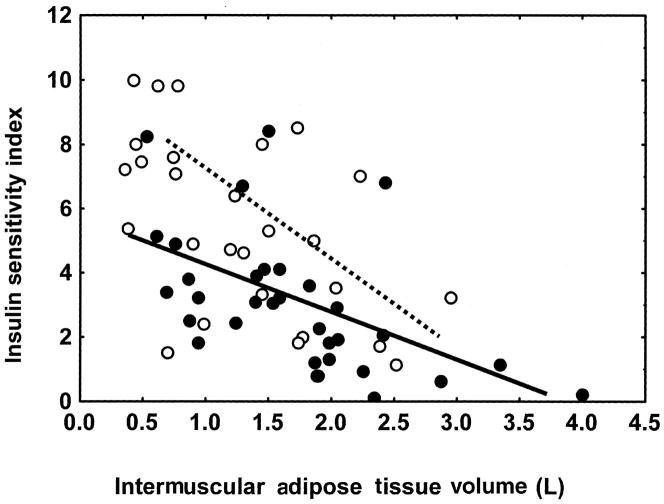
Results: AAs (n = 32) were 29-42% more insulin resistant than were whites (n = 28) after adjustment for weight and height or any AT volumes (P < 0.05). After adjustment for SM volume, the difference decreased to 19% and became nonsignificant. AAs had a 163% greater acute insulin response to glucose than did whites; this difference was significant even after adjustment for insulin sensivitity index, weight, height, and any magnetic resonance imaging measures. With respect to regional AT volumes, an association independent of race, weight, height, and SM volume was found only between increased intermuscular AT and lower insulin sensitivity index.
Conclusions: Premenopausal AA women had significantly higher insulin resistance and acute insulin response to glucose than did their white counterparts. Whereas the difference in insulin resistance was partially accounted for by a greater SM volume in the AAs than in the whites, the difference in the acute insulin response to glucose was independent of any AT and SM measures and was disproportionately larger than expected according to the difference in insulin resistance. In addition, whole-body intermuscular AT was an important independent correlate of insulin resistance.
Conflict of interest statement
JBA was responsible for the design of the study; JBA, AJK, LA, MW, EB, NR-K, and BB were responsible for subject recruitment and data collection; DG and IJ were responsible for magnetic resonance imaging analyses; JBA, AJK, and SH were responsible for data analysis; SH provided statistical expertise; JBA was responsible for data interpretation and manuscript writing; and JBA, AJK, LA, MW, EB, BB, SH, and DG were responsible for critical review of the manuscript for intellectual content. BB is an employee of Novartis Pharma Corporation; JBA has received research support from Novartis Pharma Corporation to study insulin resistance and its relation with body composition before and after weight loss. None of the other authors had any personal or financial conflicts of interest.
Figures




Comment in
-
Adipose tissue, skeletal muscle, and insulin resistance across ethnicities--systems biology in action.Am J Clin Nutr. 2005 Dec;82(6):1153-4. doi: 10.1093/ajcn/82.6.1153. Am J Clin Nutr. 2005. PMID: 16332645 No abstract available.
References
-
- Pi-Sunyer FX. Obesity and diabetes in blacks. Diabetes Care. 1991;13(suppl):1144–9. - PubMed
-
- Harris MI. Noninsulin dependent diabetes mellitus in black and white Americans. Diabetes Metab Rev. 1990;6:71–90. - PubMed
-
- O’Brien TR, Flanders D, Decoufle P, Boyle CA, DeStefano F, Teutsch S. Are racial differences in the prevalence of diabetes in adults explained by differences in obesity? JAMA. 1989;262:1485–8. - PubMed
-
- Cowie GC, Harris MI, Silverman RE, Johnson EW, Rust KF. Effect of multiple risk factors on differences between blacks and whites in the prevalence of noninsulin-dependent diabetes mellitus in the Untied States. Am J Epidemiol. 1993;137:719–32. - PubMed
-
- Haffner SM. Epidemiology of type 2 diabetes: risk factors. Diabetes Care. 1998;21(suppl):C3–6. - PubMed
Publication types
MeSH terms
Substances
Grants and funding
LinkOut - more resources
Full Text Sources
Medical
