. 2005 Dec;71(12):8611-7.
doi: 10.1128/AEM.71.12.8611-8617.2005.

Identification of bacteria in biofilm and bulk water samples from a nonchlorinated model drinking water distribution system: detection of a large nitrite-oxidizing population associated with Nitrospira spp

Affiliations

Identification of bacteria in biofilm and bulk water samples from a nonchlorinated model drinking water distribution system: detection of a large nitrite-oxidizing population associated with Nitrospira spp

Adam C Martiny et al. Appl Environ Microbiol. 2005 Dec.

Abstract

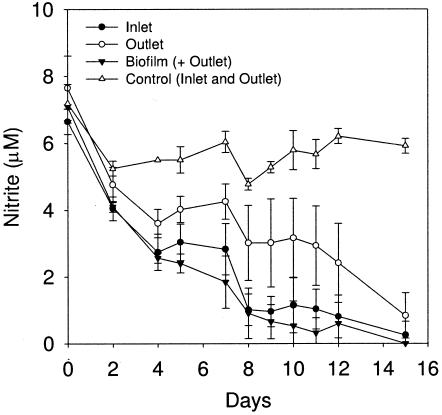
In a model drinking water distribution system characterized by a low assimilable organic carbon content (<10 microg/liter) and no disinfection, the bacterial community was identified by a phylogenetic analysis of rRNA genes amplified from directly extracted DNA and colonies formed on R2A plates. Biofilms of defined periods of age (14 days to 3 years) and bulk water samples were investigated. Culturable bacteria were associated with Proteobacteria and Bacteriodetes, whereas independently of cultivation, bacteria from 12 phyla were detected in this system. These included Acidobacteria, Nitrospirae, Planctomycetes, and Verrucomicrobia, some of which have never been identified in drinking water previously. A cluster analysis of the population profiles from the individual samples divided biofilms and bulk water samples into separate clusters (P = 0.027). Bacteria associated with Nitrospira moscoviensis were found in all samples and encompassed 39% of the sequenced clones in the bulk water and 25% of the biofilm community. The close association with Nitrospira suggested that a large part of the population had an autotrophic metabolism using nitrite as an electron donor. To test this hypothesis, nitrite was added to biofilm and bulk water samples, and the utilization was monitored during 15 days. A first-order decrease in nitrite concentration was observed for all samples with a rate corresponding to 0.5 x 10(5) to 2 x 10(5) nitrifying cells/ml in the bulk water and 3 x 10(5) cells/cm(2) on the pipe surface. The finding of an abundant nitrite-oxidizing microbial population suggests that nitrite is an important substrate in this system, potentially as a result of the low assimilable organic carbon concentration. This finding implies that microbial communities in water distribution systems may control against elevated nitrite concentrations but also contain large indigenous populations that are capable of assisting the depletion of disinfection agents like chloramines.


Figures
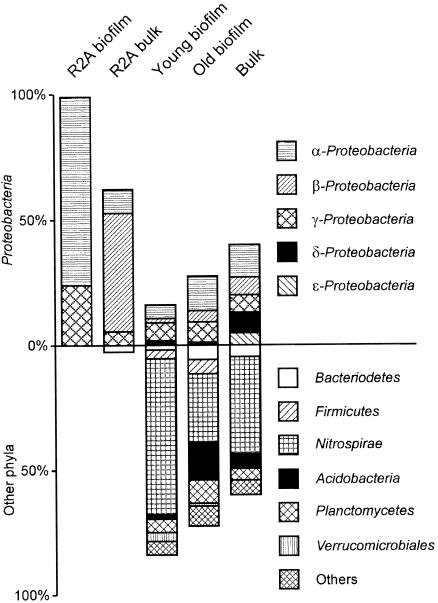
FIG. 1.
FIG. 1.
Bacterial phyla present and their proportional abundances (percentages of total) among isolates cultured on R2A medium and sequences in the clone library. Identification of strains and clones is based on 16S rRNA sequence analysis. The upper part represents subclasses of Proteobacteria, whereas the lower part represents other phyla detected. Some isolates could not be identified, which is the reason why some bars sum to less than 100%. The young biofilm category includes ages from 1 to 256 days, and the old biofilm category includes ages from 571 to 1,093 days. Bulk samples are from the inlet and outlet.
FIG. 2.
FIG. 2.
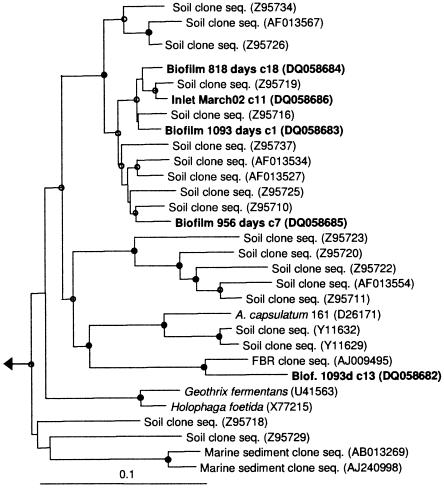
Phylogenetic reconstruction of selected cloned rRNA sequences (1,202 bases) associated with Acidobacteria. Entries generated from this study are in boldface, and biofilm samples are indicated by age and bulk water samples by inlet/outlet and month of sampling. c_ represents a unique clone number from a given sample. The tree shown was inferred by neighbor joining to accurately reproduce the branch lengths, but the topology was supported by maximum-parsimony and maximum-likelihood inference. Solid circles signify clades with bootstrap support of >90 from all algorithms. Open circles signify clades with support from one or two algorithms. The scale bar represents 10 substitutions per 100 base pairs. seq., sequence. See Materials and Methods for description of outgroup.
FIG. 3.
FIG. 3.
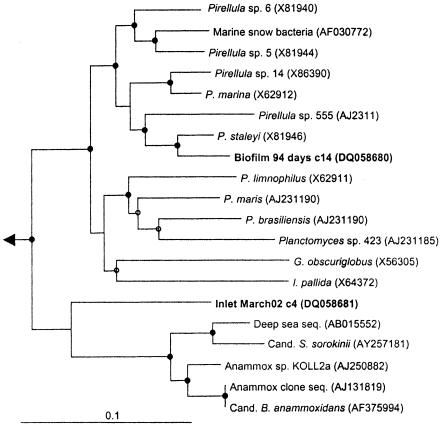
Phylogenetic reconstruction of selected cloned rRNA sequences (1,192 bases) associated with Planctomycetes. Entries generated from this study are in boldface, and biofilm samples are indicated by age and bulk water samples by inlet/outlet and month of sampling. c_ represents a unique clone number from a given sample. The tree shown was inferred by neighbor joining to accurately reproduce the branch lengths, but the topology was supported by maximum-parsimony and maximum-likelihood inference. Solid circles signify clades with bootstrap support of >90 from all algorithms. Open circles signify clades with support from one or two algorithms. The scale bar represents 10 substitutions per 100 base pairs. See Materials and Methods for description of outgroup. Among others, Pirellula species include P. marina and P. staleyi; Planctomyces species include P. limnophilus, P. maris, and P. brasiliensis. Gemmata obscuriglobus, Isosphaera pallida, “Candidatus Scalindua sorokinii,” and “Candidatus Brocadia anammoxidans” are also shown.
FIG. 4.
FIG. 4.
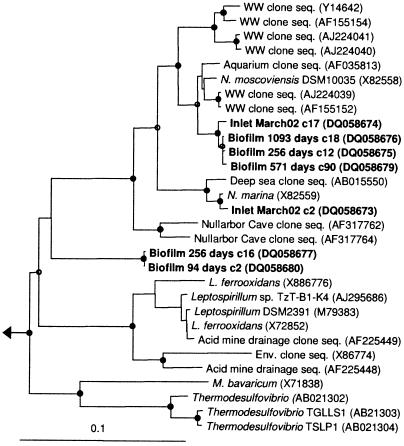
Phylogenetic reconstruction of selected cloned rRNA sequences (1,140 bases) associated with Nitrospirae. Entries generated from this study are in boldface, biofilm samples are indicated by age, and bulk water samples by inlet/outlet and month of sampling. c_ represents a unique clone number from a given sample. The tree shown was inferred by neighbor joining to accurately reproduce the branch lengths, but the topology was supported by maximum-parsimony and maximum-likelihood inference. Solid circles signify clades with bootstrap support of >90 from all algorithms. Open circles signify clades with support from one or two algorithms. The scale bar represents 10 substitutions per 100 base pairs. WW, wastewater treatment plant; Env., environmental. Among others, Leptospirillum species include L. ferrooxidans; Magnetobacterium bavarium is also shown. See Materials and Methods for description of outgroup.
FIG. 5.
FIG. 5.
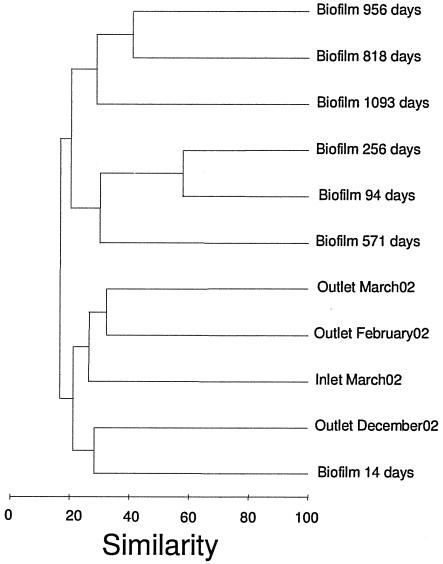
Cluster analysis of the population profiles from biofilm and bulk water samples (inlet/outlet) assembled from the distribution of OTUs defined as >97% similarity at the 16S rRNA locus. The dendrogram was generated using Bray-Curtis indices with square root transformation and group average assembly.
FIG. 6.
FIG. 6.
Nitrite utilization in batch samples from the model distribution system during the course of 15 days. Inlet and outlet, 100-ml water samples; biofilm, outlet water samples plus bacteria scraped off steel plugs due to complications from growth of Nitrospira in artificial medium; controls, autoclaved samples. The initial concentration of nitrite was 10 μM.

References

    1. Amann, R. I., W. Ludwig, and K.-H. Schleifer. 1995. Phylogenetic identification and in situ detection of individual microbial cells without cultivation. Microbiol. Rev. 59:143-169. - PMC - PubMed
    1. Barns, S. M., S. L. Takala, and C. R. Kuske. 1999. Wide distribution and diversity of members of the bacterial kingdom Acidobacterium in the environment. Appl. Environ. Microbiol. 65:1731-1737. - PMC - PubMed
    1. Boe-Hansen, R., H.-J. Albrechtsen, E. Arvin, and C. Jørgensen. 2002. Dynamics of biofilm formation in a model drinking water distribution system. J. Water Supply Res. Technol. Aqua 51:399-406.
    1. Boe-Hansen, R., A. C. Martiny, E. Arvin, and H.-J. Albrechtsen. 2003. Monitoring biofilm formation and activity in drinking water distribution networks under oligotrophic conditions. Water Sci. Technol. 47:91-97. - PubMed
    1. Buckley, D. H., and T. M. Schmidt. 2003. Diversity and dynamics of microbial communities in soils from agro-ecosystems. Environ. Microbiol. 5:441-452. - PubMed

Publication types