. 2005 Dec;71(12):8773-83.
doi: 10.1128/AEM.71.12.8773-8783.2005.

Desulfotomaculum and Methanobacterium spp. dominate a 4- to 5-kilometer-deep fault

Affiliations

Desulfotomaculum and Methanobacterium spp. dominate a 4- to 5-kilometer-deep fault

Duane P Moser et al. Appl Environ Microbiol. 2005 Dec.

Abstract

Alkaline, sulfidic, 54 to 60 degrees C, 4 to 53 million-year-old meteoric water emanating from a borehole intersecting quartzite-hosted fractures >3.3 km beneath the surface supported a microbial community dominated by a bacterial species affiliated with Desulfotomaculum spp. and an archaeal species related to Methanobacterium spp. The geochemical homogeneity over the 650-m length of the borehole, the lack of dividing cells, and the absence of these microorganisms in mine service water support an indigenous origin for the microbial community. The coexistence of these two microorganisms is consistent with a limiting flux of inorganic carbon and SO4(2-) in the presence of high pH, high concentrations of H2 and CH4, and minimal free energy for autotrophic methanogenesis. Sulfide isotopic compositions were highly enriched, consistent with microbial SO4(2-) reduction under hydrologic isolation. An analogous microbial couple and similar abiogenic gas chemistry have been reported recently for hydrothermal carbonate vents of the Lost City near the Mid-Atlantic Ridge (D. S. Kelly et al., Science 307:1428-1434, 2005), suggesting that these features may be common to deep subsurface habitats (continental and marine) bearing this geochemical signature. The geochemical setting and microbial communities described here are notably different from microbial ecosystems reported for shallower continental subsurface environments.


Figures
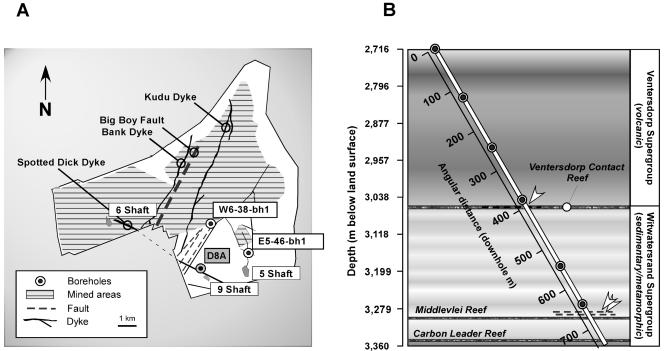
FIG. 1.
FIG. 1.
(A) Plan view showing location of borehole D8A. The Driefontein property is outlined, and major geological features are labeled. Mined areas are hatched. The locations of the comparative boreholes mentioned in the text, W6-38-bh1 (4) and E5-46-bh1 (47), are shown. (B) Geological cross section intersected by borehole. The depth, in meters below the surface, is depicted along the vertical axis, and the angular downhole distance is also shown. Faults reported are denoted with arrowheads and dashed lines. Sampling intervals are denoted by circles.
FIG. 2.
FIG. 2.
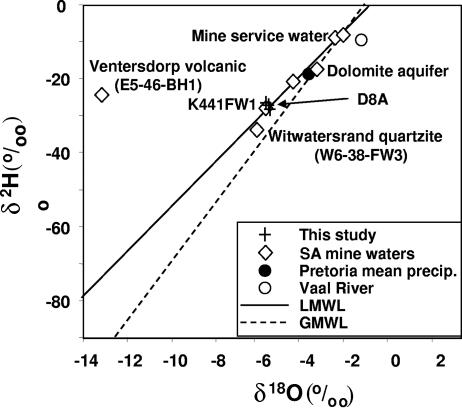
δ2H versus δ18O plot showing positions of three samples from borehole D8A (crosses) in relation to other samples from nearby mines (diamonds) (41), Vaal River water (open circle) (21), and Pretoria annual average precipitation (closed circle) (31). The local mean water line (LMWL) is depicted as a solid line (44), and the global mean water line (GMWL) is shown as a dashed line (16). The samples from D8A occupy the same positions as those from the Kloof Mine sample, for which an age of 3 to 30 Ma was determined (K4-41-FW1) (41). A sample from the Witwatersrand supergroup quartzite (W6-38-FW3) (41) also plots very close to the samples from borehole D8A, whereas samples from the overlying dolomite aquifer, mine service water (51), and a Ventersdorp supergroup metavolcanic sample (E5-46-bh1) (47) occupy different positions. The figure is based on the work of Lippmann et al. (41), with permission.
FIG. 3.
FIG. 3.
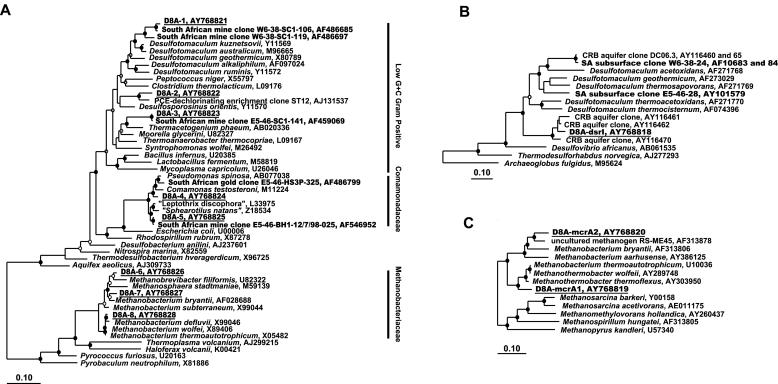
Phylogenetic analyses. Clones from Driefontein Mine boreholes are depicted with bold lettering (47). Those specific for this study are underlined. (A) Phylogenetic dendrogram based on a maximum likelihood analysis (Phylip FastDnaMl) of 862 unambiguously aligned positions of 16S rRNA gene sequences. (B) Maximum likelihood tree of dissimilatory sulfite reductase (dsrAB) genes. (C) Phylogenetic tree based on neighbor-joining analyses of methyl-coenzyme M (mcrA) reductase gene sequences. Maximum likelihood tree topologies were compared against trees generated by Bayesian inferences and parsimony. Closed circles indicate nodes conserved in all three treatments, with Bayesian probability and parsimony bootstrap values of >75%. Nodes conserved in the majority of tree topologies and with 50 to 74% probabilities and bootstraps are designated by open circles. Branch points supported by fewer than two trees or having <50% probability and bootstrap values have no designation. In the neighbor-joining tree, branch points supported by >79% bootstrap values are designated by solid circles, those supported by 60 to 79% bootstrap values are designated with open circles, and those having bootstrap values of <60% are unlabeled. Bars, changes per nucleotide.

References

    1. Altschul, S. F., T. L. Madden, A. A. Schaffer, J. H. Zhang, Z. Zhang, W. Miller, and D. J. Lipman. 1997. Gapped BLAST and PSI-BLAST: a new generation of protein database search programs. Nucleic Acids Res. 25:3389-3402. - PMC - PubMed
    1. Andrews, J. N., and G. B. Wilson. 1987. The composition of dissolved gases in deep groundwater and groundwater degassing. Special paper 33. Geological Association of Canada, St. John’s, Newfoundland, Canada.
    1. Baker, B. J., P. Hugenholtz, S. C. Dawson, and J. F. Banfield. 2003. Extremely acidophilic protists from acid mine drainage host Rickettsiales-lineage endosymbionts that have intervening sequences in their 16S rRNA genes. Appl. Environ. Microbiol. 69:5512-5518. - PMC - PubMed
    1. Baker, B. J., D. P. Moser, B. J. MacGregor, S. Fishbain, M. Wagner, N. K. Fry, B. Jackson, N. Speolstra, S. Loos, K. Takai, B. S. Lollar, J. Fredrickson, D. Balkwill, T. C. Onstott, C. F. Wimpee, and D. A. Stahl. 2003. Related assemblages of sulphate-reducing bacteria associated with ultradeep gold mines of South Africa and deep basalt aquifers of Washington State. Environ. Microbiol. 5:267-277. - PubMed
    1. Balkwill, D. L., F. R. Leach, J. T. Wilson, J. F. Mcnabb, and D. C. White. 1988. Equivalence of microbial biomass measures based on membrane lipid and cell-wall components, adenosine-triphosphate, and direct counts in subsurface aquifer sediments. Microb. Ecol. 16:73-84. - PubMed

Publication types

MeSH terms

LinkOut - more resources