


Polyphasic characterization reveals that the human pathogen Mycobacterium peregrinum type II belongs to the bovine pathogen species Mycobacterium senegalense
- PMID: 16333077
- PMCID: PMC1317161
- DOI: 10.1128/JCM.43.12.5925-5935.2005
Polyphasic characterization reveals that the human pathogen Mycobacterium peregrinum type II belongs to the bovine pathogen species Mycobacterium senegalense
Abstract
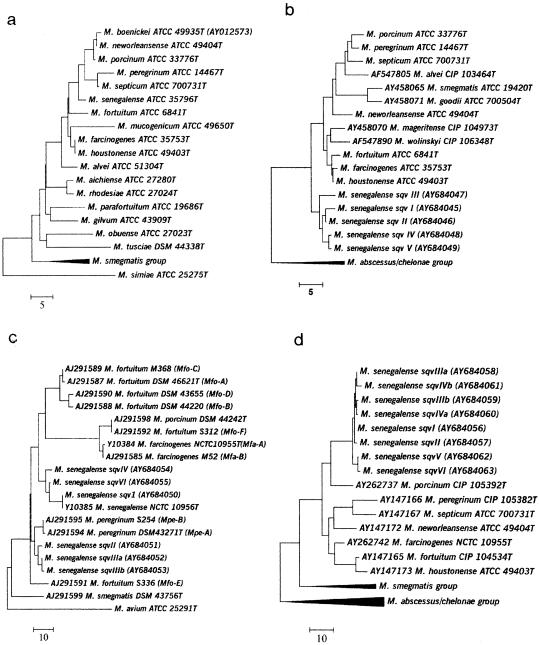
Mycobacterium peregrinum consists of two taxa: types I and II. We evaluated 43 clinical type II strains from throughout the United States. They were responsible for soft-tissue and bone infections, catheter-related infections, and possible pneumonitis. By carbohydrate utilization, they were indistinguishable from type I strains, being D-mannitol and trehalose positive. However, they had a distinct susceptibility pattern that included intermediate ciprofloxacin MICs but low clarithromycin and doxycycline MICs of < or =1 microg/ml. These features were also shared by reference isolates of Mycobacterium senegalense from African bovine cases of "farcy." By 16S rRNA gene sequencing, the type II isolates shared 100% sequence identity with M. senegalense. Partial sequencing of the type II hsp65 gene (441 bp) revealed four sequevars showing > or =98.4% identity with each other and > or =98.6% identity with the sequence of five bovine strains of M. senegalense. There was < or =97.1% identity with M. peregrinum type I isolates and other Mycobacterium fortuitum group species. Sequencing of additional gene targets including the 16S-23S rDNA internal transcribed spacer region and the rpoB gene (partial sequence) revealed a similar phylogenetic grouping. DNA-DNA hybridization showed 76 to 99% relatedness between the bovine and human strains. These studies demonstrate that type II isolates are not isolates of M. peregrinum but represent human strains of M. senegalense. This study is the first to demonstrate this species as a human pathogen. Representative human M. senegalense strains include ATCC 35755 and newly submitted strains ATCC BAA-849, ATCC BAA-850, and ATCC BAA-851.
Figures
References
-
- Baess, I.1982. Deoxyribonucleic acid relatedness among species of rapidly-growing mycobacteria. Acta Pathol. Microbiol. Scand. Sect. B 90:371-375. - PubMed
-
- Blom-Potar, M.-C., H. L. David, and N. Rastogi.1989. Isoenzymes as tools to discriminate various subdivisions in the Mycobacterium fortuitum complex. Acta Leprol. 7:39-43. - PubMed
-
- Bojalil, L. F., J. Cerbón, and A. Trujillo.1962. Adansonian classification of mycobacteria. J. Gen. Microbiol. 28:333-346. - PubMed
-
- Bönicke, R.1966. The occurrence of atypical mycobacteria in the environment of man and animal. Bull. Int. Union Tuberc. Lung Dis. 37:361-368.
MeSH terms
Substances
Associated data
- Actions
- Actions
- Actions
- Actions
- Actions
- Actions
- Actions
- Actions
- Actions
- Actions
- Actions
- Actions
- Actions
- Actions
- Actions
- Actions
- Actions
- Actions
- Actions
LinkOut - more resources
Full Text Sources
Medical
Molecular Biology Databases
Research Materials
