


Evaluation of a (1->3)-beta-D-glucan assay for diagnosis of invasive fungal infections
- PMID: 16333082
- PMCID: PMC1317189
- DOI: 10.1128/JCM.43.12.5957-5962.2005
Evaluation of a (1->3)-beta-D-glucan assay for diagnosis of invasive fungal infections
Abstract
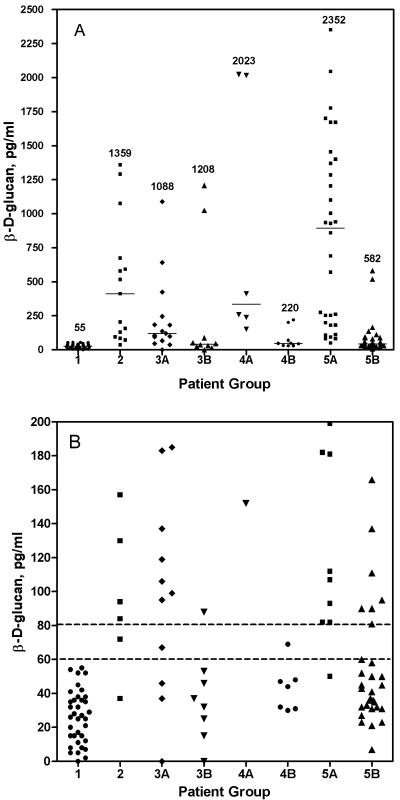
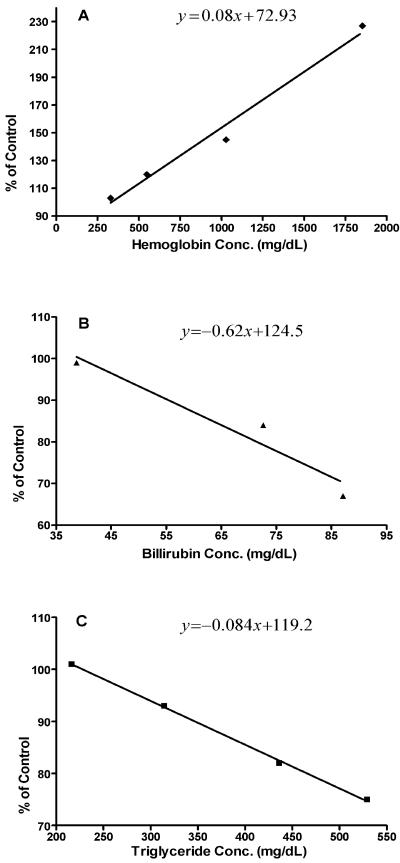
The Fungitell assay (Associates of Cape Cod, Inc.) is a commercial test that detects (1-3)-beta-D-glucan (BG) and is intended for diagnosis of invasive fungal infections. To evaluate the Fungitell assay, we tested serum and plasma samples from healthy blood donors and from patients with blood cultures positive for yeast or bacteria. All 36 blood donors were BG negative, and 13 of 15 candidemic patients were BG positive. Of 25 bacteremic patients, 14 (10 with gram-positive bacteremia) were BG positive. One of the latter patients with Staphylococcus aureus bacteremia also had invasive candidiasis, based on histological findings in a tissue biopsy; therefore, the BG result was a true positive. The sensitivity, specificity, and positive and negative predictive values of the Fungitell assay, by patient, for these three groups were 93.3%, 77.2%, 51.9%, and 97.8%, respectively. We also performed the Fungitell assay on sera that had been tested for Aspergillus galactomannan or Histoplasma antigen. All six Histoplasma antigen-positive patients and 31 of 32 Aspergillus galactomannan-positive patients were also BG positive. BG results for the 10 Histoplasma antigen-negative and the 32 Aspergillus galactomannan-negative patients varied, but we were unable to confirm many of the results. Between-run coefficients of variance (CVs) for the assay ranged from 3.2% to 16.8%; within-run CVs were < or =4.8%. The correlation coefficient for an interlaboratory reproducibility study was 0.9892. Concentrations of hemoglobulin, bilirubin, and triglycerides that caused 20% interference were 588, 72, and 466 mg/dl, respectively. Our results suggest that the Fungitel assay may be most useful for excluding invasive fungal infection.
Figures
References
-
- Ascioglu, S., J. H. Rex, B. de Pauw, J. E. Bennett, J. Bille, f. Crokaert, D. W. Denning, J. P. Donnelly, J. E. Edwards, Z. Erjavec, D. Fiere, O. Lortholary, J. Maertens, J. F. Meis, T. F. Patterson, J. Ritter, D. Selleslag, P. M. Shah, D. A. Stevens, and T. J. Walsh. 2002. Defining opportunistic IFI in immunocompromised patients with cancer and hematopoietic stem cell transplants; an international consensus. Clin. Infect. Dis. 34:7-14. - PubMed
-
- Associates of Cape Cod, Inc. 2004. Glucan assay for (1,3)-β-d-glucan in serum: Fungitell. [Online.] http://www.acciusa.com/pdfs/fungitell_insert.pdf.
-
- Clark, T. A., and R. A. Hajjeh. 2002. Recent trends in the epidemiology of invasive mycoses. Curr. Opin. Infect. Dis. 15:569-574. - PubMed
Publication types
MeSH terms
Substances
LinkOut - more resources
Full Text Sources
Other Literature Sources
Medical
