


doi: 10.1128/JCM.43.12.6130-6132.2005.
Molecular evolution of human influenza A/H3N2 virus in Asia and Europe from 2001 to 2003
Affiliations
- PMID: 16333111
- PMCID: PMC1317174
- DOI: 10.1128/JCM.43.12.6130-6132.2005
Item in Clipboard
Molecular evolution of human influenza A/H3N2 virus in Asia and Europe from 2001 to 2003
J Clin Microbiol.
2005 Dec.
Abstract
Hemagglutinin sequences of 146 human influenza A/H3N2 strains identified in respiratory specimens from Asia and Europe during the 2001-2003 influenza seasons were analyzed by DNA sequencing. Our results suggest that four amino acid substitutions, L25I, H75Q, H155T, and Q156H, led to the antigenic conversion of the previously predominant A/Panama/2007/99-like strains to the more recent A/Fujian/411/2002-like strains.
Figures
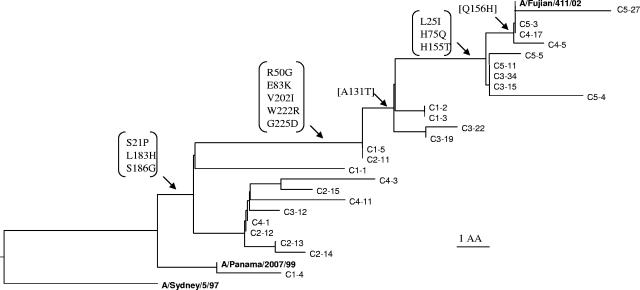
Phylogenetic analyses of influenza A/H3N2 viruses based on 320 amino acid sequences of HA1. Twenty-five HA1 sequences (five from each of the five groups) were selected from 146 specimens in an attempt to represent the varieties within the same group. The changes in the deduced amino acid sequences were compared with the sequence of A/Panama/2007/99. Only the amino acid changes corresponding to the sequence of A/Fujian/411/2002 are shown in square brackets. Bold letters indicate the reference vaccine strains. C1, C2, C3, C4, and C5 correspond to groups 1, 2, 3, 4 and 5, respectively. The group numbers are followed by hyphens and then the isolate numbers. AA, amino acid.
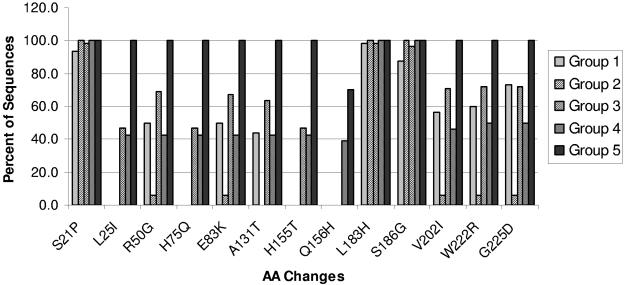
Prevalence of genetic variations in the HA1 sequences of influenza A/H3N2 viruses. The percentages of HA1 sequences exhibiting the 13 amino acid changes reflect the differences in the A/Fujian/411/2002 strain relative to A/Panama/2007/99.
References
-
- Besselaar, T. G., L. Botha, J. M. McAnerney, and B. D. Schoub. 2004. Antigenic and molecular analysis of influenza A (H3N2) virus strains isolated from a localised influenza outbreak in South Africa in 2003. J. Med. Virol. 73:71-78. - PubMed
-
- Bush, R. M., C. A. Bender, K. Subbarao, N. J. Cox, and W. M. Fitch. 1999. Predicting the evolution of human influenza A. Science 286:1921-1925. - PubMed
-
- Centers for Disease Control and Prevention. 2003. Information for the Vaccines and Related Biological Products Advisory Committee, CBER, FDA. [Online.] http://www.fda.gov/ohrms/dockets/ac/03/briefing/3922B1_2.pdf.
-
- Ferguson, N. M., and R. M. Anderson. 2002. Predicting evolutionary change in the influenza A virus. Nat. Med. 8:562-563. - PubMed
MeSH terms
Substances
Associated data
- Actions
- Actions
- Actions
- Actions
- Actions
- Actions
- Actions
- Actions
- Actions
- Actions
- Actions
- Actions
- Actions
- Actions
- Actions
- Actions
- Actions
- Actions
- Actions
- Actions
- Actions
- Actions
- Actions
- Actions
- Actions
- Actions
- Actions
- Actions
- Actions
- Actions
- Actions
- Actions
- Actions
- Actions
- Actions
- Actions
- Actions
- Actions
- Actions
- Actions
- Actions
- Actions
- Actions
- Actions
- Actions
- Actions
- Actions
- Actions
- Actions
- Actions
- Actions
- Actions
- Actions
- Actions
- Actions
- Actions
- Actions
- Actions
- Actions
- Actions
- Actions
- Actions
- Actions
- Actions
- Actions
- Actions
- Actions
- Actions
- Actions
- Actions
- Actions
- Actions
- Actions
- Actions
- Actions
- Actions
- Actions
- Actions
- Actions
- Actions
- Actions
- Actions
- Actions
- Actions
- Actions
- Actions
- Actions
- Actions
- Actions
- Actions
- Actions
- Actions
- Actions
- Actions
- Actions
- Actions
- Actions
- Actions
- Actions
- Actions
- Actions
- Actions
- Actions
- Actions
- Actions
- Actions
- Actions
- Actions
- Actions
- Actions
- Actions
- Actions
- Actions
- Actions
- Actions
- Actions
- Actions
- Actions
- Actions
- Actions
- Actions
- Actions
- Actions
- Actions
- Actions
- Actions
- Actions
- Actions
- Actions
- Actions
- Actions
- Actions
- Actions
- Actions
- Actions
- Actions
- Actions
- Actions
- Actions
- Actions
- Actions
- Actions
- Actions
- Actions
- Actions
- Actions
LinkOut - more resources
Full Text Sources
Other Literature Sources
Medical
